How to Hire a Fractional CMO
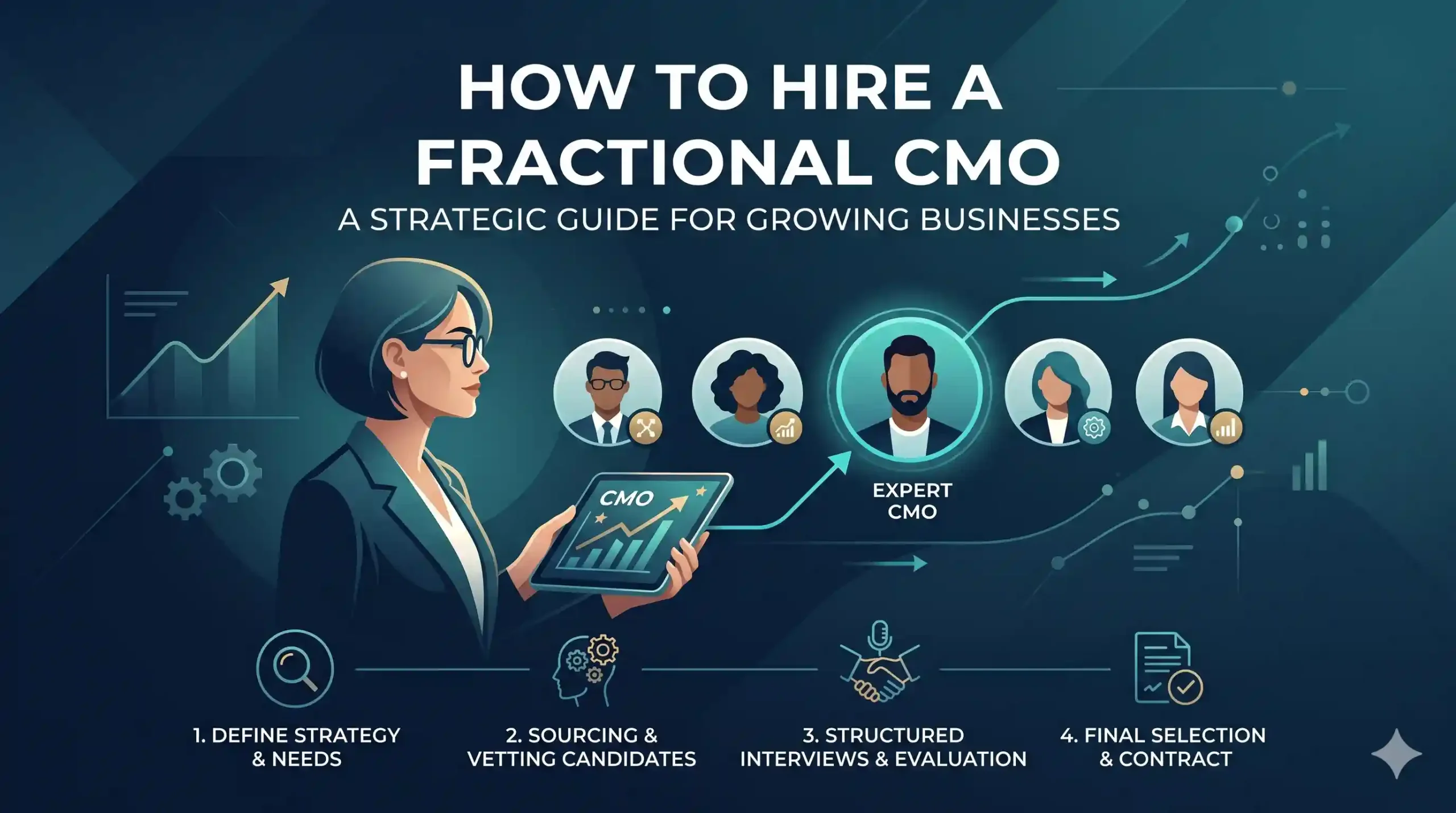

Most B2B founders eventually run into the same wall. Marketing stops working, but a full time CMO costs $250K a year plus equity. So they hire a junior marketer for $80K, hand them the strategy, and hope for the best.
Six months later there are no leads, no system, and the founder is back to running marketing on the side.
A fractional CMO solves this problem. You get senior marketing leadership for 10 to 20 hours a week at a fraction of the cost. The right person builds your strategy, hires the team, sets up the metrics, and leaves you with a working system in 6 to 12 months.
But hiring a fractional CMO is not the same as hiring an agency or a freelancer. Most companies pick the wrong person, lose a year, and spend tens of thousands of dollars before they realize the mistake. In this article I will show you when to hire a fractional CMO, what to look for during interviews, what to pay, how to structure the contract, and which red flags to avoid.
Key Takeaways
- A fractional CMO is a senior marketing leader who works with you part time, usually 10 to 20 hours a week, for $8K to $20K a month.
- Hire one when marketing has become too complex for the founder but not yet big enough for a full time executive. This is usually between $1M and $20M in annual revenue.
- The job is not to run campaigns. The job is strategy, hiring, systems, and metrics. If you need someone to write posts and run ads, hire a marketing manager instead.
- Expect a working system in 6 to 12 months. The first 90 days are audit, strategy, and team. Real results come in months 4 to 9.
- The biggest risk is hiring a generalist who has never built a B2B pipeline. Always check for direct experience in your industry and stage.
- Sign a 6 month contract with a 30 day exit clause. This protects both sides and gives the engagement enough time to produce results.
What a Fractional CMO Actually Is
A fractional CMO is a marketing executive who works for several companies at the same time. Each client gets a slice of their week, usually 10 to 20 hours, with full strategic responsibility for marketing.
This is not consulting. A consultant gives you a deck and leaves. A fractional CMO owns the outcome. They sit in your leadership meetings, hire your team, set the budget, and report on results every month.
This is also not freelancing. A freelancer executes specific tasks like ads or content. A fractional CMO decides which tasks should be done in the first place.
The model exists because experienced marketing leaders are expensive, and most companies between $1M and $20M in revenue do not need 40 hours a week of executive marketing time. They need 10 to 20 hours of senior thinking, plus a team of junior people to execute. The fractional CMO fills that gap.
Fractional CMO vs other options
| Role | Cost per month | What you get | Best for |
|---|---|---|---|
| Full time CMO | $20K to $30K plus equity | Full ownership, full attention | $20M+ revenue, large team |
| Fractional CMO | $8K to $20K | Strategy, hiring, systems | $1M to $20M revenue |
| Marketing agency | $5K to $30K | Execution of specific channels | When strategy is already clear |
| Marketing manager | $6K to $10K | Daily execution under direction | When strategy is already clear |
| Freelancer | $2K to $8K | One specific skill | Filling a gap, short projects |
The key difference is decision making. A fractional CMO decides what to do. Everyone else does what they are told.
When You Need a Fractional CMO
A fractional CMO is the right hire in a specific window. Too early and you are paying for strategy you cannot execute. Too late and a part time leader cannot hold the role.
Signs you are ready
- Revenue between $1M and $20M. Below $1M, the founder should still own marketing. Above $20M, you usually need a full time executive.
- Marketing is becoming a bottleneck. Sales is asking for more pipeline, the team is running random campaigns, and nobody can explain what works.
- You have or can hire 1 to 3 marketing people. A fractional CMO needs a team to lead. If there is no team, they will spend their hours doing junior work.
- You have a real product and real customers. Marketing cannot fix a broken product or unclear positioning at a deeper level. You need at least 10 happy customers who can explain why they bought.
- You are willing to spend $5K to $50K a month on marketing execution beyond the CMO fee. Strategy without budget produces nothing.
Signs you are not ready
- You are pre revenue or pre product market fit. Hire a marketing advisor for a few hours a month instead.
- You expect the CMO to also write content, run ads, and manage social media. That is a marketing manager job, not a CMO job.
- You want them to “fix marketing” in 60 days. A real system takes 6 to 12 months.
- The founder is not willing to spend 2 to 3 hours a week aligning with the CMO. Without founder time, even a great CMO will fail.
- You expect immediate ROI on every marketing dollar. B2B marketing has cycles of 3 to 9 months. Companies that demand instant results force the CMO into short term tactics that do not build long term growth.
If you check most of the “ready” signs and few of the “not ready” signs, start your search.
What a Fractional CMO Does in the First 90 Days
A good fractional CMO follows a predictable arc in the first quarter. If your candidate cannot describe something like this in the interview, they are not senior enough.
Month 1: audit and strategy
In the first month the CMO learns the business. They interview customers, talk to sales, review the website, audit current channels, and look at the data. The output is a written strategy document that answers four questions:
- Who is the ideal customer (ICP) and what is the buying process?
- What is the positioning, the offer, and the messages that will work?
- Which 2 or 3 channels will drive growth, and why?
- What does the team need to look like to execute?
Expect 5 to 10 customer interviews in this month. The CMO should also sit on at least 5 sales calls, read all win loss notes from the past year, and review every existing marketing asset. By the end of week 4 you should receive a written document of 10 to 20 pages. Not a slide deck. A document you can debate.
Month 2: team and systems
In the second month the CMO builds the foundation. This means hiring or restructuring the team, setting up the analytics so you can actually measure what is happening, choosing the tools (CRM, marketing automation, attribution), and writing the playbooks for each channel.
This month rarely produces visible results, and that is normal. You are paying for the system that will produce results in months 4 to 9. If your CMO promises pipeline in month 2, they are either inexperienced or about to take shortcuts that hurt you later.
A typical month 2 includes 1 or 2 hires, a CRM cleanup, the launch of a new website narrative, and the first version of a content calendar. None of this shows up in revenue numbers, but all of it is required.
Month 3: execution and metrics
In the third month the team starts running campaigns under the new strategy. The CMO sets weekly metrics, runs the team, and reports to the founder every two weeks. By the end of month 3 you should see early signals: more qualified leads, better conversion at one stage of the funnel, or a clearer pipeline.
If after 90 days the CMO has not produced a written strategy, a working team, and a measurable funnel, something is wrong. Either the engagement is under scoped, the founder is blocking decisions, or the CMO is not senior enough for the role.
How to Find Candidates
The best fractional CMOs do not advertise. They are usually busy, work through referrals, and are picky about clients.
Where to look
- Founder networks. Ask 10 founders in your industry who they would hire. The same 2 or 3 names will come up.
- LinkedIn. Search for “Fractional CMO” plus your industry. Look at their content, their past roles, and their recommendations.
- Specialized marketplaces. Platforms like Chief Outsiders, MarketerHire, and Growth Collective curate fractional executives.
- Industry communities. Slack groups, paid masterminds, and conferences are good sources of vetted candidates.
Avoid generic freelance platforms like Upwork. The fractional CMO market does not live there.
How to filter the long list
You will probably collect 10 to 20 names. Cut the list to 3 to 5 finalists using these filters:
- They have run marketing for at least one company in your industry, at your stage. SaaS is different from services. Series A is different from $20M revenue.
- They have built a team, not just done the work themselves. Ask for the names and roles of people they hired.
- They can show specific results in numbers, not adjectives. “Grew pipeline from $200K to $2M in 9 months” is good. “Drove significant growth” is not.
- They are not running 8 clients. A real fractional CMO can handle 3 to 5 clients at most. More than that and you get a freelancer in disguise.
- They have references you can actually call. Ask for 3 founder references and call all 3. The conversations will tell you more than any interview.
How to Interview a Fractional CMO
The interview is where most companies make their mistake. They ask about tools and tactics (“Do you know HubSpot? Have you run LinkedIn Ads?”) instead of testing strategic thinking.
Use 3 categories of questions.
Strategic questions
These show whether the candidate can think like a CMO.
- Walk me through how you would approach our business in the first 30 days.
- Look at our website. What 3 things would you change in the first month, and why?
- Our biggest competitor is X. How would you position us against them?
- We have $30K a month for marketing. How would you split it across channels in the first quarter?
- Who do you think our ideal customer is, based on what you know so far?
A weak answer is generic (“I would do an audit and develop a strategy”). A strong answer is specific to your business and includes trade offs. Senior candidates will tell you what they would NOT do, and why. They will also push back on assumptions in your questions.
Tactical questions
These show whether the candidate has actually done the work.
- Describe a campaign that failed. Why did it fail and what did you learn?
- How do you measure marketing? Which 5 metrics do you report to the CEO?
- Tell me about a marketing hire that did not work out. What went wrong?
- What is your relationship with the sales team usually like?
- Walk me through a B2B funnel you built from zero.
You are looking for honesty, specificity, and self awareness. A candidate who has never had a failure has not done enough. The best candidates will explain what they did wrong with a clinical tone, not a defensive one.
Cultural fit questions
A fractional CMO will sit in your leadership meetings every week. If the chemistry is wrong, the engagement will fail no matter how qualified they are.
- Why do you do fractional work instead of a full time role?
- What kind of founder do you work best with? What kind do you avoid?
- Tell me about a client engagement that ended badly. What happened?
- What do you expect from me as the founder?
The honest answer to “why fractional” is usually a mix of lifestyle, money, and variety. Be careful with candidates who say “I am between full time roles.” They will leave the moment a CMO job appears.
The best candidates also have clear expectations of you. If they do not require founder time, weekly calls, and access to data, they are planning to coast.
What to Pay
Fractional CMO pricing varies by experience, industry, and engagement model. Here is the current market.
Pricing models
| Model | Range | When it works |
|---|---|---|
| Monthly retainer | $8K to $20K a month | Default option, predictable for both sides |
| Day rate | $2K to $4K a day | Short projects, audits, interim coverage |
| Hourly | $300 to $600 an hour | Advisory only, less than 5 hours a week |
| Equity plus reduced cash | $4K to $8K plus 0.25% to 1% | Early stage startups with low cash |
Most engagements settle into a monthly retainer of $10K to $15K for 12 to 16 hours a week. This is the sweet spot for both sides.
What drives the price
- Industry experience. A CMO who has built marketing for 3 SaaS companies will charge more for SaaS work than a generalist.
- Team size. Leading 1 to 2 people costs less than leading 8 to 10.
- Time commitment. 8 hours a week is much cheaper per hour than 20 hours a week.
- Results based components. Some CMOs offer reduced retainers in exchange for performance bonuses tied to pipeline or revenue.
If a candidate quotes $5K a month for full CMO responsibilities, be careful. Either they are junior, they are stretched across too many clients, or they are about to leave for a full time job.
What is included and what is not
The retainer covers strategy, leadership, hiring, and reporting. It does not cover execution work, ad spend, software, or contractors. Plan for an additional $5K to $50K a month in marketing budget, depending on your stage and goals.
Founders often assume the CMO will write content, run ads, and design the website themselves. They will not. Their job is to direct that work, not do it. Budget for the team that will execute.
How to Structure the Contract
A clear contract protects both sides and prevents the small misunderstandings that kill engagements in month 3.
Key terms to include
- Duration. Minimum 6 months. Anything shorter and the CMO cannot deliver real results. Anything longer locks you into a relationship before you know if it works.
- Exit clause. 30 day notice from either side after the first 90 days. This gives both parties an honest way out if things do not work.
- Hours commitment. Specify the hours per week and how they will be tracked. Most CMOs do not invoice by the hour, but they should be clear about the time they commit.
- Scope. List what is included (strategy, hiring, weekly meetings, monthly reporting) and what is not (execution, design, ad spend).
- Deliverables. A 90 day plan with specific milestones. Strategy document by end of month 1, team in place by end of month 2, first metrics by end of month 3.
- Reporting cadence. Weekly call with the founder, biweekly written report, monthly board summary if applicable.
- Confidentiality. Standard NDA covering customer data, strategy, and team information.
What to avoid in the contract
- Performance guarantees. Any CMO who guarantees specific revenue or lead numbers in writing is either lying or planning to game the metrics. Marketing depends on too many factors outside their control.
- Equity only deals. Unless you are pre seed and the CMO genuinely believes in the company, equity only arrangements lead to low priority work.
- Vague scope. “Marketing leadership” without specific deliverables creates conflict in month 2 when expectations diverge.
Onboarding: First 30 Days
Even a great fractional CMO will fail with a bad onboarding. Set them up for success in the first month.
- Give them access to everything. CRM, analytics, ad accounts, customer interviews, sales calls, financials. If you hold information back, they cannot make good decisions.
- Introduce them to sales and product. Marketing does not exist alone. The CMO needs working relationships with the sales lead and the product lead in week 1.
- Block 2 hours a week of founder time. This is not optional. The founder owns the vision and the budget. Without regular founder time, the CMO will drift.
- Agree on the 90 day deliverables. Strategy document by end of month 1, team and systems by end of month 2, first metrics by end of month 3. Write this down before they start.
- Do not change the plan in week 2. Founders often panic when they do not see immediate results and pivot the strategy. Give the plan 90 days before changing anything.
- Set up a shared workspace. A Notion page or shared drive where the CMO can post strategy documents, meeting notes, and progress updates. Transparency builds trust on both sides.
Red Flags
After watching dozens of these engagements, the same warning signs appear before bad hires.
- They cannot show specific results. Adjectives instead of numbers. “Significant growth” instead of “$200K to $2M in 9 months.”
- They have never built a team. Pure executors who never hired and managed people will struggle to lead yours.
- They want to start with tactics, not strategy. A CMO who jumps to “let me run some LinkedIn Ads” before understanding your customer is a freelancer in a CMO costume.
- They have 8 or more clients. Nobody can give real leadership to 8 clients in 40 hours a week.
- They avoid talking about failures. Either they have not done enough, or they cannot reflect on their work.
- They promise fast results. Anyone who guarantees pipeline in 30 days does not understand B2B sales cycles.
- They have no opinion. A senior CMO will push back on bad ideas, including yours. A weak one will agree with everything.
- Their references are weak. Vague compliments from former clients usually mean the engagement was unremarkable. Strong references give you specific stories with numbers.
One red flag is not a deal breaker. Three or more, and you are looking at the wrong person.
Recommendation
If you are seriously considering a fractional CMO, here is what to do this month.
Start by writing down your current numbers: revenue, marketing budget, team size, biggest channel, biggest problem. If you cannot fill this in, you are not ready yet. You need a baseline before any CMO can help.
Next, ask 5 founders in your network for fractional CMO recommendations. Build a list of 10 to 15 names. Filter to 3 finalists using industry experience, team building experience, and concrete results. Skip anyone who cannot send you a one page summary of their last 3 engagements with numbers.
Run 2 conversations with each finalist. The first should be strategic, focused on how they would approach your business. The second should be tactical and cultural, focused on past work and working style. Call all 3 references for your top choice. Ask each reference one specific question: “What would have made this engagement better?” Vague answers tell you the engagement was forgettable.
Pick one. Sign a 6 month agreement with a 30 day exit clause for both sides. Block your 2 hours a week, give them full access, and let them do the work for at least 90 days before judging the results.
A fractional CMO is not a magic solution. Marketing is hard, B2B sales cycles are long, and even the best leader will need 6 to 12 months to build a working system. But for companies in the $1M to $20M range, this is the highest leverage marketing hire you can make.
Pick well, onboard properly, and give it time.
