Should You Hire a Fractional CMO?
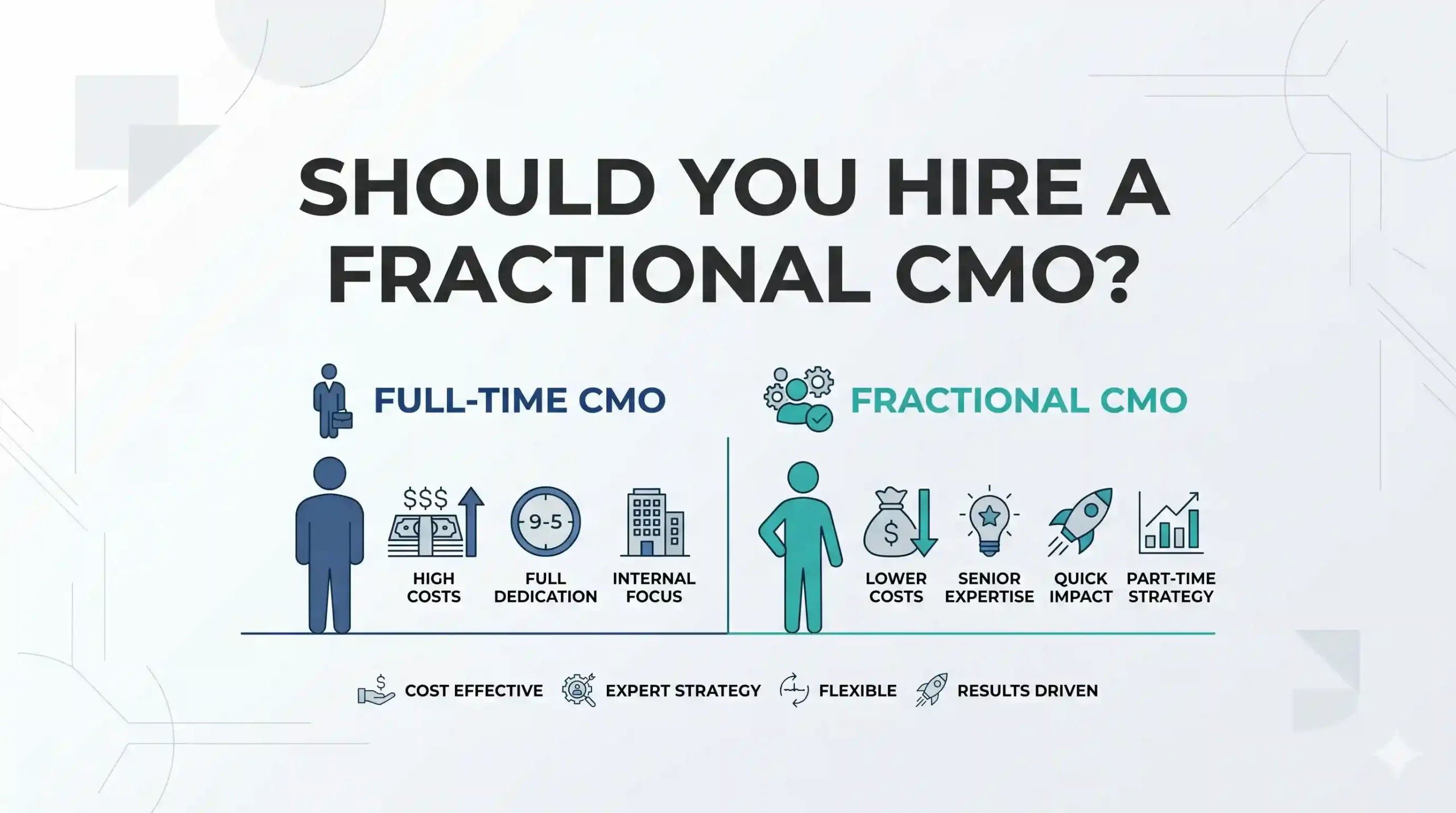
Most growing B2B companies hit the same wall. Revenue is stalling, marketing feels random, and nobody on the team can explain why pipeline is not growing.
The CEO knows they need marketing leadership. But a full-time CMO costs $200,000 to $350,000 per year plus equity, benefits, and bonus. For a company doing $2M to $20M in revenue, that is a massive commitment for a single hire.
So the company does one of two things. They promote a marketing manager who is good at execution but has never built a strategy. Or they hire an agency that runs campaigns without any strategic direction.
Both options fail for the same reason. Execution without strategy produces activity without results. The campaigns run, the content publishes, and the pipeline stays flat.
A fractional CMO solves this problem. You get C-level marketing leadership at a fraction of the cost, with the strategic depth your company needs to grow.
But a fractional CMO is not right for every company. This article covers when it makes sense, when it does not, and how to evaluate whether it is the right move for your business.
Key Takeaways
- A fractional CMO is a senior marketing executive who works with your company part-time, typically 10 to 20 hours per week. They provide strategic leadership without the cost of a full-time C-suite hire.
- The typical cost of a fractional CMO ranges from $5,000 to $15,000 per month. A full-time CMO with comparable experience costs $200,000 to $350,000 per year before benefits and equity.
- Fractional CMOs work best for B2B companies between $1M and $20M ARR that have product-market fit but lack a clear marketing strategy and senior marketing leadership.
- A fractional CMO is not a marketing manager, not a consultant, and not an agency. They operate as a member of your executive team with ownership of marketing strategy and accountability for pipeline results.
- Hiring a fractional CMO before hiring an agency is often the smarter sequence. Strategy must come before execution, or the execution has no direction.
What a Fractional CMO Actually Does
The title sounds simple but the role is often misunderstood. A fractional CMO is not a consultant who writes a strategy document and leaves. They are not a marketing manager who executes tasks. And they are not an agency account director who manages campaigns.
A fractional CMO is a senior marketing executive who embeds into your leadership team on a part-time basis. They own the marketing strategy, build the marketing function, lead the team, and take accountability for pipeline and revenue outcomes.
Strategic leadership
The fractional CMO defines your marketing strategy from the ground up. This includes identifying your ideal customer profile, developing your positioning and messaging, building your go-to-market framework, and choosing the right channels based on your budget and market.
They do this with the same depth and rigor a full-time CMO would bring. The difference is time allocation, not quality of thinking. A fractional CMO working 15 hours per week on your business delivers more strategic value than a marketing manager working 50 hours per week without strategic experience.
Marketing team development
Most B2B companies in the $2M to $20M range have a small marketing team. Often one or two people handling everything from social media to email to events. These people are typically strong executors who lack strategic guidance.
A fractional CMO leads this team. They set priorities, define KPIs, establish processes, and coach team members to improve their skills. They also identify gaps in the team and recommend when to hire, what roles to fill, and what to outsource.
This team development function is critical. Without it, your marketing people work hard on the wrong things. With it, every team member’s effort aligns with the strategy and contributes to pipeline.
Agency and vendor management
If your company works with agencies, freelancers, or marketing technology vendors, the fractional CMO manages those relationships. They set the brief, review the work, hold agencies accountable for results, and ensure all external partners align with the overall strategy.
This is especially valuable for companies that have had bad agency experiences. Often the agency was not the problem. The problem was nobody on the client side had the seniority and experience to direct the agency properly. A fractional CMO fills that gap.
Executive team participation
A fractional CMO sits in leadership meetings, contributes to business strategy discussions, and aligns marketing with sales, product, and customer success. They bring a marketing perspective to executive decisions and ensure the company’s growth plan includes a realistic marketing component.
This is something no agency or consultant provides. Agencies work for you. A fractional CMO works with you as part of the team.
When a Fractional CMO Makes Sense
A fractional CMO is not right for every company at every stage. Here are the situations where this model delivers the most value.
You have product-market fit but no marketing strategy
Your product works. Customers like it. You have some revenue and some traction. But growth has slowed because you have been relying on founder-led sales, referrals, and word of mouth.
You know you need marketing, but you do not have a strategy. You are not sure who your ICP really is, what channels to invest in, or how to build a repeatable pipeline engine.
A fractional CMO brings the strategic framework you are missing. They define the ICP, build the positioning, choose the channels, and create a plan that turns marketing from a cost center into a growth engine.
You cannot afford a full-time CMO
A strong full-time CMO with 15 to 20 years of experience costs $200,000 to $350,000 per year in base salary. Add equity, bonus, and benefits and the total compensation can exceed $400,000. For a company doing $5M in revenue, that is a significant portion of the entire marketing budget.
A fractional CMO delivers the same caliber of strategic leadership at 60 to 70 percent lower cost. Monthly retainers typically range from $5,000 to $15,000 depending on hours and scope. That gives you $60,000 to $180,000 per year instead of $300,000 or more.
The savings are not just financial. You also avoid the risk of a bad full-time hire. Recruiting a CMO takes 3 to 6 months. If the hire does not work out, you lose another 6 to 12 months before starting over. A fractional engagement can start in weeks and adjust quickly if the fit is not right.
Your marketing team needs leadership, not more people
Adding more marketers to a team without strategic leadership does not solve the problem. It makes it worse. More people producing more content, more campaigns, and more activity without a unified strategy creates chaos, not pipeline.
A fractional CMO provides the leadership layer that makes your existing team more effective. Often a team of two or three well-directed marketers produces better results than a team of six working without clear priorities.
If your team is busy but results are flat, the issue is probably leadership, not headcount.
You had a bad experience with an agency
Many companies come to the fractional CMO model after one or two failed agency engagements. The pattern is familiar: the agency promised results, delivered reports, and produced no meaningful pipeline.
In most cases the agency was not entirely at fault. The company did not have a clear strategy, a defined ICP, or someone senior enough to direct the agency’s work. The agency did what they were told, but nobody told them the right things.
A fractional CMO breaks this cycle. They build the strategy first, then either manage an existing agency relationship or help you select the right agency for execution. Strategy before execution changes everything.
You are preparing for a funding round or major growth phase
Investors and board members want to see a clear go-to-market strategy and a marketing function that can scale. A fractional CMO can build this in 3 to 6 months, creating the strategic foundation and early results that demonstrate marketing maturity.
This is often more convincing to investors than a freshly hired full-time CMO who has not had time to deliver results yet. A fractional CMO with a proven track record and measurable pipeline impact shows that your marketing function is already working.
When a Fractional CMO Is Not the Right Choice
This model does not fit every situation. Here is when you should consider alternatives.
You need a full-time executive
If your company has $20M or more in revenue, a complex product portfolio, and a marketing team of 10 or more people, you probably need a full-time CMO. The scope of work exceeds what a part-time executive can cover.
At this stage, marketing leadership is not just about strategy. It is about daily team management, cross-functional coordination, board reporting, and organizational culture. A fractional CMO working 15 hours per week cannot fulfill all of these responsibilities at enterprise scale.
You do not have product-market fit yet
If you are pre-revenue or still searching for product-market fit, a fractional CMO may be premature. At this stage, your priority is finding customers who love your product and are willing to pay for it. That is a product and sales challenge, not a marketing challenge.
Invest in product development and founder-led sales first. Once you have 10 to 20 paying customers and a repeatable sales motion, marketing becomes the lever that accelerates growth. That is when a fractional CMO adds the most value.
You only need tactical execution
If you already have a clear strategy, a defined ICP, and strong positioning, you may not need a fractional CMO. What you need is an execution team or agency to implement the strategy you already have.
A fractional CMO is a strategic role. If the strategy is already solid, paying for strategic leadership you do not need wastes budget that could go toward execution.
Your budget is under $5,000 per month for all of marketing
A fractional CMO retainer plus execution costs requires a minimum marketing budget. If your total marketing budget including tools, ads, content, and leadership is under $5,000 per month, a fractional CMO engagement will consume most of it.
In this case, consider a marketing advisor or consultant for a few hours per month combined with a focused freelancer or small agency for execution. As your budget grows, you can upgrade to a fractional CMO model.
Fractional CMO vs. Other Options
Understanding how a fractional CMO compares to alternatives helps you choose the right model.
Fractional CMO vs. full-time CMO
A full-time CMO is embedded in your company 40 to 50 hours per week. They manage a large team, participate in every executive discussion, and own marketing completely. The cost is $200,000 to $350,000 or more per year.
A fractional CMO delivers the same strategic quality at reduced time commitment. They focus on the highest-impact decisions and activities. The cost is $60,000 to $180,000 per year.
Choose a full-time CMO when your company exceeds $20M in revenue and your marketing function needs daily executive management. Choose a fractional CMO when you need strategic leadership but your stage and budget do not justify a full-time hire.
Fractional CMO vs. marketing agency
An agency provides execution: content creation, paid media management, SEO, design, and campaign management. Most agencies do not provide C-level strategic leadership. They implement a plan but do not create one.
A fractional CMO creates the strategy and can manage agencies as part of the execution layer. The best model for many companies is a fractional CMO who sets the direction plus an agency that handles day-to-day execution under their guidance.
Choose an agency alone when you have a clear strategy and need execution capacity. Choose a fractional CMO when you need the strategy itself and someone to direct all marketing efforts.
Fractional CMO vs. marketing consultant
A consultant provides advice. They analyze your situation, write recommendations, and deliver a report. Then they leave. Implementation is your responsibility.
A fractional CMO provides advice and implementation leadership. They stay involved week after week, manage the execution, adjust the strategy based on results, and remain accountable for outcomes.
Choose a consultant when you need a one-time strategic assessment or audit. Choose a fractional CMO when you need ongoing leadership and accountability.
Fractional CMO vs. VP of Marketing hire
A VP of Marketing is typically a strong executor with 8 to 12 years of experience. They can manage a team, run campaigns, and implement a strategy. But they may not have the C-level strategic experience to build the strategy from scratch.
A fractional CMO brings 15 to 20 years of leadership experience including strategy development, market positioning, and executive-level decision-making. They operate at a higher strategic altitude than most VP-level hires.
The best combination is often a fractional CMO for strategic leadership plus a full-time VP of Marketing or marketing director for day-to-day management and execution.
Comparison table
| Factor | Full-Time CMO | Fractional CMO | Agency | Consultant |
|---|---|---|---|---|
| Annual cost | $200K–$350K+ | $60K–$180K | $60K–$300K | $10K–$50K |
| Strategic depth | High | High | Low to medium | Medium |
| Execution capability | Leads team | Directs team and vendors | Delivers execution | None |
| Time to start | 3–6 months to hire | 2–4 weeks | 2–4 weeks | 1–2 weeks |
| Commitment | Full-time, long-term | Flexible, monthly | Contract-based | Project-based |
| Best for | $20M+ ARR | $1M–$20M ARR | Companies with existing strategy | One-time assessments |
What to Look for in a Fractional CMO
Not all fractional CMOs are equal. Some are strong strategists with deep industry experience. Others are marketing managers who rebranded themselves with a fancier title. Here is how to evaluate candidates.
Industry experience that matches your market
A fractional CMO who has spent 15 years in consumer marketing will not be effective for your B2B cybersecurity company. Industry experience matters because it determines how quickly the CMO can understand your buyers, your competitive landscape, and your sales process.
Look for someone who has worked in your industry or a closely related one. If you are a B2B SaaS company, find someone with B2B SaaS experience. If you are in manufacturing, find someone who knows industrial buyers. The more relevant their background, the faster they deliver value.
Track record of building pipeline
Ask for specific examples of pipeline impact from past fractional CMO engagements. What was the starting pipeline when they joined? What did it grow to during their engagement? How long did it take?
Vague answers like “we improved marketing performance” are not sufficient. You want numbers: pipeline grew from $500K to $2M in 6 months, CAC decreased by 40%, SQL rate improved from 12% to 28%.
If the candidate cannot point to measurable pipeline results from previous engagements, they may be more of an advisor than an operator.
Experience building and leading teams
A fractional CMO must be able to lead your marketing team effectively even with limited hours. This requires strong leadership skills, clear communication, and the ability to set priorities that the team can execute without constant supervision.
Ask how they have managed teams in previous fractional engagements. How did they structure their time? How did they set priorities for the team? How did they handle performance issues?
Strategic and tactical range
The best fractional CMOs can operate at both the strategic and tactical levels. They can build a go-to-market framework in the morning and review ad copy in the afternoon. This range is essential because growing companies need a leader who can switch between strategy and execution fluidly.
Be cautious of candidates who only want to work on strategy and refuse to engage with tactical details. In a growing company, the CMO must be willing to get hands dirty when needed.
Cultural fit with your leadership team
A fractional CMO sits in your executive meetings and works closely with your CEO, VP of Sales, and other leaders. Cultural fit matters. If the communication style, work pace, or decision-making approach clashes with your leadership team, the engagement will struggle regardless of the CMO’s experience.
Most fractional CMOs offer a trial period or initial engagement of 30 to 90 days. Use this time to evaluate the working relationship before committing to a longer-term arrangement.
How a Fractional CMO Engagement Typically Works
Understanding the structure of a typical engagement helps you set the right expectations.
Month 1: Discovery and strategy
The first month is focused on understanding your business deeply. The fractional CMO interviews your leadership team, reviews your existing marketing data, analyzes your competitive landscape, and maps your buyer journey.
By the end of month one, you should have a clear marketing strategy document that covers ICP definition, positioning, channel selection, content strategy, budget allocation, and a 90-day execution plan.
Months 2–3: Foundation building
The CMO begins implementing the strategy. This includes refining your messaging, setting up tracking and analytics, restructuring your marketing team’s priorities, briefing any agencies or freelancers, and launching initial campaigns.
This phase is about building the foundation that everything else grows from. Results will start to appear as early signals: improved lead quality, better sales and marketing alignment, and clearer reporting.
Months 4–6: Pipeline acceleration
With the foundation in place, the focus shifts to pipeline growth. Campaigns are running, content is publishing, and the team is executing against clear priorities. The CMO optimizes based on data, adjusts channel allocation, and scales what is working.
By month six you should see measurable pipeline impact. More qualified leads, higher SQL rates, and an increasing volume of sales-ready opportunities. If the strategy is working, the numbers will show it clearly.
Months 7–12: Scale and transition planning
At this stage the marketing function is operating with a clear strategy and producing predictable pipeline. The fractional CMO focuses on scaling what works, building repeatable processes, and documenting the marketing playbook.
This is also when you start planning the long-term structure. Some companies continue with a fractional CMO indefinitely. Others use this phase to hire a full-time marketing leader who inherits a functioning system instead of building one from scratch. The fractional CMO can help recruit, onboard, and transition to the full-time hire.
Pricing and Engagement Models
Fractional CMO pricing varies based on experience level, time commitment, and scope of work.
Time-based retainers
Most fractional CMOs charge a monthly retainer based on hours per week. Here is what to expect.
| Time Commitment | Monthly Cost | Best For |
|---|---|---|
| 5–10 hours per week | $5,000–$8,000 | Strategic advisory with limited hands-on involvement |
| 10–15 hours per week | $8,000–$12,000 | Strategy plus team leadership and agency management |
| 15–20 hours per week | $12,000–$15,000 | Deep engagement across strategy, team, and execution |
| 20+ hours per week | $15,000–$20,000 | Near full-time leadership for high-growth companies |
Fractional CMO plus execution team
Some fractional CMOs work within agencies that provide both strategic leadership and an execution team. In this model you get the CMO for strategy and team leadership, plus content creators, paid media specialists, SEO experts, and designers who execute under the CMO’s direction.
This model typically costs $10,000 to $25,000 per month depending on team size and scope. It works well for companies that need both leadership and execution capacity without building an in-house team.
Project-based engagements
Some fractional CMOs offer project-based engagements for specific deliverables. For example, $15,000 to $25,000 for a complete go-to-market strategy, or $10,000 to $15,000 for an ICP and positioning workshop.
This model works for companies that need a specific strategic output but do not need ongoing leadership. However, strategy without ongoing leadership often fails at the execution stage. Consider whether ongoing support would deliver better long-term results.
Questions to Ask Before Hiring
Use these questions to evaluate any fractional CMO candidate.
About their experience:
- How many fractional CMO engagements have you completed?
- What industries and company stages do you specialize in?
- Can you share three examples of pipeline impact from past engagements?
- What is the typical engagement length with your clients?
About their approach:
- How do you structure the first 30 days of an engagement?
- How do you define and refine the ICP for a new client?
- What is your process for building a go-to-market strategy?
- How do you handle situations where the CEO disagrees with your recommendation?
About working together:
- How many hours per week will you dedicate to our company?
- How do you communicate with the team between working sessions?
- Do you work with other clients simultaneously and how many?
- What does a typical week look like in your engagements?
About results and accountability:
- What KPIs do you hold yourself accountable for?
- How soon should we expect to see measurable pipeline impact?
- How do you report on progress and what does the reporting look like?
- Under what circumstances would you recommend we hire a full-time CMO instead?
Red Flags to Watch For
Not every person calling themselves a fractional CMO has the experience to back it up. Watch for these warning signs.
No pipeline metrics from past engagements. If the candidate cannot show specific revenue or pipeline results, they may be a strategist on paper but not an operator in practice. Ask for numbers and verify them if possible.
Only worked at large companies. A former CMO from a Fortune 500 company may not adapt well to a startup or mid-market environment. Large-company marketing is about managing scale. Growth-stage marketing is about building from scratch with limited resources. These are different skills.
Unwilling to engage with tactical work. A fractional CMO at a growing company must be comfortable reviewing ad copy, editing landing pages, and solving operational problems. If they only want to sit in strategy meetings, they are a consultant, not a CMO.
Too many simultaneous clients. A fractional CMO working with six or seven companies at the same time cannot give your business the attention it needs. Ask how many active engagements they maintain. Three to four is typical. More than five is a concern.
No structured onboarding process. An experienced fractional CMO has a clear process for the first 30, 60, and 90 days. If they cannot explain how they get up to speed and deliver early wins, they may lack the operational discipline the role requires.
Resistance to being measured. A fractional CMO should welcome accountability. If they push back on defining KPIs or resist pipeline-based measurement, they may not be confident in their ability to deliver results.
Bottom Line
A fractional CMO is one of the most efficient ways for growing B2B companies to get senior marketing leadership without the cost and risk of a full-time executive hire.
The model works best for companies between $1M and $20M ARR that have product-market fit but lack a marketing strategy and the leadership to execute it. At this stage, a fractional CMO builds the strategic foundation, leads the team, manages agencies, and takes ownership of pipeline outcomes.
Do not hire a fractional CMO if you do not have product-market fit yet. Do not hire one if you already have a strong strategy and only need execution. And do not hire one if your total marketing budget cannot support both leadership and execution costs.
If the timing is right, a fractional CMO can transform your marketing from random activity into a predictable pipeline engine. They bring the experience of a $300,000 executive at a fraction of the cost, with the flexibility to scale the engagement as your company grows.
Strategy before execution. Leadership before headcount. Pipeline before vanity metrics. That is what a good fractional CMO delivers.
