Benefits of Hiring a Marketing Agency
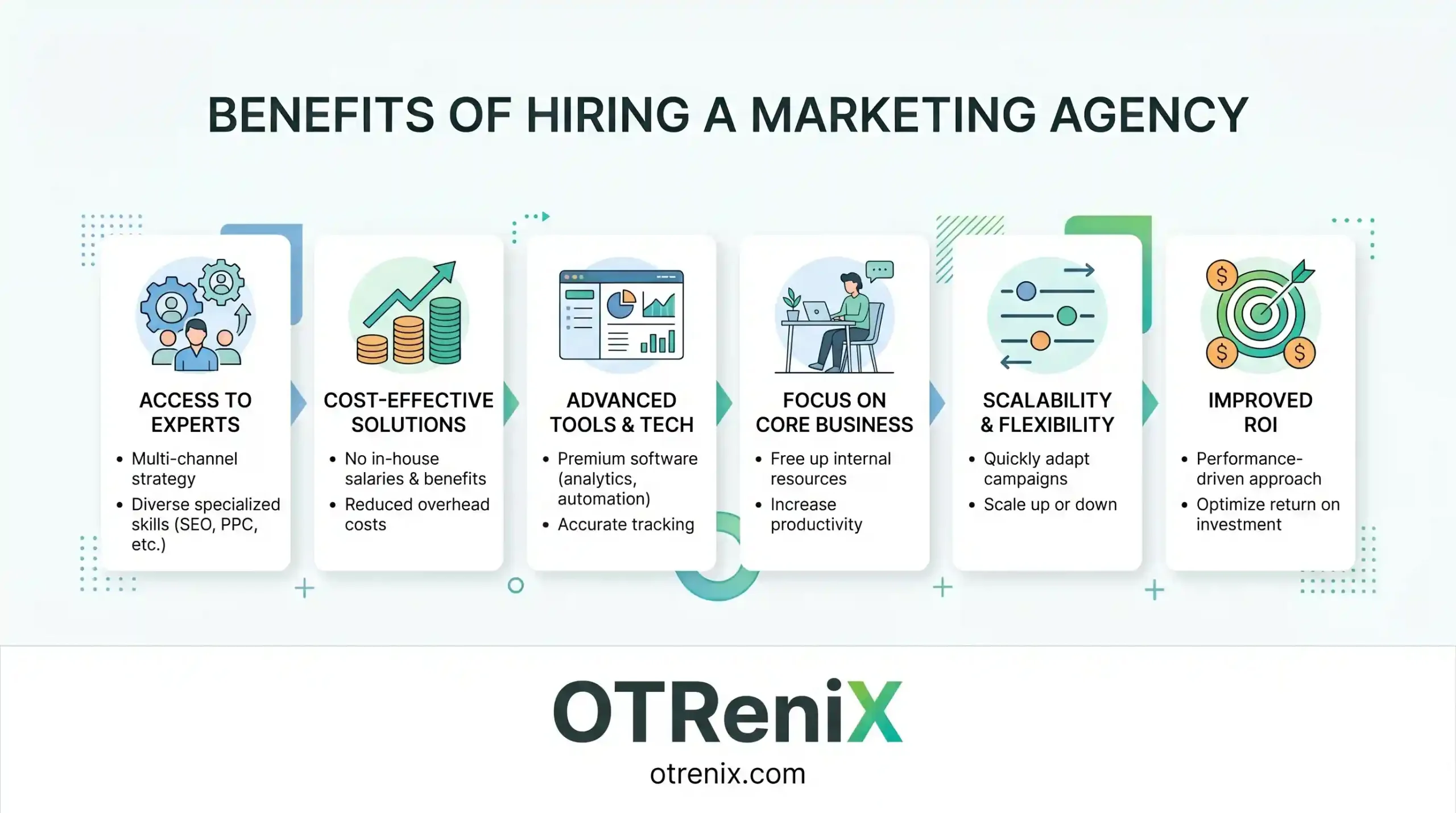

Most B2B companies eventually face the same decision. Marketing is not producing the pipeline it should. The founder is tired of running it on the side. The internal team is too small to cover everything. Hiring 3 full time marketers will cost $400K a year and take 6 months. So the company looks at marketing agencies and asks the obvious question: is this actually worth it?
The answer depends on what you need and how you hire. A good agency replaces 3 full time hires for half the cost, gets you to results in 90 days instead of 9 months, and gives you access to senior expertise you could never afford to keep on payroll. A bad agency burns $200K, produces a deck nobody implements, and sets your marketing back a year.
This article covers the real benefits of hiring a marketing agency, the situations where it is the right call, the situations where it is not, and how to capture the upside without paying for the downside.
Key Takeaways
- A marketing agency gives you access to senior expertise, specialized skills, and execution capacity without the cost or time of building a full internal team.
- The right time to hire an agency is when you need capabilities your team does not have, when you need results faster than hiring allows, or when you need senior strategic thinking your stage cannot yet justify in a full time role.
- Compared to building an internal team, an agency is usually 30% to 50% cheaper for the first year and 4 to 6 months faster to produce results.
- Agencies fail when the work is unclear, the founder is not engaged, or the contract structure is wrong. These problems are usually preventable with good upfront work.
- The biggest risk is hiring a generalist agency for a specialized need. Industry depth matters more than agency size or brand name.
What a Marketing Agency Actually Provides
Before looking at the benefits, it helps to be clear on what you are buying. Different agency types provide different value, and the benefits depend on which type you hire.
A strategic agency provides senior thinking. Positioning, ICP, messaging, channel strategy, and the marketing plan that ties it together. The deliverable is a written strategy plus enough hand holding to make it stick.
A demand generation agency runs the campaigns that produce pipeline. Paid ads, SEO, content, ABM, email, and the technical operations behind them. The deliverable is leads, opportunities, and pipeline value.
A specialist agency focuses on one capability done well. PR, video, partner marketing, SEO, or product marketing. The deliverable is depth in that one area, usually beyond what an in house team can produce.
A full service agency combines several of the above. The promise is one team that handles everything. The risk is that “everything” usually includes some workstreams the agency does badly.
Each type produces different benefits. A founder evaluating agencies should know which type they need before taking the first call.
The Core Benefits of Hiring a Marketing Agency
1. Access to senior expertise without the senior salary
A senior marketing leader costs $200K to $300K a year in salary, plus benefits, equity, and the 6 month search to find one. An agency gives you access to that same level of expertise for $10K to $20K a month, often with the actual senior person sitting in your weekly meetings.
This is the strongest argument for using an agency at the $1M to $20M ARR stage. The company needs senior thinking, but the budget for a full time CMO is hard to justify against revenue. An agency closes the gap. You get the strategy and direction of someone who has built marketing at 5 or 10 companies, applied part time to your business.
The math works because the agency spreads that senior time across multiple clients. You pay for 10 to 20 hours a week of someone whose full attention would cost you 5 times more.
2. Faster time to results
Hiring an internal marketing team takes time. A senior marketer is 3 to 6 months to find. The first hire then needs to be ramped, which adds 2 to 3 months. Then they hire 2 or 3 more people, each with their own ramp. Realistic timeline from “we need marketing” to “marketing is producing pipeline” is 9 to 12 months when building internally.
A good agency starts producing real work in week 2 and meaningful results in month 3 to 4. The team is already trained, the systems are already built, and the playbooks are already proven. You skip the entire ramp curve.
For companies under pressure to hit revenue targets in the next 12 months, this speed advantage is usually decisive. A 6 month head start often means hitting plan instead of missing it.
3. Access to specialized skills you could not justify in house
Modern B2B marketing requires skills that are hard to combine in one person and expensive to staff individually. SEO, paid media, content writing, design, marketing operations, ABM, analyst relations, video production, and event marketing all require different expertise.
Building all of this in house means hiring 6 to 10 people. Most companies under $20M ARR cannot justify that headcount. An agency gives you access to all those skills as you need them, in the right proportion for your stage.
This also means you can run sophisticated programs that would otherwise be out of reach. ABM at the level of named account research, custom content, and 1 to 1 engagement is hard to do in house with 2 marketers. An agency with the right team can run that program from day 1.
4. Pattern recognition across many companies
A senior in house marketer has built marketing at maybe 3 to 5 companies in their career. A senior agency operator has worked across 30 to 50 companies, often in the same category. They have seen what works and what fails across many situations, which is hard to replicate inside one company.
This pattern recognition shows up in better decisions. Which channels actually work in your category. What positioning angles succeed. What pricing structures hold up. What hire to make next. Where the typical pipeline leaks. The agency has watched these decisions play out at other clients and can tell you what is likely to work for you.
This is one of the underrated benefits. You are not just paying for execution, you are paying for the lessons learned from companies that came before you.
5. Lower cost than building internally
Run the math at $5M ARR. A small in house team to cover marketing properly looks like this: a director of marketing at $180K, a content manager at $90K, a demand gen manager at $110K, a designer at $80K, plus benefits, software, and overhead. Total cost is around $550K to $650K a year, with a 6 to 9 month timeline to fully assemble.
A comparable agency engagement runs $200K to $300K a year and is producing work in 30 days. The cost difference is 50% to 60%, and the time to value difference is 6 months or more.
This math holds at most stages between $1M and $20M ARR. It starts to flip above $20M ARR, where building internal capability becomes cheaper per output than agencies can match. But for the stage where most companies hire agencies, the cost advantage is real and significant.
6. Flexibility to scale up and down
Agency contracts can scale with the business. Need more demand generation in Q2? Add to the retainer. Cutting back in Q4? Reduce scope. Need a one time project for a product launch? Add it on top. The flexibility is hard to match with full time hires.
This matters in 2 specific situations. First, when the business is growing fast and marketing needs to keep up. Adding agency hours is faster than adding headcount. Second, when the business hits a slow quarter and marketing needs to compress. Reducing agency scope is much easier than restructuring a team.
For companies in volatile or seasonal markets, this flexibility can be the difference between maintaining marketing momentum and starting over every 18 months.
7. Outside perspective and honest feedback
Internal teams develop blind spots. They get used to the company’s quirks, accept the leadership’s preferences, and stop questioning decisions that should be questioned. An agency, especially one with senior operators, brings outside perspective that internal teams cannot.
A good agency will tell you when your positioning is wrong, when your pricing is too low, when your sales team is the bottleneck, or when the founder needs to step back from marketing decisions. This feedback is hard to get from people who report to the founder.
The honest feedback is sometimes uncomfortable. But uncomfortable feedback that prevents a $500K mistake is one of the most valuable things an agency provides.
8. Built in tooling and processes
Modern marketing requires a stack of tools: marketing automation, CRM integration, SEO platforms, attribution software, ABM tools, content systems, analytics, and reporting. Building this stack in house costs $50K to $150K a year in software alone, plus the time to set it up correctly.
Agencies bring their own tooling and licenses. They can run sophisticated programs without you having to buy the underlying platforms. This is especially valuable in the first year, when investing in the wrong tool stack is a common and expensive mistake.
After 12 to 18 months, companies often start migrating tooling in house. But the head start the agency provides removes a lot of friction in the early stages.
9. Risk reduction on hiring mistakes
A bad full time marketing hire is expensive. Salary plus ramp plus departure plus rehiring usually costs $200K and a year of lost progress. The risk is real because senior marketing hires are hard to evaluate in interviews.
An agency engagement is much lower risk. The first 90 days reveal whether the team can deliver. The contract usually includes a 30 day exit clause, which means the cost of being wrong is one month of fees, not 12 months of payroll.
This is one reason agencies are particularly valuable for first time founders or technical founders who are not yet sure how to evaluate marketing leadership. The agency provides a way to learn what good marketing looks like before betting a $250K hire on it.
10. Clear accountability and reporting
Internal teams report on what they did. Agencies report on what they produced. The framing is different and the outcome is usually better.
Agency reporting tends to focus on metrics that connect to revenue: pipeline generated, opportunities created, sales qualified leads, content performance, channel ROI. The structure exists because agencies have to defend their work to clients every month. Internal teams often drift toward activity metrics because there is less external pressure on the reporting.
This accountability extends to the relationship itself. Agencies that miss numbers lose clients. The structural pressure on the agency to actually produce results is part of what you are paying for.
When a Marketing Agency Is the Right Call
The benefits above are real, but they only apply in the right situations. Hiring an agency at the wrong moment wastes money and slows the company down. Here is when the math works.
You need capabilities you do not have
If your team is missing skills that you need now, an agency closes the gap immediately. SEO at scale, ABM, analyst relations, partner marketing, technical content for security or developer audiences. Building these capabilities internally takes years. An agency provides them in week 1.
You need results faster than hiring allows
If revenue targets require pipeline in 6 months and you do not have a marketing team yet, internal hiring will not get there in time. An agency starts producing in 30 days and shows real pipeline impact by month 4 to 6.
You need senior thinking your stage cannot justify in house
A $3M ARR company cannot justify a full time CMO at $250K. But it absolutely needs senior marketing strategy. A fractional CMO or strategic agency engagement provides the senior input at the right cost for the stage.
You need temporary capacity for a specific project
Product launches, brand refreshes, website rebuilds, and big events are time bound projects. Hiring full time for these makes no sense. An agency handles the project, then scales down.
You want pattern recognition from outside your company
If your marketing has plateaued and you cannot diagnose why, an outside team that has seen 30 similar companies is more valuable than another internal hire who only knows your business.
When a Marketing Agency Is the Wrong Call
The cases where agencies underperform are also clear. If any of these apply, fix them before hiring an agency.
You are pre product market fit
Marketing cannot fix a product that does not match a real customer need. If you have 5 customers and each one uses the product differently, you are not ready for an agency. Solve product market fit first.
You expect the agency to also write daily content, run ads, and manage social
This is execution work that requires a marketing manager, not a marketing agency. Hiring an expensive agency to do junior level work wastes money. The right answer is to hire a manager and use the agency for senior strategic input.
You expect results in 60 days
B2B marketing has cycles. SEO takes 6 months to show. ABM takes 4 months to produce real opportunities. Even paid media needs 90 days to optimize. Agencies that promise 60 day results are either lying or planning to game the metrics. The companies that demand them force agencies into short term tactics that do not build long term growth.
The founder is not willing to engage
An agency needs 2 to 3 hours a week of founder or CMO time. Strategy alignment, customer access, decision making. Without that input, even great agencies drift. Founders who hire an agency hoping to outsource marketing entirely are usually disappointed.
You are above $20M ARR with a mature marketing team
At this scale, the math starts flipping toward in house. A 10 person marketing team at $20M ARR costs less per output than agency equivalents and produces deeper institutional knowledge. Specialized agencies (PR, analyst relations, video) still make sense, but full service GTM work usually moves in house.
Cost Comparison: Agency vs Internal Team
Here is what the numbers actually look like at different stages, comparing a typical agency engagement to the equivalent internal team.
| Stage | Internal Team Annual Cost | Comparable Agency Cost | Time to Productivity |
|---|---|---|---|
| $1M to $3M ARR | $300K to $400K (2 to 3 hires) | $120K to $180K | Internal: 6 to 9 months. Agency: 30 days |
| $3M to $10M ARR | $500K to $700K (4 to 5 hires) | $200K to $360K | Internal: 9 to 12 months. Agency: 30 to 60 days |
| $10M to $20M ARR | $800K to $1.2M (6 to 8 hires) | $360K to $600K | Internal: 12 to 18 months. Agency: 60 to 90 days |
| $20M+ ARR | $1.2M+ (8+ hires) | Often more expensive | Internal becomes more cost effective |
These numbers are conservative on the internal side. They do not include software, recruiting fees, the cost of bad hires, or the productivity loss when key people leave. Real total cost of ownership for an internal team is usually 20% to 40% higher than the headline salary numbers.
The agency numbers also assume you hire well. A bad agency at $300K a year is more expensive than a good in house team, because the work has to be redone. The cost comparison only holds when the agency choice is right.
How to Capture the Benefits Without the Risks
The benefits of an agency are real but conditional. Companies that hire well capture all of them. Companies that hire badly capture none.
Define the work before talking to agencies
Most failed engagements start with vague scope. “Help us with marketing” is not a brief. The right brief includes specific outcomes, specific time frames, specific budget, and specific deliverables. Agencies that try to expand vague scope into bigger contracts are common, and the way to prevent it is to define the scope yourself before any conversation starts.
Hire for category depth, not agency size
A 10 person agency with 8 cybersecurity clients will outperform a 200 person agency with 1 cybersecurity specialist. The senior people on your specific account matter more than the overall scale of the firm. Always ask by name who will work on your account and check their backgrounds.
Use a 6 month contract with 30 day exit
This protects both sides. 6 months gives the agency time to produce real results. 30 day exit after the first 90 days lets you leave if it is not working. Contracts with 12 month minimums or no exit clauses favor the agency, not you.
Block 2 to 3 hours of founder or CMO time per week
The single biggest predictor of agency success is the time the founder gives the agency. Without weekly strategy alignment, even great agencies drift. Founders who treat the agency as a partner get 3 times the value of founders who treat it as a vendor.
Measure outcomes, not activity
Agencies should report pipeline, opportunities, sales qualified leads, win rate, and revenue contribution. Reports full of impressions, traffic, and engagement are warning signs. The right metrics force the agency to focus on work that matters.
Plan the transition out from day 1
The best agency engagements end with the client building internal capability that takes over. Plan for this from the start. Document the playbooks, train your future team, and treat the agency relationship as 12 to 24 months of accelerated learning, not as a permanent arrangement. Companies that build this transition plan get long term value. Companies that do not stay dependent on the agency for years.
Recommendation
If you run a B2B company between $1M and $20M ARR and your marketing is not producing what the business needs, hiring the right agency is usually the highest leverage move available. The benefits are real: senior expertise at a fraction of full time cost, faster time to results, access to specialized skills, pattern recognition from outside your company, and lower risk than building a full internal team.
But none of these benefits show up automatically. They require defining the work clearly, hiring for category depth, structuring the contract correctly, and giving the agency the founder time it needs to succeed. Companies that do this well capture significant value. Companies that hire vaguely, skip the diligence, and disengage from the relationship usually waste their money.
Start with the work. What does your business need from marketing in the next 12 months? If the honest answer requires capabilities, speed, or seniority your team cannot deliver, an agency is the right call. Build a shortlist of 3 specialists who match your category and stage. Run 2 conversations with each. Call 3 references for your top choice. Sign a 6 month contract with a 30 day exit clause. Block weekly time with the founder.
A good agency relationship is one of the most valuable tools available to a B2B company in growth stage. The math works, the speed advantage is real, and the risk is much lower than building a full team from scratch. Pick well, engage seriously, and the benefits compound for years.