B2B Event Marketing Guide
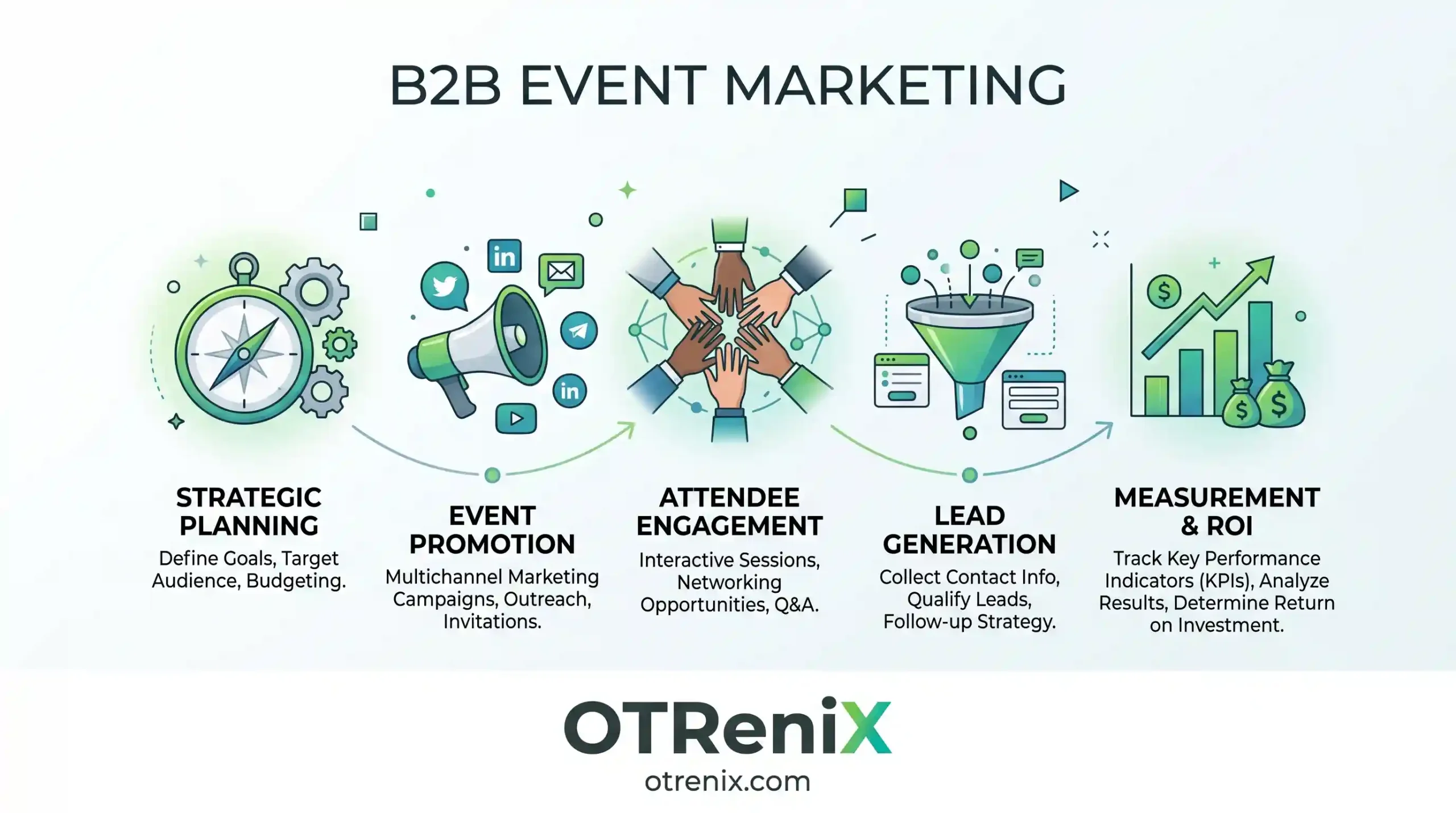

Most B2B companies treat events as a budget line, not a pipeline channel. They sponsor a booth at the biggest industry conference, send 4 reps with branded t shirts, collect 200 business cards, and 6 months later nobody can explain what came of it. The CFO asks for ROI, the marketing team produces a slide with vague engagement metrics, and the budget shrinks the next year.
This is not an event problem. It is a strategy problem. Events done well drive 20% to 40% of pipeline for B2B companies in mature markets. Events done badly burn $200K to $2M a year and produce nothing measurable.
The difference between the two is not the size of the booth or the quality of the swag. It is whether the company built the event around the customer or around the budget. The right approach treats every event as a 4 month campaign, not a 3 day appearance, and measures it the same way you measure any other pipeline channel.
This guide covers what works in B2B event marketing in 2026: when to invest, how to plan, what formats produce results, how to measure outcomes, and what to do before, during, and after the event itself.
Key Takeaways
- Events are a top 3 pipeline channel in most B2B markets. Companies that treat them as a brand expense underperform companies that treat them as a measurable campaign.
- The choice of event matters more than the size of the spend. Sponsoring the wrong conference at $250K produces less pipeline than running 3 targeted dinners at $40K each.
- 70% of event ROI comes from before and after the event, not the event itself. Pre event outreach and post event follow up are where the pipeline is actually built.
- Booths are usually the worst use of event budget. Speaking slots, private dinners, and analyst meetings on the sidelines produce 5 to 10 times more measurable pipeline per dollar.
- Measure events in pipeline value and influenced revenue, not in business cards collected or booth visitors.
- Plan each event 4 to 6 months in advance. Last minute event marketing always underperforms because the pre event outreach has no time to land.
Why B2B Events Still Matter in 2026
After years of digital first marketing, some founders assume events are obsolete. They are not. In B2B markets where deals are large, sales cycles are long, and trust drives purchase decisions, in person interaction still moves deals faster than any digital channel.
A few reasons explain why.
Trust compresses time
A 30 minute conversation at a conference does the work of 5 emails and 3 calls. The prospect sees the team, asks unscripted questions, and walks away with a feel for whether they want to do business with the company. In categories where deals run 6 to 18 months, this trust building shortens cycles by 20% to 40%.
Decision makers attend events
Senior buyers who never answer cold emails will stand at a session, attend a dinner, or take a coffee meeting at a conference. Events are one of the few channels where you can reach a CTO, CFO, or CISO who has otherwise filtered out vendor contact.
Competitive intelligence happens in person
You learn more about competitors in 2 days at a major conference than in 6 months of analyst calls. You see who is winning attention, what messages land, and how customers actually compare options. This signal feeds back into positioning and product decisions.
Customer expansion lives at events
Existing customers who attend the same conferences as you can become references, advisors, and expansion accounts. The customer dinner at a major conference is one of the highest leverage motions in B2B, and it costs almost nothing relative to its impact.
When Events Are the Right Channel
Events are not the right answer for every B2B company. Three conditions need to hold for the math to work.
Your customer attends the event
This is obvious and most companies still get it wrong. They sponsor a conference because their competitors do, not because their actual prospects are there. Before committing to any event, get the attendee list or the buyer profile from the organizer and verify that your ICP is in the room. If 70% of attendees are vendors and consultants instead of customers, walk away.
Your deal size justifies the cost
A typical B2B event campaign costs $40K to $400K all in, depending on size and format. If your average deal is $20K and your conversion rate from event lead to closed customer is 5%, you need to close 4 to 40 customers from each event just to break even. For most companies with sub $20K deals, events do not work. For companies with $50K+ deal sizes, they often do.
You can commit to the full campaign cycle
A real event campaign starts 4 months before the event and ends 4 months after. If your team cannot commit to that cycle, do not run the event. Showing up at the booth without pre event outreach and post event follow up is the most expensive way to do event marketing badly.
How to Choose Which Events to Attend
Most B2B companies attend too many events with too little focus. The discipline is saying no to good events so the team can do great work at fewer.
Tier the event landscape
In every B2B category, events fall into 3 tiers.
- Tier 1: Industry defining events. RSA Conference for security. Dreamforce for Salesforce ecosystem. AWS re:Invent for cloud. These are mandatory if your category lives there. They are also crowded and expensive.
- Tier 2: Vertical or persona specific events. Smaller, more targeted, often with 500 to 3,000 attendees who are mostly buyers. Examples include Money 20/20 in fintech, ViVE in healthcare tech, KubeCon for cloud native. These often produce better pipeline per dollar than Tier 1.
- Tier 3: Customer led communities and field events. Local meetups, regional conferences, customer councils, and private vendor hosted events. Cheap to attend, expensive to host. Often the highest pipeline conversion when done well.
Pick a portfolio, not a list
A balanced annual event plan typically includes 1 or 2 Tier 1 events for visibility and analyst meetings, 4 to 8 Tier 2 events for direct customer access, and 6 to 12 Tier 3 events for community presence and customer expansion. Trying to cover everything fails. Picking a focused portfolio that maps to ICP segments works.
Use the buyer journey as the filter
Different events serve different stages of the funnel. A flagship Tier 1 event is good for awareness and analyst visibility. A vertical Tier 2 event is good for qualified pipeline. A field dinner with 15 named accounts is good for closing deals already in the pipeline. Match the event to the GTM stage where you need help.
Event Formats That Actually Work
Not all event activations produce the same pipeline. Below are the formats ranked by typical pipeline contribution per dollar spent, based on what works for B2B companies in the $5M to $50M ARR range.
| Format | Typical cost | Pipeline ROI | Best for |
|---|---|---|---|
| Private executive dinner | $15K to $40K per dinner | High | Closing target accounts in pipeline |
| Speaking slot at major conference | $0 to $20K plus travel | High | Awareness and credibility with senior buyers |
| Analyst meetings on the sidelines | $5K to $15K travel and prep | High | Long term analyst relations and pipeline |
| Customer advisory board | $30K to $80K per meeting | High | Customer expansion and product feedback |
| Hosted half day workshop | $25K to $60K | Medium high | Mid funnel education and engagement |
| Sponsored booth at major conference | $80K to $400K | Low to medium | Brand presence, lead capture |
| Branded happy hour or party | $20K to $80K | Low to medium | Awareness and team morale |
| Conference sponsorship without booth | $30K to $150K | Low | Brand presence only |
The pattern is clear. Smaller, more targeted, more personal formats outperform large, broad, expensive ones. Most B2B companies invest in the wrong end of this table.
Why booths usually fail
A typical $200K booth at a major conference produces 200 to 500 scanned badges, of which 10 to 30 are actual qualified prospects, of which 1 to 5 turn into closed customers within 12 months. The math rarely works.
Booths fail because they wait for prospects to come to them. The prospects who come to a booth are usually doing tier 2 vendor research, not making a near term purchase decision. The senior customers you actually want to meet are in private meetings, sponsor sessions, or executive briefings, not walking the show floor.
If you must do a booth, pair it with at least 3 of these other formats. Never do a booth as your only activation.
Why dinners and small events work
A $30K private dinner with 15 named target accounts produces 12 to 15 prospect conversations, often with 2 to 3 senior decision makers per account. The conversion to qualified pipeline is typically 30% to 50%. The conversion to closed revenue is usually 10% to 20% within 12 months.
The math is straightforward. A $30K dinner that produces 2 closed deals at $80K each delivers a 5x return. Even one closed deal usually pays back the cost. Compare to a $200K booth that struggles to break even.
The Pre Event Campaign
70% of event ROI happens before and after the event, not during. The work that drives pipeline is in the campaign that surrounds the event, not the event itself.
8 to 12 weeks before the event
This is when target account selection and outreach begin. The marketing team identifies 50 to 200 named accounts attending the event. The list comes from the organizer, your CRM, LinkedIn searches, and intent data tools.
For each account, identify the 2 to 4 contacts you want to meet and the meeting format that fits. CISO meeting at a private dinner. Buying committee for a 1:1 demo. End user for a product workshop. The map between account, contact, and meeting type drives everything that follows.
6 to 8 weeks before
Outreach begins. The sales team and SDRs run targeted email and LinkedIn sequences offering specific meetings, not generic “stop by our booth” pitches. The strongest sequences offer something the prospect actually wants: a 30 minute briefing on a topic they care about, an introduction to a peer customer, an analyst session.
Marketing supports with paid LinkedIn campaigns aimed at attendee lists, conference hashtags, and target account lists. The goal is to be visible to your target prospects in the weeks leading into the event, not just on the show floor.
4 to 6 weeks before
Confirmed meetings start to fill the calendar. By 4 weeks out, you should have 30% to 50% of your target meetings booked. If the rate is lower, the team is targeting the wrong accounts or running weak outreach.
Speaking slots, panel placements, and analyst briefings are confirmed at this stage. Speaker materials and demos are in late draft. The team builds the playbook for the event itself: who attends which meeting, who runs which session, who covers the booth, who runs the dinner.
2 weeks before
Final reminders go to confirmed prospects. Backup plans are set for cancellations, which always happen. The follow up sequences are written and loaded into the marketing automation tool, ready to fire the day after the event ends. This pre loaded follow up is one of the biggest performance differences between strong and weak event programs.
During the Event
The event itself is execution, not strategy. The strategic work was done in the 12 weeks before. During the event, the focus is on running the playbook and capturing the data needed for follow up.
Run the meeting calendar
Senior reps and execs should be in 6 to 10 prospect meetings a day, not standing at a booth. Marketing handles the booth, junior reps handle lead capture, senior people are in private meetings with target accounts. Companies that mix this up waste their highest leverage talent on lowest leverage work.
Capture meeting context, not just contact info
The follow up email “great to meet you, here is some content” produces almost no pipeline. The follow up that references the specific conversation, the prospect’s exact problem, and the next step they agreed to produces real pipeline. This requires capturing 3 or 4 sentences of context for every meaningful meeting, not just scanning a badge.
The simplest tool is a shared Google Sheet or Notion table where reps log meetings as they happen. The team that does this consistently outperforms the team that does not by 2 to 3x in post event conversion.
Run a tight evening schedule
The evening events are where deals actually move. Dinners, drinks, executive receptions, customer parties. Build the evening schedule before the event starts and treat it as part of the campaign, not a social bonus. Reps and execs should know which dinner each night, which prospects they are sitting with, and what the conversation goal is for each one.
Take the analyst meetings seriously
Analyst meetings at a conference are 30 to 45 minutes, often with 2 or 3 analysts in the same room. The preparation matters more than the meeting itself. Prepare 2 or 3 specific things you want the analyst to know. Bring a customer story, not a product pitch. Follow up within a week with the assets they asked for. Done well over 12 to 18 months, this work moves you up a Magic Quadrant or Wave, which is worth millions in pipeline.
The Post Event Campaign
The work after the event is what turns prospect conversations into pipeline. Most companies underinvest here because the team is tired and the next event is already on the calendar.
Within 24 hours
Personalized follow ups go to every meaningful prospect contact. Personalized means the email references the actual conversation, not the company website. The next step is concrete: a calendar link for a deeper conversation, a specific resource the prospect asked for, an introduction to a customer reference.
The 24 hour window matters because prospects are still in event mode. After 72 hours, the conversation has cooled and re engagement is much harder.
Week 1 to 2
The pipeline review meeting happens. Every meeting from the event is logged in CRM with context, next step, and qualification stage. Weak prospects are routed to nurture. Strong prospects are escalated to AE follow up. Marketing tags every contact for ongoing campaigns.
The team also writes up what worked and what did not. Which meetings produced the strongest interest. Which messages landed. Which target accounts surprised the team. This learning feeds the next event plan.
Week 3 to 8
The follow up sequences run. For prospects in active evaluation, AE outreach moves to demos, pricing conversations, and proposals. For prospects who are interested but not ready, marketing runs nurture sequences with content that maps to their stated problem from the event meeting.
The marketing team builds a post event content asset, often a recap blog post, a research summary, or a video series, that gives the sales team a reason to reconnect with prospects who went silent.
Month 3 to 6
The pipeline that is going to convert from this event is now visible. The metrics conversation happens. How much pipeline was created, how much converted, what was the cost per qualified opportunity, what was the ROI versus other channels. This data drives the next year’s event plan, not gut feel.
How to Measure Event ROI
The single biggest reason event marketing has a credibility problem is bad measurement. Marketing teams measure inputs, not outputs, and CFOs lose patience.
The fix is to measure events the same way you measure any other pipeline channel.
Primary metrics
- Pipeline value created. Total dollar value of opportunities sourced from the event within 6 months.
- Pipeline value influenced. Total dollar value of opportunities the event touched, even if not first sourced.
- Cost per qualified opportunity. Total event cost divided by number of qualified opportunities.
- Closed revenue within 12 months. Actual closed revenue from accounts that engaged at the event.
- Sales cycle compression. Average time from first event touch to close, compared to non event sourced deals.
Secondary metrics
- Number of target accounts reached. Useful for ABM driven event programs.
- Analyst meetings completed. Useful for analyst relations programs.
- Customer references generated. Useful for advocacy and expansion programs.
- Net new contacts at target accounts. Useful for multi threading enterprise deals.
What not to measure
Booth visitors, badges scanned, business cards collected, social media impressions during the event. These are activity metrics, not outcome metrics. Reporting on them tells the CFO that the marketing team does not understand their own work.
A simple rule: if a metric does not connect to pipeline or revenue within 2 hops, do not put it in the post event report. Use it internally for diagnostics if useful.
Budget Expectations
A realistic B2B event budget for companies in the $5M to $50M ARR range looks like this.
$5M to $10M ARR
- Total annual event spend: $200K to $500K
- 1 Tier 1 conference, with speaking slot, sidelines meetings, optional small booth: $80K to $150K
- 3 to 5 Tier 2 events, with sponsorships, dinners, or workshops: $100K to $250K
- 8 to 15 Tier 3 events, community meetups, hosted dinners, regional events: $30K to $100K
$10M to $25M ARR
- Total annual event spend: $500K to $1.5M
- 2 Tier 1 conferences, with full activations: $250K to $600K
- 6 to 10 Tier 2 events: $200K to $600K
- 15 to 30 Tier 3 events: $50K to $300K
$25M to $50M ARR
- Total annual event spend: $1M to $3M
- 2 to 3 Tier 1 conferences, with major sponsorships and booth: $500K to $1.5M
- 8 to 15 Tier 2 events: $300K to $800K
- 30+ Tier 3 events: $200K to $700K
These numbers cover the all in cost: sponsorships, booth design and shipping, travel, hotel, dinners, swag, gifts, paid media around events, and team time. Most companies underestimate the all in cost by 30% to 50% because they only count the obvious line items.
What to Avoid
A few mistakes appear in almost every underperforming B2B event program.
- Saying yes to events because competitors are there. This is not a strategy. Competitors might also be wrong.
- Sending too many people. Most companies overstaff events. Five reps at a conference do less than 3 reps with focused meeting calendars.
- Investing in branded swag. Premium swag does not move pipeline. Spend the money on a private dinner instead.
- Treating events as separate from the broader campaign. Events should be tied to product launches, content campaigns, and outbound programs. Standalone events underperform integrated ones.
- Skipping the pre event work. Without 8 weeks of pre event outreach, even a great event will produce average pipeline.
- Skipping the post event work. Without 8 weeks of follow up, even a great event will produce nothing.
- Letting the most senior people stand at the booth. Senior reps and execs should be in private meetings, not greeting strangers.
Recommendation
If you run B2B marketing for a company with deal sizes above $30K and you currently treat events as a budget line, you are leaving money on the table. The path to better results does not require more spend. It requires better strategy, more discipline, and proper measurement.
Start by auditing the last 12 months of event spend. For each event, identify the actual pipeline created and the cost. Most companies find that 20% of their events produce 80% of the pipeline, and the other 80% produce almost nothing measurable. Cut the bottom 50% of events from next year’s plan and reinvest the budget into better activations at the events that work.
Pick a portfolio of 6 to 12 events for the next 12 months. For each one, define the goal, the format, the target accounts, and the measurement plan before committing the budget. Build the 4 month campaign cycle around each event: pre event outreach starts 8 weeks out, post event follow up runs 8 weeks after. Block this in the calendar before any event date is locked.
Move budget away from booths and toward dinners, speaking slots, and private meetings. A $30K dinner with 15 named accounts almost always produces more pipeline than a $200K booth at the same event. Run the experiment for 2 events and measure the difference. The math will be obvious.
Measure every event in pipeline value and influenced revenue, not in business cards collected. Build a simple reporting template that tracks pipeline created, closed revenue, and cost per qualified opportunity. Bring it to the CFO. Bring it to the board. Replace the credibility problem with real data.
B2B events still work in 2026. They just do not work the way most companies run them. The companies that fix the strategy, the measurement, and the campaign cycle around their events outperform the ones that keep paying for booths nobody remembers. Pick fewer events, plan them better, measure them honestly, and the channel becomes one of the most reliable pipeline engines in the marketing mix.