Fractional CMO for Fintech Companies
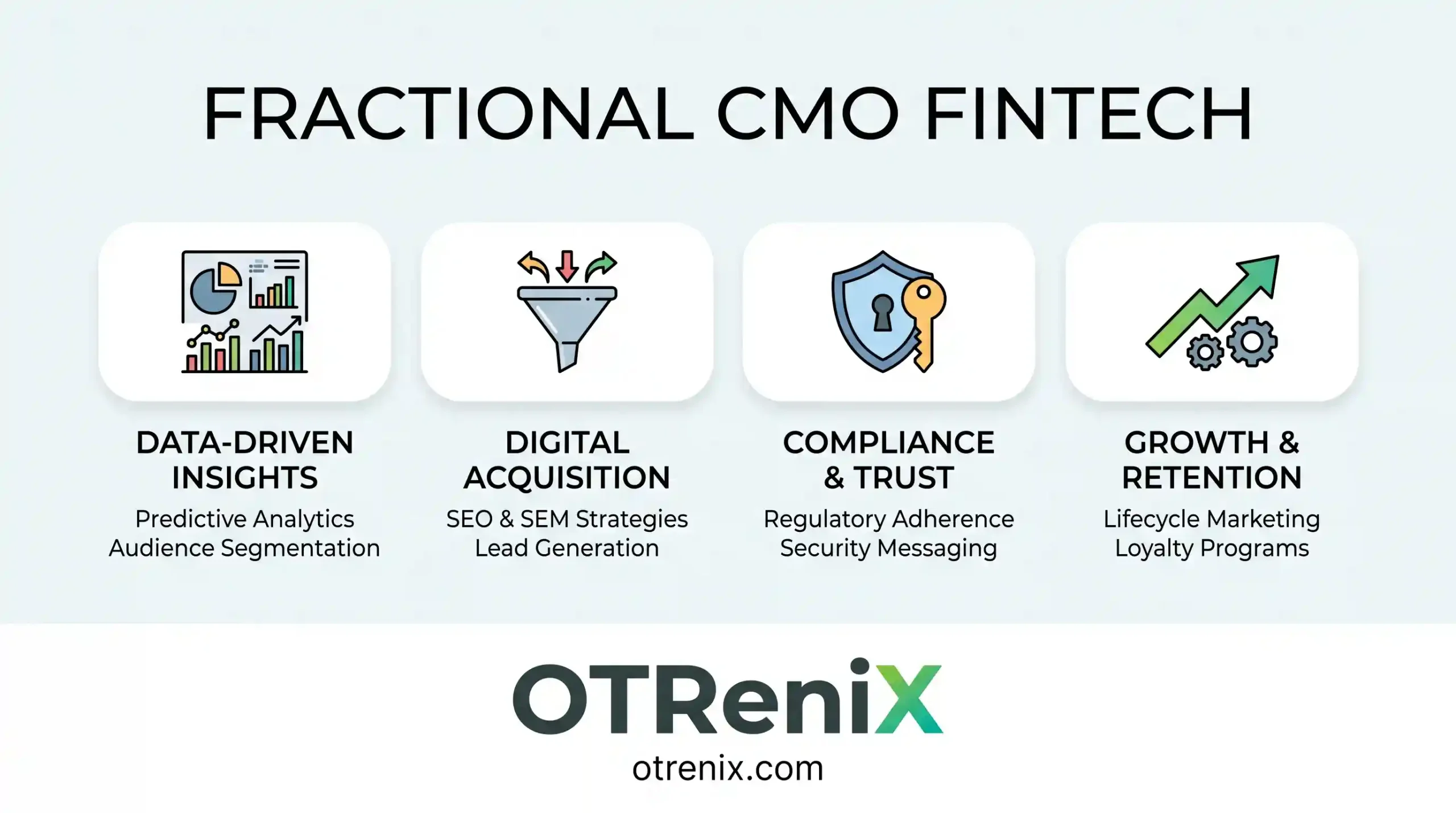

Fintech is one of the most expensive markets to get marketing wrong. Customer acquisition costs in consumer fintech have tripled since 2020. B2B fintech sales cycles run 9 to 18 months. Compliance and licensing constraints kill half the campaigns generic agencies want to run. And the competition includes both nimble startups and giants like Stripe, Plaid, Chime, Adyen, and the major banks.
Most fintech founders come from finance, engineering, or product backgrounds. They understand payment rails, risk models, and APIs in detail but struggle to write a landing page that turns a regulated CFO or a skeptical consumer into a paying customer. They hire a junior marketer for $90K, run some Google Ads, and watch CAC climb past LTV.
A fractional CMO who has worked in fintech solves this problem. They understand the customer, the regulatory environment, the channels that actually work, and the traps that kill most fintech marketing programs. For companies between $1M and $30M in revenue, this is often the highest leverage hire the founder can make.
In this article I will show you why fintech marketing is different, what a fractional CMO does in this space, which channels actually work, and how to pick the right person for your company.
Key Takeaways
- Fintech marketing is harder than general B2B or consumer because of regulation, trust requirements, and aggressive competition. Generic playbooks fail in this market.
- A fractional CMO with fintech experience understands compliance constraints, the prospect’s risk tolerance, and the channels that actually drive growth. This experience cannot be taught in 90 days.
- Avoid fractional CMOs without direct fintech experience. The learning curve on regulation, trust signals, and category specifics is too steep for a part time leader.
- Expect the first 90 days to focus on positioning, customer interviews, compliance review, and team alignment. Real pipeline or user growth comes in months 4 to 9.
- Budget $10K to $20K a month for the CMO, plus $20K to $150K a month for execution depending on stage and whether you sell B2B or B2C.
- The right hire can cut CAC by 30% to 50% and double qualified pipeline within a year for B2B, or significantly improve activation and retention for B2C.
Why Fintech Marketing Is Different
Most B2B and consumer playbooks do not work in fintech. Here is why.
Trust is the entire purchase
Customers are handing over their money, their data, or both. A typo on your website creates real doubt. A missing security badge can kill a conversion. A vague claim about returns triggers regulatory scrutiny. In fintech, trust is not a brand attribute. It is the product.
This changes how every page, ad, and email gets written. Generic claims like “best in class” make a fintech prospect close the tab. They want specific evidence: who regulates you, who insures you, who audits you, and what happens when something breaks.
Regulation shapes every campaign
In most markets, marketing teams write what they want and run it. In fintech, every claim goes through compliance. Words like “guaranteed,” “safe,” “investment,” “FDIC insured,” “savings,” and “yield” trigger different regulatory requirements depending on the product and jurisdiction.
A fractional CMO who has not lived inside a fintech compliance review will move too fast and get campaigns killed. A good one will understand the rules well enough to design campaigns that pass review on the first round, which often saves 4 to 6 weeks per campaign.
CAC is brutal and rising
In consumer fintech, customer acquisition costs have climbed past $100 per activated user in many categories. In B2B fintech, fully loaded CAC for mid market deals often exceeds $20K per logo. Margins do not always support these costs, so marketing must be ruthlessly efficient or the unit economics break.
This means marketing cannot be optimized for vanity metrics. It must be measured by activated customers, paying customers, retained customers, and LTV to CAC ratio. A fractional CMO who reports on impressions and leads is not senior enough for fintech.
The buying committee is hidden
In B2B fintech, the deal looks like a finance team purchase, but the actual decision involves the CFO, the controller, the head of accounting, IT, security, legal, and sometimes the CEO. Each one has different concerns. The CFO wants ROI. Security wants SOC 2. Legal wants the contract terms. IT wants the integration roadmap.
In consumer fintech, the buying decision is often a household conversation, not a single user decision. A spouse, a financial advisor, or a parent can kill a sale you thought you had won.
Adjacent giants are always 1 click away
Stripe, Plaid, Chime, Adyen, Block, PayPal, Robinhood, and the major banks are not abstract competitors. They are 1 search result, 1 ad, or 1 referral away from your prospect. Marketing has to give the prospect a clear, defensible reason to choose you over a known incumbent. “We are cheaper” rarely works because the giants can match price for 12 months and bury you.
What a Fractional CMO Does for a Fintech Company
A fractional CMO with fintech experience focuses on 6 things that move the needle in this market.
Positioning against incumbents
Every fintech startup competes against at least one giant. If you do payments, you compete with Stripe and Adyen. If you do banking, you compete with Chime and the neobanks. If you do lending, you compete with established consumer credit brands. If you do B2B accounting, you compete with QuickBooks and NetSuite.
The fractional CMO helps you find the positioning where you actually win. Usually this is a specific customer segment, a specific use case, or a specific feature gap that the incumbent ignores or handles badly.
“Better than Stripe” is not positioning. “The payments platform built for marketplaces with international sellers in 40+ countries who need same day payouts in local currency” is positioning. The difference is the size of your pipeline 9 months later.
Customer interviews and messaging
Before any campaign runs, the CMO should interview 15 to 25 customers, lost prospects, and target accounts. Not survey responses. Real conversations of 30 to 45 minutes each. The questions are not about your product. They are about how the customer makes financial decisions, what risks they are protecting against, and what words they use when they describe their problem.
The output of these interviews is the messaging foundation for everything else. The website, the ads, the content, the sales deck, and the onboarding flow all speak in the words the customer actually uses. Most fintech startups skip this step and wonder why their conversion rates are flat.
Trust and credibility infrastructure
Fintech marketing rests on a base of trust signals. Regulatory disclosures. Security certifications (SOC 2, PCI DSS, ISO 27001). Insurance details. Audit information. Customer logos with named industries. Press coverage from credible outlets. Research from respected analysts.
A fractional CMO who has worked in fintech knows what this base looks like and which signals matter for which customer segment. Without it, every channel performs 30% to 50% worse because prospects bounce on the first whiff of doubt.
Channel mix that respects regulation
Some channels that work in general B2B do not work in fintech. Affiliate programs need careful structuring to comply with consumer credit and investment rules. Influencer marketing needs disclosures. Display advertising in some jurisdictions requires pre approval. Comparison sites can be a great channel or a regulatory minefield depending on the product.
A fintech experienced CMO knows which channels to use, which to avoid, and how to structure each one to pass compliance. This knowledge prevents the painful cycle of launching a channel, getting flagged, and having to take it down 30 days later.
Content that finance professionals respect
Finance and security professionals have a nose for marketing fluff. A blog post titled “5 Tips to Save More Money” gets zero traction. A detailed breakdown of how SOX compliance interacts with cloud accounting workflows, written by someone who has actually done the work, gets shared across the industry.
The fractional CMO directs the content strategy toward depth over volume. 12 great technical or financial pieces a year beat 100 generic posts. The content should come from your founders, your finance team, and your product experts, not from a content agency that writes for everyone.
Activation and retention, not just acquisition
In fintech, getting someone to sign up is the easy part. Getting them to fund an account, complete KYC, run their first transaction, and stay engaged 90 days later is where the economics live. Many fintechs have great top of funnel and terrible activation, which destroys the unit economics no matter how good the ads are.
A good fractional CMO works as much on activation, onboarding, and retention as on acquisition. They will dig into the funnel data, find the drop off points, and fix them before pushing more spend into the top.
When a Fintech Company Needs a Fractional CMO
The fractional CMO model works best in a specific stage. For fintech companies, the window depends on whether you are B2B or B2C.
Signs a B2B fintech is ready
- $1M to $20M in ARR. Below $1M, the founder should still own marketing and talk to every customer. Above $20M you usually need a full time CMO with a head of demand generation underneath.
- At least 20 paying customers. You need enough customer voices to build real messaging and positioning. Fewer than 20 and the patterns are not yet clear.
- A working sales team of 2 to 8 reps. Marketing without sales to follow up is wasted. Sales without marketing leaves the reps prospecting cold all day.
- Compliance function in place. Marketing in fintech moves through compliance. If you do not have a compliance lead or external counsel, hire that first.
- Budget for execution. Plan for $20K to $80K a month beyond the CMO fee, depending on stage and goals.
Signs a B2C fintech is ready
- At least 5,000 active customers and a working onboarding flow. Below this scale, the founder should be in every customer conversation.
- A clear LTV and CAC picture, even if rough. If you cannot articulate your unit economics, a CMO cannot help until you can.
- Compliance function in place. Same rule as B2B. Probably more important.
- Budget for paid spend. B2C fintech typically requires $50K to $300K a month in paid channels at the right stage. Smaller budgets cannot move the needle.
- Product market fit signals. Retention curves that flatten, organic word of mouth, customers who can articulate why they chose you.
Signs you are not ready in either case
- Pre product market fit. You have early customers and each one is using the product differently. Fix this before hiring marketing leadership.
- No founder time for marketing. If the founders do not have 2 hours a week to align on strategy, no CMO can succeed.
- Looking for a “growth hacker.” Fintech does not respond to growth hacks. The customers are too cautious and the regulators too patient.
- Expecting results in 90 days. In fintech, 90 days gets you positioning, compliance review, and early infrastructure. Real growth takes 6 to 9 months.
What to Look For in a Fintech Fractional CMO
A generic fractional CMO will struggle in fintech. The learning curve is steep and a part time engagement does not give enough time to learn. Here is what to look for.
Direct fintech experience
They should have been CMO, VP of Marketing, or head of a major marketing function at a fintech company. Ideally at your stage or one stage ahead. A CMO who took a B2B fintech from $3M to $20M ARR can help you do the same. A CMO who only ran marketing at a $500M public bank will struggle with the scrappiness your stage requires.
Ask for specific companies, specific numbers, and specific channels they used. “Reduced CAC from $1,200 to $480 in 12 months at a Series B B2B fintech” is the kind of answer you want.
Understanding of the customer
In the first conversation, ask them to describe the customer they would target for your product. A senior candidate will describe the company size, industry, financial maturity, regulatory exposure, and decision process for B2B, or the demographic, financial behavior, and life stage for B2C. A weak candidate will say “small businesses” or “millennials.”
Also ask what your typical customer actually worries about on a typical Tuesday. If they cannot answer, they have never talked to enough customers to lead your marketing.
Compliance experience
Ask if they have worked inside a compliance review process. Ask what disclosures they have written. Ask which regulatory frameworks they have marketed under, whether that is SEC rules for investment products, CFPB rules for consumer credit, FINRA, FDIC, state lending licenses, or international equivalents.
If they have never done compliance heavy marketing, they will move too fast and get campaigns killed. You can still hire them for other strengths, but you will need a strong compliance partner inside the company to slow them down before campaigns go out.
Numerical literacy
Fintech marketers must read financial statements, understand unit economics, and model the impact of their work on the P&L. Test this in the interview. Ask them to explain CAC payback, LTV to CAC ratio, and how marketing investment should change as the company scales. If they cannot, they will run programs that look good in marketing dashboards and bad in the board deck.
Channel breadth
Fintech requires more channels than most B2B because no single channel scales infinitely. Ask about their last 3 channel mixes by company. A senior CMO will describe a portfolio of 4 to 6 channels, with rationale for each. A weak one will overweight whichever channel they are most comfortable with.
Channels That Actually Work in Fintech
One of the biggest values a fintech fractional CMO provides is knowing where to spend. Here is a realistic picture of which channels drive growth in this market, based on what works for companies in the $1M to $30M revenue range.
B2B fintech channels
| Channel | Effort to set up | Time to results | Typical pipeline contribution |
|---|---|---|---|
| Content and SEO | Medium | 6 to 12 months | 20% to 35% |
| LinkedIn ABM | Low | 3 to 6 months | 15% to 25% |
| Targeted events and dinners | Medium | 1 to 6 months | 10% to 20% |
| Customer advocacy and case studies | Medium | 3 to 9 months | 10% to 20% |
| Partnerships and integrations | High | 6 to 18 months | 15% to 30% |
| Industry analyst relations | High | 12 to 18 months | 5% to 15% |
| Outbound SDR programs | Low | 1 to 3 months | 10% to 25% |
| Webinars and roundtables | Low | 3 to 6 months | 5% to 15% |
| Google Ads on intent keywords | Low | 1 to 3 months | 5% to 15% |
B2C fintech channels
| Channel | Effort to set up | Time to results | Typical contribution |
|---|---|---|---|
| Paid social (Meta, TikTok) | Low | 1 to 3 months | 25% to 45% |
| Performance content and SEO | Medium | 6 to 12 months | 15% to 30% |
| Referral programs | Medium | 3 to 6 months | 10% to 25% |
| Influencer and creator partnerships | Medium | 1 to 3 months | 10% to 20% |
| Comparison sites and aggregators | Medium | 1 to 3 months | 10% to 25% |
| Podcast advertising | Low | 3 to 6 months | 5% to 15% |
| App store optimization | Medium | 3 to 9 months | 10% to 20% |
| Email and lifecycle marketing | Medium | 3 to 6 months | 15% to 25% (retention) |
| Direct mail (for credit and lending) | Medium | 1 to 3 months | 10% to 20% |
A good fractional CMO will usually focus on 4 or 5 channels at a time. Trying to run all 9 at the same time at $1M to $5M revenue is a recipe for spreading the team too thin and failing at everything.
What to Expect in the First Year
Fintech marketing operates on longer timelines than most consumer markets due to compliance and trust building, but shorter than cybersecurity. Here is a realistic picture of what a fractional CMO can deliver in 12 months.
Months 1 to 3: Foundation
The CMO does 15 to 25 customer interviews, audits current marketing, reviews compliance constraints, rebuilds positioning, writes the messaging framework, and updates the website narrative. They also hire or restructure the marketing team. Customer growth and pipeline do not change significantly in this period, and that is expected.
Months 4 to 6: Execution
The first campaigns run under the new strategy. Content publishing becomes regular, paid channels are tested and optimized, the first targeted partnership or event runs, and customer lifecycle programs launch. Early signals appear: better conversion at one stage of the funnel, lower CAC in test channels, sales reps reporting better quality conversations.
Months 7 to 9: Scale
Growth starts to compound meaningfully. The 2 or 3 channels that worked best in testing get scaled. Activation and retention metrics improve as the lifecycle work pays off. Customer references feed back into acquisition campaigns. Compliance review cycles get faster because the team has learned what passes.
Months 10 to 12: System
Marketing becomes a predictable engine. You can forecast pipeline or new customer acquisition from channel data. The team runs without daily direction. Decisions about next year’s budget are based on real data, not guesses. This is the point where the fractional CMO either stays on to run the system or transitions you to a full time hire.
Budget Expectations
Fintech marketing budgets vary more by business model than by stage. B2B fintech tends to look like enterprise B2B SaaS. Consumer fintech tends to look more like consumer brand budgets, often heavier on paid media. Here are realistic ranges.
B2B fintech, $1M to $5M ARR
- Fractional CMO: $8K to $15K a month
- Execution team: 1 or 2 full time
- External help: $5K to $15K a month
- Paid channels: $10K to $30K a month
- Total marketing spend: $30K to $70K a month
B2B fintech, $5M to $20M ARR
- Fractional CMO: $12K to $20K a month
- Execution team: 3 to 6 full time
- External help: $10K to $30K a month
- Paid channels: $30K to $80K a month
- Total marketing spend: $80K to $200K a month
Consumer fintech, $1M to $10M revenue
- Fractional CMO: $10K to $18K a month
- Execution team: 2 to 5 full time
- External help: $10K to $30K a month
- Paid channels: $50K to $200K a month
- Total marketing spend: $100K to $300K a month
Consumer fintech, $10M to $30M revenue
- Fractional CMO: $15K to $25K a month, transitioning to full time within 12 months
- Execution team: 5 to 12 full time
- External help: $20K to $50K a month
- Paid channels: $150K to $600K a month
- Total marketing spend: $250K to $800K a month
These numbers feel high until you compare them to the cost of not hiring correctly. A fintech company that spends $2M a year on marketing without a CMO often produces 30% to 50% less customer growth than a competitor that spends the same with a CMO who knows what they are doing.
Red Flags Specific to Fintech
Beyond the general red flags for any fractional CMO, a few are specific to this market.
- They cannot name the regulatory bodies relevant to your product. If they do not know what CFPB, FINRA, SEC, FDIC, or your relevant international equivalents do, they will create compliance problems within the first quarter.
- They have no opinion on compliance review cycles. Every fintech marketer has strong opinions about how to structure campaigns to pass compliance fast. A candidate who shrugs has not been in the field.
- They reach for consumer growth playbooks for B2B fintech, or B2B playbooks for consumer. The 2 motions are very different. A CMO who has only done one will struggle with the other.
- They want to avoid talking about CAC and LTV. In fintech, these numbers run the business. A CMO who treats them as “finance team metrics” is missing the entire job.
- They treat trust signals as a checkbox. Trust signals are the foundation of every conversion in fintech. A CMO who sees them as legal compliance and not as marketing material is missing the point.
- They promise to “scale paid spend aggressively.” In consumer fintech especially, aggressive paid scaling without strong unit economics destroys companies. A senior CMO will want to fix the funnel before scaling spend.
Recommendation
If you run a fintech company between $1M and $30M in revenue and marketing is not producing the growth you need, start the fractional CMO search this month.
Build a list of 10 candidates with direct fintech experience at your stage and business model. Skip generalists, even strong ones. The learning curve on regulation, trust signals, and channel mix is too steep for part time work. Ask each founder in your network who they would hire if they were in your position. The same 2 or 3 names will come up and those are your starting list.
Interview your top 3 finalists with a specific focus on fintech depth. Ask them to describe your ideal customer in detail. Ask about their experience with compliance review. Ask what they would change on your website in week 1 and why. Ask how they would model your CAC payback in the next quarter. A candidate who cannot answer these in specific terms is not senior enough for this market.
Call at least 3 references for your top pick. Ask each reference one question: “If you were doing it over, would you hire them again for a fintech company, and why?” Specific answers with numbers tell you they delivered. Vague praise tells you the engagement was forgettable.
Sign a 6 month contract at $10K to $20K a month, with a 30 day exit clause after day 90. Plan for $20K to $200K a month in additional execution budget based on your stage and business model. Block 2 hours a week of founder time for weekly strategy calls. Give them full access to customer calls, sales data, financials, and the product roadmap from day 1.
Expect the first 90 days to focus on positioning, customer interviews, compliance review, and foundation. Real growth starts in month 4 and compounds through month 12. A good fintech fractional CMO can cut your CAC by 30% to 50%, double qualified pipeline within a year, or significantly improve activation and retention for consumer products.
Marketing in fintech is hard. The customers are cautious, the regulators are patient, and the giants are always 1 click away. But with the right CMO, marketing becomes one of your strongest competitive advantages. The fintech companies that win are not always the ones with the best product. They are the ones a customer trusts enough to fund an account with.