B2B Marketing Audit
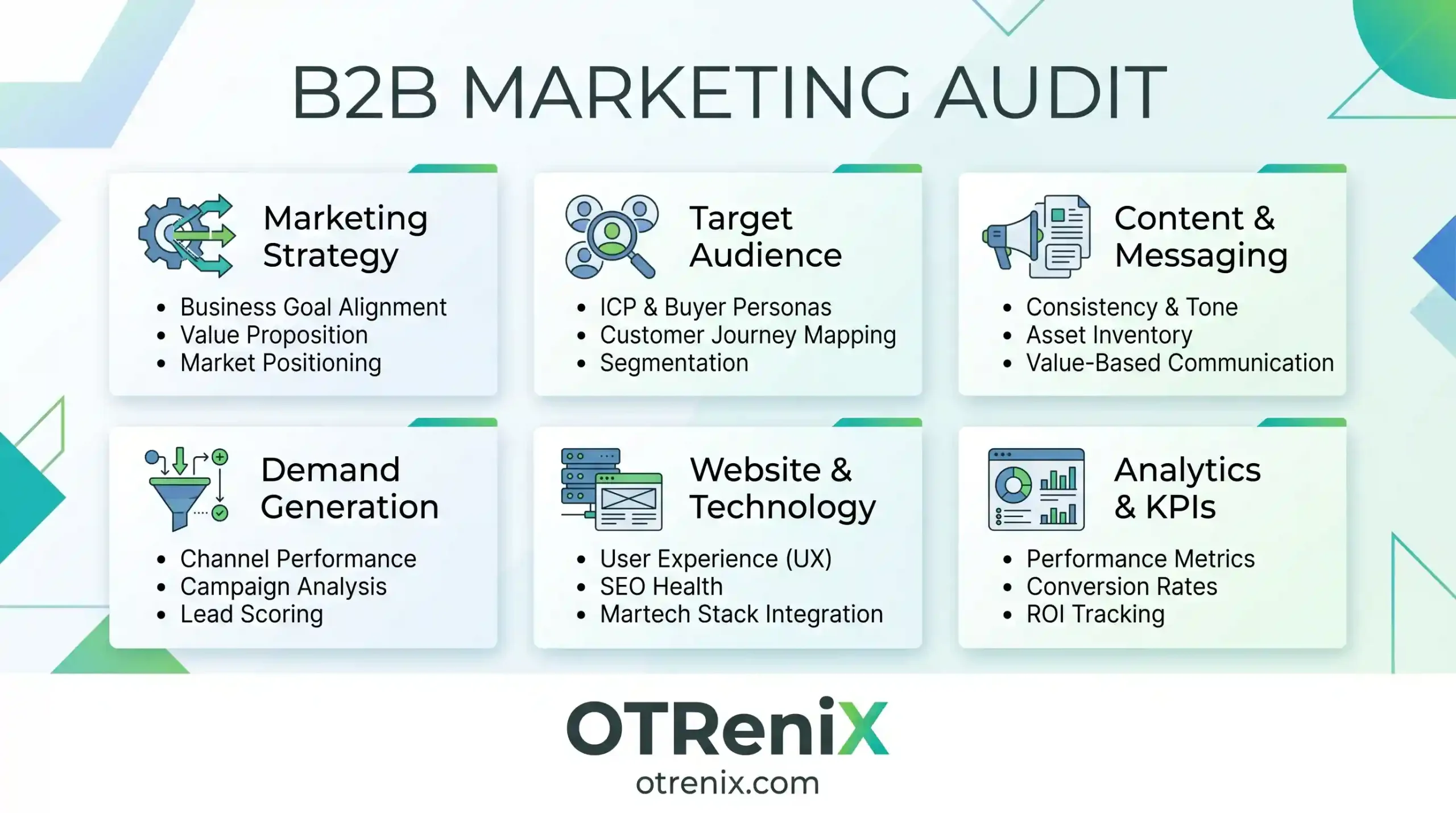

Most B2B marketing teams have no idea what is actually working. They run 8 channels, produce 12 reports a quarter, and pay 4 agencies. Pipeline numbers go up and down for reasons nobody can fully explain. The CMO defends the budget every quarter with attribution data that everyone privately admits is incomplete.
This is normal. B2B marketing is now too complex for any single dashboard to capture. By the time you account for SEO, paid search, paid social, content, events, ABM, partner programs, email, and product led motions, you have 30+ moving parts. Most teams stop trying to understand the whole picture and just defend the parts they own.
A B2B marketing audit fixes this. Done well, it produces a clear picture of what is working, what is wasting budget, what is missing, and what to change in the next 90 days. It is the single most useful exercise a B2B marketing team can run, and most do not.
This article covers what a B2B marketing audit actually is, when to run one, what it should include, how to do it (whether internally or with an outside partner), and how to act on the results without burning down the team.
Key Takeaways
- A B2B marketing audit is a structured review of strategy, channels, operations, and outcomes designed to surface what is working, what is not, and what to change.
- Most companies should run a full audit every 18 to 24 months, plus a lighter quarterly check on key metrics.
- A good audit covers 6 areas: positioning and ICP, channels and pipeline, content and assets, marketing technology, team and processes, and analytics and attribution.
- Audits work best when run by someone with no political stake in the outcome. Internal audits often miss problems because the team that built the program is the one being audited.
- Cost in 2026 ranges from $0 (DIY) to $40K+ for a senior external audit. The right level depends on stage, complexity, and how much pipeline is at risk.
What a B2B Marketing Audit Actually Is
A marketing audit is not the same as a campaign review or a quarterly business review. Those look at recent results. An audit looks at the entire system that produces those results.
The 6 standard areas covered in a thorough B2B marketing audit are positioning and ICP, channels and pipeline, content and assets, marketing technology, team and processes, and analytics and attribution. The output is a written report with findings, prioritized recommendations, and a 90 day action plan.
A good audit answers 5 questions:
- Is the marketing strategy aligned with the actual business?
- Which channels and programs are producing pipeline, and at what cost?
- What is missing from the current marketing system?
- What is being wasted that should be cut?
- What changes will produce the highest impact in the next 90 days?
If the audit cannot answer all 5 with specifics, it failed.
When to Run a Marketing Audit
A B2B marketing audit makes sense in 6 specific situations.
After a leadership change
A new CMO or VP of Marketing inherits decisions made by predecessors. An audit in the first 60 to 90 days lets the new leader understand the system before changing it, and gives a baseline to measure against.
Before a major budget cycle
When the budget conversation is coming, an audit produces the data needed to defend, expand, or reallocate. Going into a board meeting with audit findings is dramatically more effective than going in with last quarter’s report.
When pipeline is missing the number
If marketing sourced pipeline is below target for 2 consecutive quarters, the team usually doubles down on existing tactics. The right move is often the opposite: an audit to find out where the system is leaking.
Before a funding round
Investors increasingly ask hard questions about marketing efficiency, CAC payback, and channel diversification. An audit produces the numbers that survive due diligence.
Before or after a merger or acquisition
Combining 2 marketing teams without an audit is how marketing organizations end up with 4 CRMs, 3 marketing automation platforms, and 2 incompatible attribution models for 18 months.
Every 18 to 24 months on schedule
The strongest B2B marketing teams audit themselves on a regular cadence. Every 18 to 24 months for a full audit, plus quarterly lightweight checks on key metrics. This is the most underused discipline in B2B marketing.
What a Full B2B Marketing Audit Covers
A thorough audit covers 6 areas. Each one is a chapter in the final report.
1. Positioning and ICP
This is the foundation. If the company does not know who it sells to and what makes it different, every downstream marketing decision is shakier than it looks.
The audit reviews:
- The current ICP definition and whether actual closed deals match it
- Positioning statements and whether they hold up against competitors
- Messaging consistency across website, sales decks, content, and ads
- Customer interview data and whether it reflects current customers
- Win loss analysis from the past 12 months
Most audits at this stage uncover that the ICP on paper does not match the customers actually buying. This single finding usually justifies the audit cost on its own.
2. Channels and Pipeline
The largest section of most audits. This is where pipeline contribution by channel gets pulled apart.
The audit reviews:
- Pipeline sourced and influenced by every channel over the past 12 months
- Cost per opportunity and cost per closed revenue by channel
- Conversion rates at every funnel stage
- Channel mix versus competitors and benchmarks
- Underperforming and missing channels
The output is a channel level scorecard showing what to scale, what to fix, and what to cut.
3. Content and Assets
Most B2B companies have hundreds of content assets and no idea which ones are working. The audit cleans this up.
The audit reviews:
- Top 50 content assets by traffic, leads, and pipeline contribution
- Content gaps in the buyer journey (top, middle, bottom of funnel)
- Quality and accuracy of existing assets
- Sales enablement content usage and gaps
- Customer story and case study coverage
A typical audit finds that 70% of content produces no measurable value and 30% produces almost all of the pipeline. The action item is usually to retire the dead weight and double down on what works.
4. Marketing Technology
The marketing tech stack is where most B2B companies waste money silently.
The audit reviews:
- Every active tool, contract value, and renewal date
- Tool usage and adoption across the team
- Integration health between systems
- Duplicate or overlapping tools
- Missing capabilities that are blocking pipeline
A typical audit at a $20M ARR B2B company finds 4 to 8 tools that can be cut, $50K to $200K a year in unused subscriptions, and 1 to 2 critical gaps that are limiting pipeline.
5. Team and Processes
The audit is not a performance review of individuals. It is a structural review of how work gets done.
The audit reviews:
- Team structure and skill coverage
- Workflow and handoff with sales
- Agency and vendor relationships
- Decision making and approval processes
- Meeting cadence and reporting
Most B2B marketing teams have at least one structural problem: an over hired specialist function, an under hired strategic role, a broken sales handoff, or an agency that should have been cut 2 quarters ago.
6. Analytics and Attribution
The final section. If the data foundation is broken, every other finding has limited value.
The audit reviews:
- Attribution model and its limitations
- Pipeline reporting accuracy
- CRM data hygiene
- Source tagging discipline
- Reporting cadence and audience
A common audit finding is that 30% to 50% of opportunities have no source data, which means a third or more of the pipeline is invisible in attribution reports.
What a Marketing Audit Should Produce
A B2B marketing audit is not useful unless it produces specific, actionable outputs. The minimum deliverables are:
| Deliverable | Format | Purpose |
|---|---|---|
| Executive summary | 2 to 4 pages | Top findings and recommendations for leadership |
| Detailed findings | 30 to 60 pages | Section by section analysis with evidence |
| Channel scorecard | Spreadsheet or dashboard | Pipeline, cost, and ROI by channel |
| Prioritized action list | 15 to 30 items | What to do, in what order, with which owner |
| 90 day plan | Roadmap | Specific work to launch in the next quarter |
| 12 month plan | Strategic roadmap | Larger structural changes over a year |
Audits that produce only a slide deck of findings without an action plan tend to sit on a shelf. The action plan is what turns audit findings into pipeline.
How to Run a B2B Marketing Audit
There are 3 main models for running an audit. Each fits different situations.
Internal audit by the marketing team
The cheapest option. The marketing team runs the audit on itself, usually led by the CMO or VP of Marketing.
Strengths: Free or close to it. Fastest setup. Team learns from the process.
Weaknesses: Almost always biased. The team that built the system tends to defend it. Politically difficult to find honest answers about underperforming programs the team owns.
Best for: Lightweight quarterly checks, not full audits every 18 to 24 months.
Internal audit with an external advisor
A senior outside advisor (often a fractional CMO or specialist consultant) guides the audit while the internal team does most of the work.
Strengths: Outside perspective without full agency cost. The team learns the methodology. Findings have more credibility internally.
Weaknesses: Still partly biased. The advisor depends on the team for data and access, which limits how challenging the findings can be.
Best for: Mid sized B2B companies with capable marketing teams that need outside perspective without paying for a full external audit.
Full external audit
An outside team (usually a specialist marketing consultancy or agency) runs the entire audit independently.
Strengths: No internal politics. Honest findings. Benchmarks against other companies the consultancy has audited.
Weaknesses: More expensive. Takes 4 to 8 weeks minimum. The team can feel threatened, which has to be managed.
Best for: Major audits before fundraising, after leadership changes, or when pipeline is significantly below target.
What an Audit Costs in 2026
Pricing varies widely by depth and provider type.
| Audit type | Provider | Duration | Cost |
|---|---|---|---|
| DIY internal | Marketing team | 4 to 8 weeks | $0 (team time only) |
| Lightweight quarterly | Marketing team or 1 advisor | 1 to 2 weeks | $0 to $5K |
| Internal with advisor | Fractional CMO or consultant | 4 to 6 weeks | $8K to $20K |
| Mid market external | Specialist agency | 4 to 8 weeks | $15K to $30K |
| Enterprise external | Senior consultancy | 6 to 12 weeks | $40K to $100K+ |
The right level depends on company stage and what is at stake. A $5M ARR company running a $20K audit before a fundraise is reasonable. A $50M ARR company running a $5K DIY audit is usually missing the value the audit could produce.
What a Lightweight Quarterly Audit Looks Like
Not every audit has to be a full review. A lightweight quarterly audit, run in 1 to 2 weeks, keeps the marketing system honest between major audits.
The minimum quarterly audit covers:
- Pipeline contribution by channel for the quarter
- Cost per qualified opportunity by channel
- Top 10 and bottom 10 content assets by performance
- Tool stack utilization and any cuts to make
- Sales feedback on lead quality, summarized
- 5 things to start, stop, or change in the next quarter
This takes 1 senior person 4 to 8 hours a week for 2 weeks. The output is a 5 to 10 page document and a 60 minute meeting with the leadership team. Most B2B companies should be doing this and are not.
How to Act on Audit Findings
The audit is half the value. Acting on it is the other half. Most audits fail at the action stage.
Prioritize ruthlessly
A typical audit produces 25 to 50 findings. Acting on all of them at once is impossible. The right move is to prioritize by impact and effort, then commit to the top 5 to 10 for the first 90 days.
A simple matrix helps:
| Priority | Impact | Effort | Action |
|---|---|---|---|
| Tier 1 | High | Low | Do in first 30 days |
| Tier 2 | High | High | Plan for 60 to 90 days |
| Tier 3 | Low | Low | Do when capacity allows |
| Tier 4 | Low | High | Skip or defer indefinitely |
Most audit teams want to fix everything. The discipline is to ignore Tier 3 and 4 entirely for the first quarter and focus the team’s energy on Tier 1 and 2.
Communicate honestly to the team
Marketing teams are nervous about audits. The audit is not a performance review, but it can feel like one. The right communication makes 3 things clear:
- The audit is about the system, not the people
- Findings are not blame, they are data
- The action plan is collaborative, not imposed
Without this communication, the team gets defensive, withholds context, and slow rolls implementation.
Build in checkpoints
Audit recommendations have a natural tendency to drift. The team agrees in week 1 that “we will fix attribution by month 3,” and by month 3 it has not happened. The fix is scheduled checkpoints: 30 day, 60 day, and 90 day reviews of what got done.
Re audit lightly in 90 days
A lightweight check at 90 days looks at the same metrics from the original audit and measures movement. Did pipeline contribution improve in the targeted channels? Did the tool stack actually get cut? Did the content cleanup happen? This 90 day re check is what separates audits that produce results from audits that produce a binder.
Common Audit Mistakes
Even well intentioned audits make these mistakes.
Auditing without sales involvement
Marketing audits that ignore sales miss half the picture. Sales feedback on lead quality, win loss data, and pipeline visibility are critical inputs. The audit team should interview at least 5 sales reps and the head of sales as part of any full audit.
Confusing data review with audit
Pulling 6 months of channel data and calling it an audit is not an audit. The data is the input. The audit is the analysis, the interpretation, and the action plan.
Hiring the wrong auditor
A generic management consultant who does not know B2B marketing will produce generic findings. A boutique B2B specialist who knows your industry and stage will produce findings that move pipeline. Pay for the relevant expertise.
Skipping the action plan
The most common audit failure mode. The team produces 50 pages of findings, presents them, and never builds the implementation plan. Three months later nothing has changed. Without the action plan, the audit was waste.
Letting the audit become political
If the audit becomes a tool for one executive to attack another, the findings get distorted and the team loses trust in the process. Strong leaders manage the politics actively, frame the audit as system review, and protect the team from blame.
Doing it once and never again
A single audit produces value, but the compounding value comes from regular audits. Companies that audit on schedule build a discipline that consistently outperforms companies that audit only in crisis.
What an Audit Should Not Try to Do
Some things an audit cannot fix.
Replace strategic clarity from leadership
If the CEO does not know what the company is, the audit cannot define it. Audits surface positioning gaps but cannot decide the answer for leadership.
Substitute for product market fit
If the product is not working in the market, no marketing fix will produce sustainable pipeline. An audit can identify this but cannot fix the underlying product issue.
Solve sales execution problems
If sales reps cannot close qualified pipeline, marketing cannot fix that with better leads. The audit can flag the issue but cannot run sales training or sales process redesign.
Replace good marketing leadership
An audit produces findings and recommendations. Senior marketing leadership has to act on them, week after week. An audit without good leadership behind it tends to produce one quarter of activity and then fade.
How to Pick an Audit Partner
If you choose to hire externally, the right partner makes a major difference. A few filters help.
B2B specialization
Generic marketing consultants will not understand the rhythms of long sales cycles, complex buying committees, or B2B specific channels like ABM and partner programs. Look for partners with at least 5 named B2B clients in the past 2 years, ideally in your industry.
Stage match
A partner who works mostly with Fortune 500 companies will produce recommendations that do not fit a $10M ARR business. A partner who works with seed stage startups will not have the depth for an enterprise audit. Match the partner’s typical client to your stage.
Senior team on the actual work
Some firms send senior partners to win the deal and junior consultants to do the work. The audit quality depends on senior judgment. Confirm in writing who will run the audit day to day and what their background is.
Methodology and templates
Strong audit firms have a documented methodology and reusable templates. They have audited 50+ B2B companies and have benchmark data. Firms that build their first audit framework on your project are still figuring out the work on your time.
Pipeline focus, not awareness focus
Some audit partners come from brand or PR backgrounds and focus on awareness metrics. For B2B, the right partner thinks in pipeline, sales qualified opportunities, and revenue. Filter out partners who lead with brand metrics.
References from similar companies
Ask for 3 references from clients similar to your company. Call all 3. Ask each one: “What did the audit find that you would not have found yourselves, and what changed because of the audit?” Specific answers prove value. Vague answers mean the work was forgettable.
Recommendation
If you run B2B marketing for a company between $1M and $50M ARR, plan a serious marketing audit at least every 18 to 24 months. The compounding discipline of regular audits produces stronger pipeline performance than any tactical investment.
For most growth stage companies, the right approach is a hybrid. A full external audit every 18 to 24 months ($15K to $30K), supplemented by lightweight internal quarterly checks. This balances the rigor of outside perspective with the speed of internal review.
For early stage companies, a senior fractional CMO or specialist advisor running an internal audit (typically $8K to $15K) is usually the right balance of cost and depth. Skip the $40K enterprise audit until your scale justifies it.
For enterprise companies, treat audits as a permanent operations function. Annual full audits, quarterly lightweight reviews, dedicated analyst time, and regular benchmarking against industry data. The cost is real but trivial against the size of the marketing budget being optimized.
Whatever stage you are at, the rules are the same. Honest audits produce uncomfortable findings. Acting on findings is harder than producing them. Sales involvement is non negotiable. The action plan matters more than the report. And the 90 day re check is what separates audits that produce pipeline from audits that produce binders.
The marketing teams that win in 2026 are the ones that are willing to take an honest look at their own systems on a regular schedule, fix what is broken, and double down on what works. Audits are not a sign of weakness. They are the discipline of teams that intend to keep improving.
