B2B Market Positioning

A Series B SaaS company has 60 customers, $8M in ARR, and a problem. Sales cycles are getting longer. Win rates are dropping. Prospects keep saying “we’re already evaluating 4 other vendors that look just like you.” The product is good. The team is strong. The marketing budget is healthy. But the pipeline is leaking.
The founders blame sales. Sales blames product. Product blames marketing. Everyone is partly right, but the real problem is upstream of all of them. The company has no clear positioning. They sell to “any company that needs better security” and describe themselves as “an AI powered platform for modern enterprises.” So does every competitor.
Positioning is the most underrated discipline in B2B marketing. It defines who you are, who you serve, and why you win. Done well, it makes every other marketing activity 3x more effective. Done badly, it leaves your team running expensive campaigns that produce vague pipeline and confused prospects.
Most B2B companies treat positioning as a one time exercise during the early stage and never revisit it. They write a positioning statement, paste it into a deck, and forget about it. Five years later the company has changed, the market has changed, and the positioning is wrong, but nobody notices because nobody is measuring it.
This article covers what B2B market positioning actually is in 2026, how to develop it, how to test it, and how to evolve it as your company grows. The goal is to give you a working framework you can use this quarter, not a textbook definition.
Key Takeaways
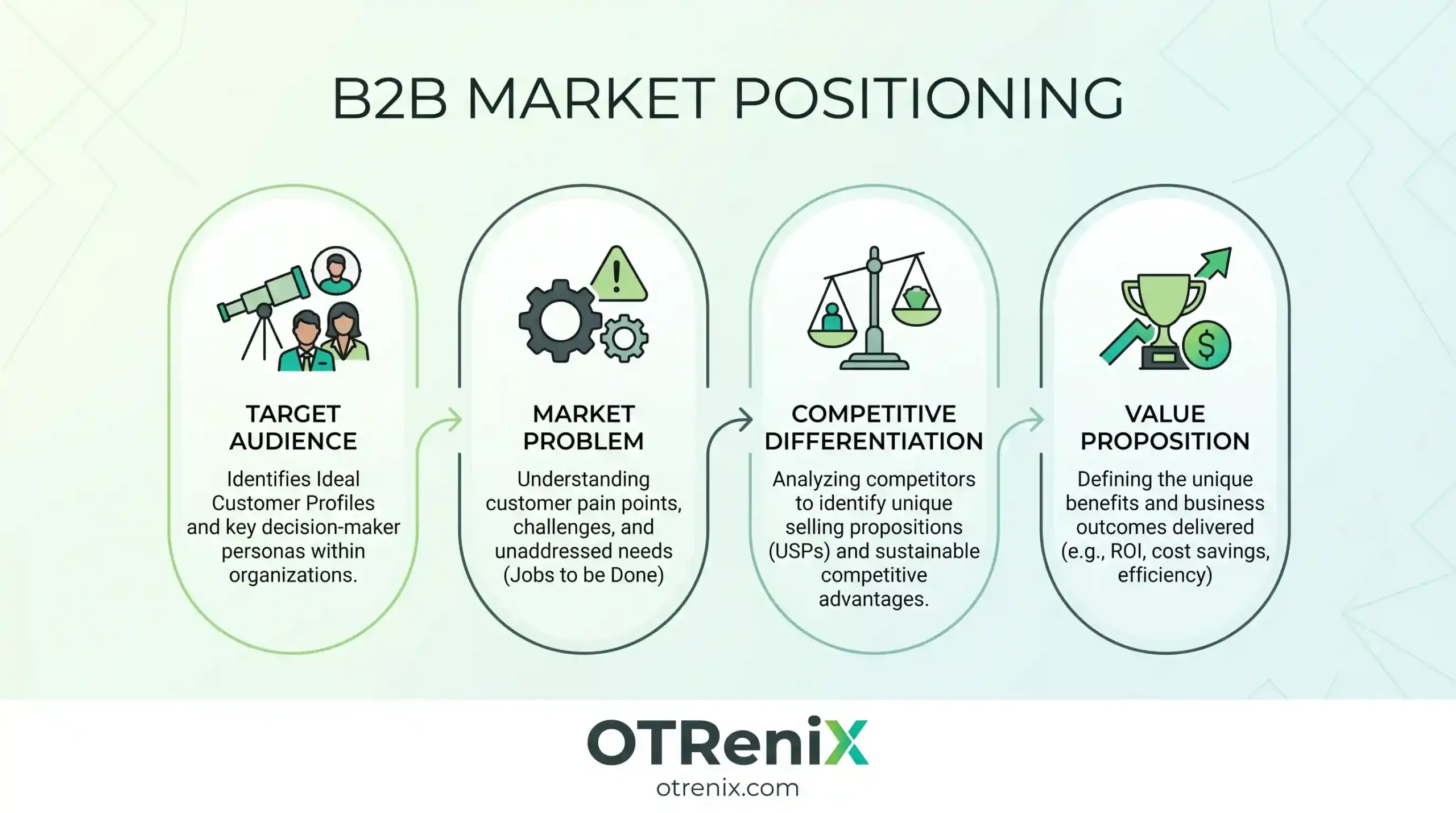
- Positioning is the answer to 4 questions: who is the customer, what is the alternative, what is unique about you, and what is the value to the customer.
- Strong positioning makes everything downstream easier: sales conversations, marketing campaigns, content, hiring, fundraising. Weak positioning leaks 30% to 50% of marketing investment.
- Positioning is not a tagline or a value proposition. Those are outputs. Positioning is the underlying strategic decision about which market segment you will win.
- The biggest positioning mistakes are being too broad, too feature focused, too similar to competitors, and never revisiting the positioning as the company grows.
- Repositioning is a 90 to 180 day project that touches messaging, sales enablement, website, and product marketing. Done right, it can double pipeline conversion within 6 months.
What Positioning Actually Is
Positioning is the strategic choice your company makes about how to be perceived in the market. It answers 4 questions.
| Question | Strong example | Weak example |
|---|---|---|
| Who is the customer? | “Mid market healthcare organizations with 1K to 10K endpoints needing HIPAA audit evidence in under 30 days” | “Companies that care about security” |
| What is the alternative? | “CrowdStrike, SentinelOne, and Microsoft Defender for Endpoint” | “Other security solutions” |
| What is unique about you? | “Pre built HIPAA audit packages, deployment in 2 weeks, healthcare specific threat detection” | “AI powered platform with industry leading detection” |
| What is the value? | “Pass HIPAA audits 60% faster, reduce compliance reporting time by 70%” | “Enterprise grade security and peace of mind” |
The right column is what most B2B companies write. It feels safe because it offends no one. It also wins no one. The left column makes choices. Choices create attraction with one segment and repulsion from others. That is the point.
Positioning is not a tagline
Many marketing teams confuse positioning with messaging. Messaging is what you say. Positioning is the strategic decision behind what you say.
A company with strong positioning can write 50 different taglines, and all of them will reflect the same underlying strategy. A company with weak positioning produces taglines that contradict each other from one campaign to the next, because there is no strategy underneath.
Positioning is not a value proposition
A value proposition describes the benefit of using your product. Positioning describes which market you are competing in and why you win there. The value proposition is downstream of positioning.
Two companies can have the same value proposition (“save time on compliance”) but completely different positioning. One sells to mid market healthcare. The other sells to enterprise financial services. The value prop sounds similar, but the marketing, sales, product, and pricing are entirely different.
Positioning is not branding
Branding is the visual and emotional expression of the company: logo, colors, voice, design system. Positioning is the strategic underpinning that branding expresses. Strong branding without positioning is decoration. Strong positioning without branding is invisible. Both are needed, in that order.
Why Positioning Matters More in 2026
Several forces have made positioning more important than it was 5 years ago.
Category saturation
In most B2B categories, the number of vendors has doubled or tripled since 2020. Cybersecurity has 3,500+ vendors. Marketing tech has over 14,000 tools. Sales tech, fintech, HR tech, dev tools all show similar density. When 50 companies compete for the same prospect, vague positioning becomes a death sentence.
Buying committees are fatigued
A typical B2B prospect now evaluates 4 to 7 vendors per category. Each evaluation takes hours. By the third demo, all the products start to blur together. The vendor with sharp positioning is the one the buyer remembers. The vendor with vague positioning is the one cut from the shortlist.
AI generated content has flooded the market
Most B2B content in 2026 is partially or fully AI generated. The result is a sea of plausible sounding sameness. Companies with distinctive positioning produce distinctive content that stands out. Companies with generic positioning produce generic content that disappears.
Sales cycles got longer
A B2B sales cycle that took 4 months in 2019 takes 8 to 12 months in 2026. Every additional touch costs the company time and money. Sharp positioning shortens cycles by helping the right prospects self select faster and the wrong prospects exit faster.
The 4 Most Common Positioning Mistakes
Even mature B2B companies fall into these patterns.
Mistake 1: Trying to serve everyone
The biggest positioning mistake is targeting “any company that needs X.” A founder who positions for everyone usually does this from fear: fear of leaving money on the table, fear of saying no to a deal, fear of narrowing the market.
The math works the other way. A company that sells to mid market healthcare with HIPAA pressure wins more healthcare deals than one that sells to “enterprise security buyers.” Specificity attracts. Generic repels.
Mistake 2: Positioning around features
“AI powered.” “Cloud native.” “End to end platform.” These are feature claims, not positioning. They describe what the product is, not why a specific customer should choose it over alternatives.
Feature positioning fails because every competitor has the same features. Real positioning is built on customer outcomes for a specific segment, not on the technology used to deliver them.
Mistake 3: Positioning that mirrors competitors
When 10 companies in a category use the same words (“modern,” “intelligent,” “next generation,” “platform”), prospects cannot tell them apart. Marketing teams often default to category language because it feels safe and familiar. The result is invisibility.
The best positioning often deliberately uses different language than competitors. If everyone says “platform,” call yourself a “system.” If everyone says “AI powered,” lead with the human expertise instead. Differentiation in words usually reflects differentiation in strategy.
Mistake 4: Setting positioning once and never updating it
Positioning is not a one time project. The company changes. The product changes. Customers change. Competitors change. Positioning that worked at $5M ARR is usually wrong by $20M ARR.
Most companies update positioning every 18 to 36 months at growth stage, more frequently when major events happen: a new product line, a new market, a competitive shift, an acquisition. Companies that never revisit positioning slowly drift into irrelevance.
How to Develop B2B Positioning
A working positioning project follows 5 stages over 60 to 90 days.
Stage 1: Customer interviews
Talk to 15 to 25 customers and prospects. Mix won customers, lost prospects, churned customers, and target accounts. The conversations are open ended, not surveys. The questions cover:
- What was happening in your business that triggered the search for a solution?
- What alternatives did you consider?
- What made you choose us, or what made you choose someone else?
- What words did you use internally to describe the problem and the solution?
The output is a record of how customers actually talk about the category, not how the marketing team thinks they talk. Most positioning projects fail when this step is skipped or done with 3 friendly customers instead of 15 to 25 mixed ones.
Stage 2: Competitive analysis
Map the top 5 to 10 competitors on 4 dimensions:
- Who do they target?
- What do they claim as their unique value?
- What words do they use?
- Where are they weak?
The goal is finding the gap. Where is there real customer pain that no competitor is addressing well? That gap is your positioning opportunity.
Stage 3: Define the segment
Choose 1 specific customer segment to win. Not 5 segments. Not “primary and secondary.” One. The segment should be defined precisely enough that you can list 200 named target accounts that match it.
Examples of strong segment definitions:
- Mid market healthcare organizations with 1K to 10K endpoints in the US
- Series B and C SaaS companies with 50 to 200 employees building dev tools
- European retail banks with $5B to $50B in assets undergoing digital transformation
The narrower the segment, the stronger the positioning. Companies often expand the segment later, but they should win 1 first.
Stage 4: Define the unique value
For the chosen segment, identify what you do that no realistic alternative does as well. This is not a feature list. It is the customer outcome that matters most to that segment, delivered in a way only you can deliver.
The test is: if a competitor read your positioning, could they say it about themselves? If yes, the positioning is too generic. If no, you have something distinctive.
Stage 5: Pressure test before rolling out
Before changing the website and rebuilding sales decks, test the new positioning in 5 ways:
- Run it past 5 customers. Do they recognize themselves and the problem?
- Run it past 5 prospects in active sales cycles. Does it resonate or fall flat?
- Run it past sales reps. Can they use it in a real call?
- Run it past 3 industry analysts. Do they understand the market choice?
- Run it past internal teams. Does it create energy or confusion?
If 4 of 5 groups respond well, roll it out. If 2 of 5 push back, revise before going further.
The Positioning Document
The output of a positioning project is a written document, usually 5 to 10 pages, that becomes the source of truth for everything downstream. The document includes:
| Section | What it contains |
|---|---|
| Target segment | Specific customer profile, named target accounts, segment size |
| Customer problem | Top 3 pains the segment faces, in their own words |
| Alternatives considered | Specific competitors and substitutes, including “do nothing” |
| Unique value | What you uniquely deliver that alternatives do not |
| Proof points | Customer evidence, data, and stories that support the unique value |
| Messaging framework | Headline, sub headlines, key talking points, words to use, words to avoid |
| Competitive narrative | How to position against each major competitor |
| Use cases | 3 to 5 specific scenarios where you win, with named customer examples |
This document feeds the website, sales deck, ads, content calendar, product marketing assets, hiring messaging, and investor pitch. Every team uses the same source. When the document changes, the downstream assets update.
Companies that skip the document usually end up with conflicting messages across teams. The website says one thing. Sales says another. Product marketing has its own version. Content marketing writes a fourth angle. The result is exactly the vague positioning the project was supposed to fix.
How to Position Against Bigger Competitors
The hardest positioning challenge is competing against giants. Most B2B markets have a clear leader (Salesforce, Microsoft, Palo Alto, Stripe) and a set of smaller players. Smaller companies usually win when they pick a fight on a specific dimension where the giant cannot follow.
The 4 dimensions of differentiation against giants
| Dimension | The play | Example |
|---|---|---|
| Customer segment | Win a specific segment the giant treats as one of many | “Built for mid market healthcare” vs “enterprise platform” |
| Use case depth | Solve 1 problem dramatically better than the broad platform | “Best in class incident response” vs “complete security platform” |
| Speed and simplicity | Faster deployment, less complexity, less services overhead | “Deploy in 2 weeks” vs “12 month implementation” |
| Service model | More personal support, more consulting, more partnership | “Dedicated CISO advisor” vs “tier 3 support tickets” |
Trying to compete head on with a $50B company on every dimension is suicide. Picking 1 dimension where you can be 10x better is how challengers grow.
What does not work
- “Cheaper than [giant].” Price as the only differentiator is a race to the bottom. Customers who buy on price churn on price.
- “Easier to use than [giant].” Probably true but every competitor says this. Not a differentiator.
- “More flexible than [giant].” Vague and hard to prove. Means nothing in a sales conversation.
- “Better support than [giant].” True but only meaningful when paired with a specific service model.
The challenger plays that work tend to be: I am the best for this specific segment, with this specific use case depth, deployed in this specific way, with this specific service model.
Repositioning: When and How
Repositioning is the process of changing the strategic positioning of an established company. It is more disruptive than initial positioning because there is existing momentum to redirect. Common triggers:
Triggers for repositioning
- Win rates dropping below 25% in core deals
- Sales cycle lengthening by 30% or more year over year
- Multiple competitors entering with similar messaging
- A major product expansion or acquisition
- Entering a new geographic or vertical market
- A category itself is shifting (zero trust, AI native, platform consolidation)
The repositioning timeline
A serious repositioning takes 4 to 6 months from kickoff to full rollout.
| Month | Activity |
|---|---|
| Month 1 | Customer interviews, competitive analysis, internal alignment |
| Month 2 | Segment selection, value definition, draft positioning document |
| Month 3 | Pressure testing with customers, prospects, analysts, sales |
| Month 4 | Messaging framework, sales enablement, content audit |
| Month 5 | Website rebuild, deck refresh, campaign launch |
| Month 6 | Measure results, refine, train teams |
Companies that try to compress this into 30 days produce shallow positioning that does not stick. Companies that stretch it past 6 months lose momentum and the work fails.
Internal alignment is the hardest part
The CEO must own positioning. If the CEO does not align on the strategic choice, the rest of the company will not either. Most failed positioning projects fail not on the strategy but on the alignment.
Sales leaders and product leaders need to be in the room from week 1. Bringing them in at month 4 to “approve” the positioning produces resistance. Bringing them in at week 1 to co create produces ownership.
Measuring Whether Positioning Is Working
Strong positioning produces measurable improvement across 6 metrics within 6 months.
| Metric | What good looks like |
|---|---|
| Win rate | Increases by 15% to 40% in target segment |
| Sales cycle length | Decreases by 20% to 40% in target segment |
| Average deal size | Increases by 20% to 50% in target segment |
| Inbound lead quality | More leads from target segment, fewer from outside it |
| Sales rep ramp time | New reps productive in 60% of original time |
| Marketing efficiency | Cost per qualified opportunity drops by 25% to 40% |
The metrics do not move evenly. Sales cycle length usually shifts first, in months 2 to 4. Win rate follows in months 3 to 6. Deal size and ramp time take 6 to 12 months to fully reflect the change.
Leading indicators
In the first 90 days after a repositioning launch, watch leading indicators that predict the outcome metrics:
- Sales rep confidence in the new pitch (survey monthly)
- Customer reference quotes that mirror the new positioning
- Prospect language in discovery calls (do they use your new words back to you?)
- Analyst recognition of the positioning shift
- Inbound lead language and source mix
If these indicators move in the right direction in months 1 to 3, the outcome metrics will follow in months 4 to 6.
How Positioning Connects to Product
Positioning is not just a marketing exercise. The strongest B2B companies use positioning to drive product strategy.
When you position for a specific segment, the product roadmap follows. Features that serve the segment become priorities. Features that serve adjacent segments get deprioritized. The product becomes sharper for the chosen customer, which strengthens the positioning further.
Companies that try to keep an “anyone can use it” product while positioning for a specific segment end up with positioning that the product cannot deliver. Customers buy the positioning, then discover the product is not actually built for them, and churn.
The opposite mistake is also common. Companies build deeply for one segment, then position broadly to “anyone in the market.” They underdeliver on the broad promise and miss the chance to win the specific segment they could actually own.
Recommendation
If you run B2B marketing or are a founder at a company between $1M and $50M ARR in 2026, positioning is the highest leverage strategic project you can take on this quarter. Strong positioning makes every other marketing activity work better. Weak positioning makes every other activity less effective.
Start by testing the current positioning. Ask 10 customers and 10 prospects to describe what your company does and who it is for. If the answers cluster tightly, your positioning is working. If the answers vary wildly, the positioning is broken or absent.
For early stage companies, do the initial positioning project before scaling marketing spend. Spending $500K a year on demand generation with weak positioning is more expensive than spending $50K on a positioning project first and then deploying the demand generation budget against a clear strategy.
For growth stage companies, audit the positioning every 18 months. The market moves faster than most leadership teams realize. Positioning that worked 2 years ago is rarely the right positioning today.
For enterprise stage companies, treat positioning as a permanent strategic function. Most companies above $50M ARR have a head of product marketing whose primary job is owning and evolving positioning across product lines and segments.
Whatever stage you are at, the principles are the same. Pick a specific segment to win. Choose 1 dimension of differentiation. Write it down in a document the whole company can use. Test it with real customers and prospects before rolling it out. Measure win rate, cycle length, and deal size 6 months later.
Positioning is not glamorous work. It does not produce a launch event or a viral campaign. It produces something more valuable: a company where every customer interaction, every piece of content, and every sales call reinforces the same clear message. That clarity is what wins markets in 2026, not bigger budgets or louder ads. Get the positioning right, and everything else gets easier.