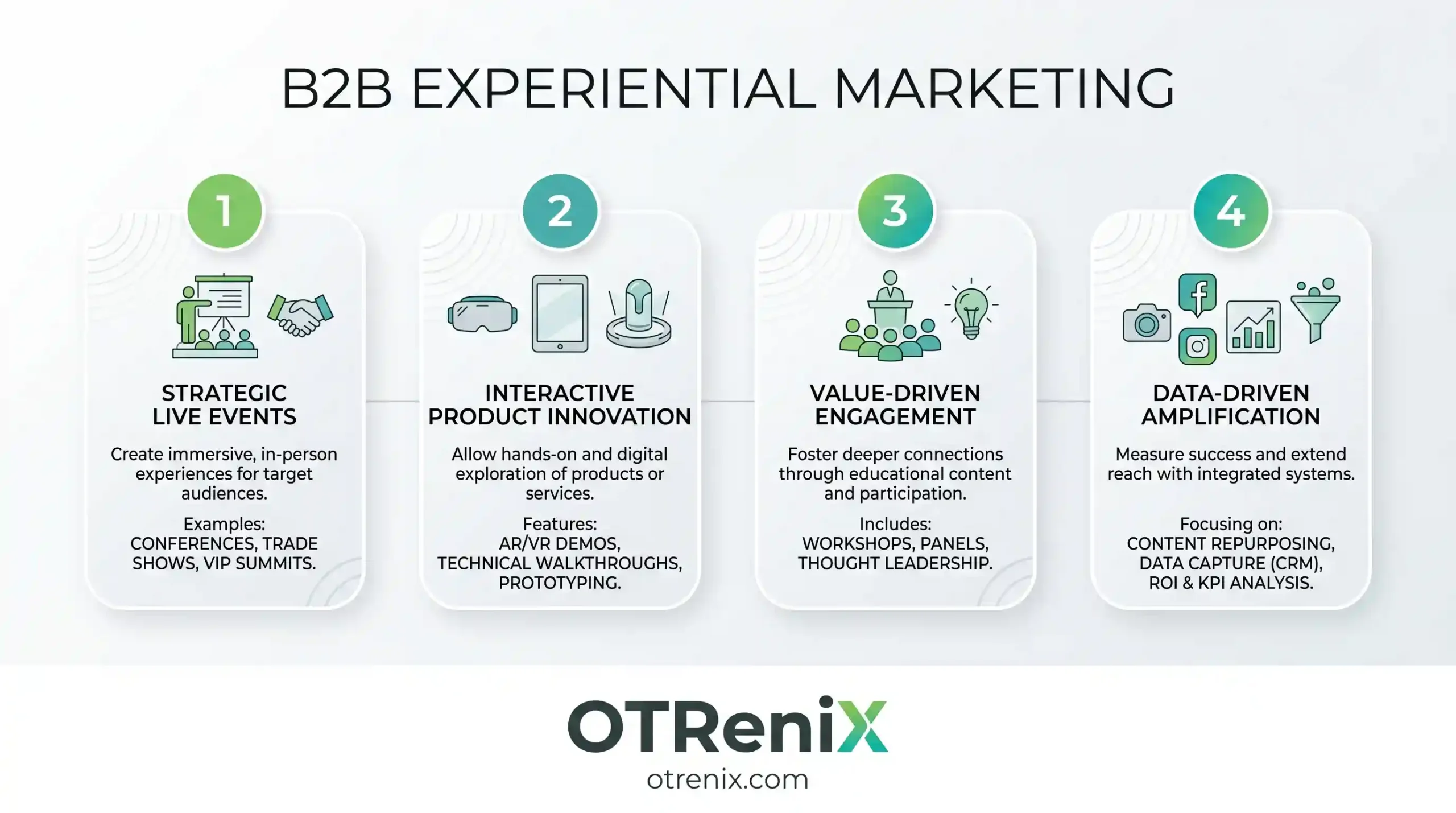
B2B Experiential Marketing

A CISO at a $2B financial services firm gets 200 emails a week from cybersecurity vendors. She ignores most of them. Her LinkedIn DMs are full of unread sales pitches. Her calendar already has 4 demos this week, none of which she scheduled herself.
But she will fly to Las Vegas for Black Hat. She will sit through a 2 hour CISO dinner if the conversation is good. She will spend a Saturday morning at a private threat intelligence briefing if the people in the room are interesting. Why? Because real conversations with peers and experts are now the highest signal way to evaluate vendors and ideas.
This is the bet behind B2B experiential marketing. When digital channels are saturated and email open rates drop every quarter, the brands that win are the ones that create real moments where prospects, customers, and partners come together. Not booth swag and lanyards. Real experiences with real people that move buying decisions.
Most B2B companies do this badly. They sponsor an RSA Conference booth for $200K, send 4 reps, collect 80 business cards, and call it a marketing investment. Six months later the pipeline from that event is impossible to track and probably non existent. The same money spent on 5 small private dinners would have produced 25 real conversations with target accounts, 5 of which would close within 12 months.
This article covers what B2B experiential marketing actually is in 2026, why it works when other channels are losing effectiveness, how to plan and budget for it, and how to measure ROI in a way that holds up to a CFO review.
Key Takeaways
- B2B experiential marketing is the discipline of creating in person and hybrid experiences that build relationships with target accounts, customers, and partners. It includes events, dinners, briefings, summits, and field marketing.
- The right experiential program produces 3x to 10x the pipeline per dollar of a traditional booth presence, but only when targeted to specific accounts and run with discipline.
- Realistic budgets in 2026 range from $50K a year for early stage field programs to $5M+ for enterprise event operations. Most growth stage B2B companies should plan for $300K to $1.5M a year.
- The best experiences are small, curated, and useful. Private dinners with 12 CISOs beat conference booths with 5,000 visitors.
- Measuring experiential is hard but possible. Pipeline sourced and influenced by event attendance, not lead counts, is the metric that matters.
What B2B Experiential Marketing Actually Is
The term covers a wide range of formats. The common thread is bringing target customers, prospects, and partners into a real experience that they remember.
Owned events
Conferences, user summits, and customer days that your company runs. Dreamforce is the famous example, but most companies run smaller versions. A 200 person customer summit, a 30 person executive briefing day, an annual user conference. The format puts you in control of the agenda, the attendees, and the experience.
Sponsored events
Booths, sponsorships, and speaking slots at industry events. RSA Conference, Black Hat, Gartner Symposium, Money 20/20, and hundreds of smaller events fit here. The model is older but still produces results when run well.
Field marketing
Smaller, regional, or vertical specific activities. Private dinners, breakfast briefings, executive roundtables, regional user groups. These are usually 10 to 50 people, often co hosted with a partner, and tightly focused on a specific buying segment.
Hybrid experiences
Programs that combine in person and digital. A live conference broadcast to a virtual audience. An in person executive panel that becomes a podcast and webinar series. A roadshow that runs in 5 cities physically and reaches 5,000 people online.
Experiential activations
Branded experiences designed to create memorable moments. A pop up at a major event. An interactive demo at a customer location. A launch event tied to a product release. The goal is brand presence and storytelling, not direct lead capture.
Why Experiential Works in B2B
Several forces have made experiential marketing more important in 2026 than it was 5 years ago.
Digital saturation
Email open rates in B2B have dropped from 21% in 2019 to under 12% in 2026. LinkedIn InMail response rates have fallen from 8% to 2%. Cold call connect rates are below 5%. Every digital channel is more crowded and less effective than it used to be.
In person and curated experiences cut through this noise. A CISO who ignores 200 cold emails will read a personalized invitation to a small dinner with peers. The signal is higher because the effort is higher.
AI flooding the market
Generative AI made it cheap to produce mass personalized outreach. The result is a massive increase in volume and a collapse in trust. Prospects assume any digital outreach is AI generated until proven otherwise. Real human interaction has become the trust layer that digital used to be.
The buying committee got bigger
A typical B2B purchase in 2026 involves 6 to 10 stakeholders, up from 4 to 6 a decade ago. Reaching all of them through digital channels is impossible. Bringing them into a single room or event makes alignment dramatically easier.
Customers are harder to reach
Senior buyers like CISOs, CTOs, and VPs of Engineering are increasingly inaccessible by digital means. Their inboxes are filtered. Their LinkedIn is locked down. Their calendars are guarded. The only reliable channel left is the experience they choose to attend, where they show up because something is genuinely interesting.
Where Experiential Fits in the Marketing Mix
Experiential is not a replacement for digital marketing. It is the closing layer on top of it. Different formats serve different funnel stages and goals.
| Funnel stage | Format | Audience size | Primary goal |
|---|---|---|---|
| Top of funnel | Speaking slots, conference sponsorships | 1,000+ | Category awareness, brand recognition |
| Middle of funnel | Executive briefings, demo days | 20 to 40 | Educate buying committees, qualify intent |
| Bottom of funnel | Private dinners, 1:1 briefings | 10 to 16 | Move active opportunities to close |
| Customer expansion | User summits, advisory boards | 50 to 500 | Deepen relationships, drive upsell |
| Partner enablement | Channel events, joint customer days | 30 to 200 | Build ecosystem, joint pipeline |
The mistake most companies make is using one experiential format for all goals. A booth at a major conference does not build close relationships with target accounts. A private dinner does not generate broad awareness. Match the format to the goal.
How to Plan a B2B Experiential Program
A working experiential program is built in 5 stages.
Stage 1: Define the goals
The first job is naming the specific business outcome each experience will deliver. Vague goals like “build awareness” or “generate leads” produce vague programs. Specific goals look like:
- 50 meetings with target accounts at RSA Conference, leading to 10 sales qualified opportunities within 90 days
- 30 customer expansion conversations at the user summit, leading to 5 expansion deals within 6 months
- 15 partner introductions through channel events, leading to 5 active resellers within 12 months
If the goal cannot be written as a specific number tied to pipeline, the program will produce vague results.
Stage 2: Identify the target audience
Experiential is most effective when tightly targeted. A list of 200 named accounts you want in the room is more useful than a goal of “fill 200 seats.” Use intent data, sales account lists, customer expansion targets, and partner pipelines to build the invite list before the event.
The best programs invest 60% to 80% of total time on getting the right people in the room. Logistics, venue, and program design are easier than recruiting the right audience.
Stage 3: Design the experience
The format should match the goal. The table below shows the typical economics of each format in B2B in 2026.
| Format | Attendees | Cost per event | Cost per attendee | Best for |
|---|---|---|---|---|
| Private dinner | 10 to 16 | $8K to $15K | $500 to $1,000 | Bottom of funnel, target accounts |
| Executive breakfast | 15 to 25 | $4K to $8K | $200 to $400 | Regional pipeline, vertical focus |
| Executive briefing | 20 to 40 | $20K to $50K | $800 to $1,500 | Buying committee education |
| Customer summit | 100 to 500 | $300K to $1.2M | $2K to $4K | Expansion, retention |
| Conference sponsorship | 5,000+ | $150K to $500K | $30 to $100 | Brand awareness, broad reach |
| Field roadshow (5 cities) | 200 to 400 | $200K to $400K | $700 to $1,500 | Regional development |
| Partner summit | 50 to 200 | $80K to $250K | $1K to $2K | Channel growth |
Cost per attendee tells only part of the story. A $50 cost per attendee at a conference booth is misleading if 95% of attendees are not target accounts. A $1,000 cost per attendee at a dinner is a bargain if all 12 are senior buyers from target accounts.
Stage 4: Plan the follow up
Most B2B experiential programs fail at follow up, not at the event itself. A great dinner with no follow up plan produces less pipeline than a mediocre dinner with rigorous follow up.
The minimum follow up structure includes: personalized outreach within 48 hours, content delivery tied to discussion topics within a week, sales handoff with full context within 2 weeks, and pipeline tracking by attendee for 6 to 12 months.
Sales teams need to be in the planning conversation before the event, not handed a list afterward. The reps who attend the dinner should be the ones who follow up.
Stage 5: Set the measurement framework
Decide before the event how you will measure success. Standard metrics include attendees from target accounts, meetings booked from event, pipeline sourced within 90 days, and pipeline influenced within 12 months.
Capture data at every stage: registration source, attendance, conversations had, follow up completed, opportunities created. Without this data the CFO conversation 6 months later is impossible.
Budgeting for B2B Experiential
Realistic budgets in 2026 break down by stage and goal.
| Company stage | Annual budget | Mix | Expected pipeline contribution |
|---|---|---|---|
| Early ($1M to $5M ARR) | $50K to $150K | 8 dinners, selective conference attendance, 2 partner events | 10% to 20% of marketing pipeline |
| Growth ($5M to $25M ARR) | $300K to $1.5M | 1 major event, 4 to 6 mid size events, 15 to 25 dinners, 1 customer summit | 20% to 40% |
| Enterprise ($25M+ ARR) | $2M to $8M+ | 2 to 4 major events, flagship customer summit, regional field marketing, partner programs | 25% to 50% |
The mix matters more than the total. A $1M experiential budget split across 1 booth and 30 dinners produces dramatically different results than the same $1M on 1 massive activation. Pipeline contribution is the right test.
Where the money goes
A balanced experiential budget at the growth stage typically splits like this: 35% to 45% on event production and venue costs, 15% to 25% on travel and team time, 15% to 20% on content and program design, 10% to 15% on technology and tracking, and 5% to 10% on agency or partner support.
Programs that put 70% of budget into venue and production usually overinvest in the visible parts and underinvest in audience recruitment and follow up, which is where the real value lives.
What Most B2B Experiential Programs Get Wrong
Even well funded programs repeat the same mistakes.
Booth sized thinking at the wrong stage
A $200K booth at RSA Conference produces a few hundred badge scans, most of which are not target accounts. The same money split across 8 private dinners produces 100 conversations with named target accounts and usually 5x to 10x the pipeline. Most companies spend on booths because everyone else does, not because the math works.
Treating events as standalone
Events that are not part of a connected program produce one off pipeline that is hard to scale. The companies that win run experiential as a year round system: pre event outreach, event execution, post event nurture, repeat. A single great event with no system around it leaks 70% of its potential value.
No sales alignment
When marketing plans events without sales involvement, the wrong people get invited, the agenda misses real buyer concerns, and follow up fails. The fix is involving sales leadership in event planning from day 1, including the rep who will follow up.
Measuring on attendance instead of pipeline
A successful event is not one with 500 attendees. It is one with 30 attendees from target accounts who become 8 sales conversations and 3 closed deals. Headcount metrics flatter the marketing team but do not reflect business outcomes.
Ignoring the 90 day follow up window
Most B2B opportunities sourced from events take 60 to 180 days to convert. Programs that report results 30 days after the event miss most of the actual pipeline. Reports should run at 30, 90, and 180 days, with the 180 day number being the most accurate picture of value.
Confusing brand awareness with pipeline
Some experiential investments are pure brand plays: speaking at a major conference, sponsoring an industry award, hosting a thought leadership podcast at an event. These have value but should not be measured on pipeline. Mixing them with pipeline focused activities confuses the budget conversation.
How to Measure B2B Experiential ROI
The CFO will ask for ROI. Here is how to give an honest answer.
Pipeline sourced from event
Direct opportunities created from event attendees within 90 to 180 days. Tagged in the CRM with the event as the source. This is the cleanest number but understates total value.
Pipeline influenced by event
Opportunities where event attendance was a meaningful touchpoint, even if not the source. Usually 2x to 4x larger than sourced pipeline. Captured through multi touch attribution and self reported attribution on opportunity records.
Cost per qualified meeting
Total event cost divided by sales qualified meetings produced. The benchmarks below are from B2B technology programs running in 2026.
| Format | Cost per qualified meeting |
|---|---|
| Private dinner | $1,500 to $3,000 |
| Executive breakfast | $1,000 to $2,500 |
| Field roadshow stop | $2,500 to $5,000 |
| Customer summit | $3,000 to $6,000 |
| Conference booth (major event) | $5,000 to $15,000 |
The comparison alone changes most budget conversations. A program built around dinners and field events almost always outperforms one built around major sponsorships on a cost per qualified meeting basis.
Customer expansion attributable to events
For customer focused events like user summits, track expansion revenue from attendees over the following 12 months and compare against non attendees. Attendees usually expand 30% to 80% more than matched non attendees, which is the real value of customer events.
Partner and channel pipeline
For partner events, track partner sourced pipeline created in the 6 to 12 months following the event. New partners onboarded, joint accounts created, and co sell deals are all measurable.
What to ignore
Total attendees, social media impressions during the event, booth scans, and “leads collected” are vanity metrics in B2B. They flatter the program but do not predict pipeline.
How to Run Smaller Experiential Programs Well
Most B2B companies under $25M ARR cannot afford a flagship event or major sponsorship. The good news: smaller experiences usually produce better ROI when run with discipline.
The CISO dinner playbook
Cost: $8K to $15K per dinner. Attendees: 10 to 14 senior buyers from target accounts. Format: private dining room, no slides, no pitch, 90 minutes of facilitated conversation on a topic that matters to them.
The host is usually a senior executive from your company plus a respected industry guest (a CISO from a customer, an analyst, an author). Sales reps are present but as participants, not pitchers. Follow up within 48 hours with a personal note from the host.
A program of 12 dinners a year, well executed, produces 120 to 150 senior conversations and 20 to 35 sales qualified opportunities. Total investment: $120K to $180K. ROI usually exceeds any other channel at this stage.
The executive breakfast briefing
Cost: $4K to $8K per breakfast. Attendees: 15 to 25 prospects and customers. Format: 90 minutes including a breakfast, a 25 minute expert led briefing on a current industry topic, and 35 minutes of facilitated discussion.
This works particularly well in regional markets and verticals. Co host with a customer or partner to expand the audience and credibility.
The customer advisory board
Cost: $30K to $80K per session, run 2 to 4 times a year. Attendees: 8 to 16 senior customers. Format: half day or full day session with structured feedback on product, roadmap, and market trends.
The business value is dual. Customers feel heard and become stronger references. Marketing and product gain insights that improve everything else. Many companies attribute their highest expansion deals to advisory board members.
The intimate launch event
Cost: $25K to $75K. Attendees: 30 to 60 customers, prospects, analysts, and press. Format: 3 to 4 hours including product demo, customer panel, and networking.
Better than a press release for major launches. The combination of customer voices, hands on demos, and analyst presence creates stories that travel.
Recommendation
If you run B2B marketing for a company between $1M and $50M ARR in 2026, your experiential program should be the highest leverage channel in your mix. Digital channels keep losing effectiveness. Real experiences keep gaining importance. The companies that win in B2B over the next 5 years will be the ones that learn to do experiential at scale, not the ones with the biggest ad budgets.
Start by defining 1 specific business goal for the next 12 months. Pipeline from target accounts, expansion from existing customers, partner ecosystem growth, or category awareness. Build the program around that goal, not around copying what competitors do.
For early stage companies, focus on field marketing. 8 to 12 small dinners and breakfasts a year with target accounts. Skip the major event sponsorships until you have product market fit and the pipeline to justify the spend.
For growth stage companies, build a balanced program. Mix major event presence with consistent field marketing and at least 1 customer event a year. Aim for 25% to 35% of marketing sourced pipeline coming from experiential within 18 months of starting.
For enterprise companies, treat experiential as a major operations function. Dedicated team, sophisticated tracking, integration with sales and customer success, regular ROI reporting at the executive level.
Whatever stage you are at, the rules are the same. Quality beats quantity. Follow up beats activation. Sales alignment beats marketing autonomy. 180 day measurement beats 30 day reporting. Real experiences with the right people produce more pipeline than any other channel available to B2B companies in 2026.
The CISO who ignores your emails will come to your dinner if the conversation is good. The CFO who blocks your demo will fly to your customer summit if their peers are there. The CTO who never opens cold outreach will speak on your panel if the topic is interesting. Build experiences worth showing up for, and the pipeline follows