B2B Outbound Marketing Guide
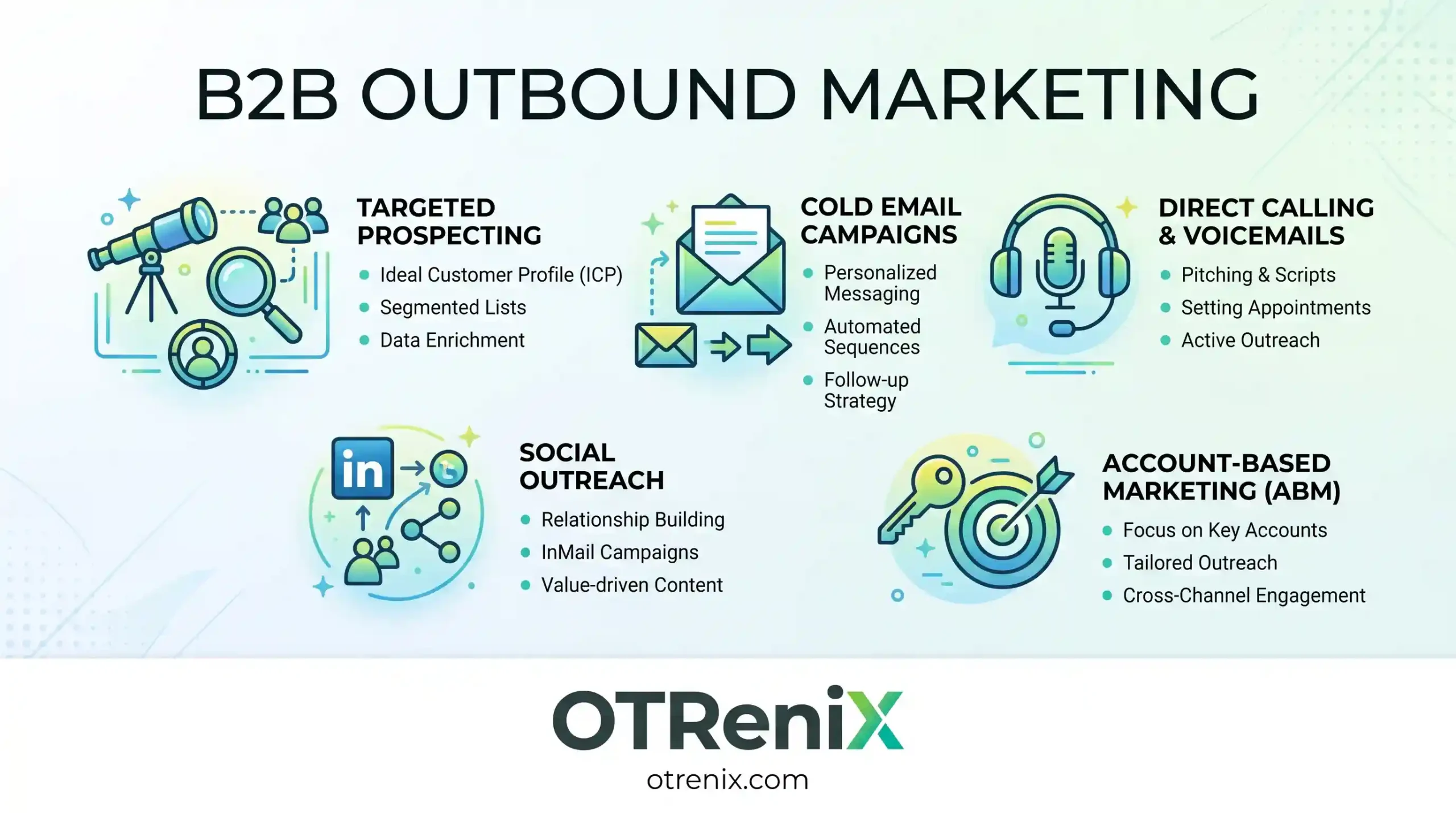

Most B2B companies talk about outbound the same way. They send 500 cold emails a week, get 5 replies, book 1 meeting, and call it a working program. Then they wonder why pipeline keeps shrinking even as they hire more SDRs.
The problem is not that outbound is dead. It is that the playbook from 2018 stopped working in 2023. Email deliverability collapsed under the weight of automated tools. LinkedIn became saturated. Buyers learned to ignore generic personalization. And the few companies that figured out modern outbound built 5x to 10x advantages over competitors still running old plays.
A working outbound program in 2026 is a different system. It uses tighter targeting, smaller list volumes, real research, multichannel sequences, and tight integration between SDRs, marketing, and sales. Done right, it produces 10% to 25% reply rates and meeting conversion rates that justify the cost. Done wrong, it burns budget, damages domain reputation, and trains your prospects to ignore you forever.
This guide covers what works in B2B outbound today: targeting, channels, sequences, copy, technology, metrics, and how to build a program from scratch or fix one that has stopped producing.
Key Takeaways
- Modern B2B outbound is multichannel, low volume, and high research. The “send 1,000 emails a day” playbook is dead in most categories.
- Reply rates under 5% mean the targeting, the message, or both are broken. Strong programs hit 10% to 25% reply rates.
- Email deliverability is now a separate discipline. Without proper domain setup, warmup, and list hygiene, even good copy lands in spam.
- The right channel mix is email, LinkedIn, phone, and sometimes physical mail or video. Single channel outbound underperforms by 50% or more.
- Outbound only works when sales and marketing run the same motion. Misaligned teams produce expensive noise instead of pipeline.
- Expect 3 to 6 months to build a working program. Companies that demand instant results force the team into shortcuts that destroy long term performance.
What B2B Outbound Actually Is
Outbound is any motion where the seller initiates contact with a prospect who did not raise their hand first. This includes cold email, cold calling, LinkedIn outreach, direct mail, paid ABM ads targeted at named accounts, and personalized video messages.
Outbound is not the same as inbound. Inbound captures demand that already exists. Outbound creates conversations with prospects who have not started a buying process yet. Both matter, and most B2B companies need both, but they require different teams, different metrics, and different timelines.
Outbound also is not the same as broad cold prospecting. Modern outbound is precise. You pick 200 to 1,000 named accounts, research them, design messages that fit their context, and run multichannel sequences over 4 to 8 weeks. Anything broader than that is spam, regardless of what the tools call it.
When outbound works
Outbound is the right motion in 5 specific situations:
- Your ICP is identifiable and finite. You can list the 500 or 5,000 companies that fit. Broad horizontal categories where the ICP is fuzzy do not work.
- Your ACV justifies the cost. Outbound costs $200 to $800 per qualified meeting. If your annual contract value is under $5K, the math usually does not work.
- Your category has urgency or compliance drivers. Customers who have a deadline or a forced renewal cycle respond better than those who do not.
- You are entering a new market or segment. Outbound builds awareness in places where you have no inbound presence yet.
- Your competitors are slow. Markets where the incumbents have weak sales motions reward fast moving outbound teams.
When outbound does not work
Skip outbound if any of these apply:
- Pre product market fit. You will burn budget validating something that does not work yet.
- ACVs under $3K to $5K with no path to expansion. The unit economics break.
- Highly relationship driven categories where introductions and warm referrals are the only respected motion.
- Markets where your prospect base is small enough that you can simply call every one of them by name. Then you do not need outbound, you need direct sales.
The 5 Components of a Working Outbound Program
Strong outbound programs share the same structure. Weak programs are missing 1 or 2 of these components, which is why they fail.
1. Targeting and list quality
Most outbound programs fail at the list, not the message. If your list is wrong, no copy can save it. If your list is right, even average copy produces meetings.
A good list has 3 attributes:
- Tight ICP fit. Industry, company size, technology stack, growth stage, and any other variable that defines your real customer. Skip companies that fit only 2 of 5 criteria.
- Right buyer titles. The actual decision maker, not their assistant or their direct report. For most B2B, this means VP, Director, or Head of [function].
- Trigger or signal. Something that makes this account relevant right now: funding round, leadership change, technology adoption, hiring pattern, public news.
Lists built without all 3 produce 1% to 3% reply rates. Lists with all 3 produce 10% to 25%.
2. Multichannel sequence design
Single channel outbound underperforms multichannel by 50% to 100%. Buyers ignore individual channels constantly: emails go to spam, LinkedIn DMs get missed, phones go to voicemail. Touching the same person across channels increases the chance one of those touches lands.
A modern sequence runs 8 to 12 touches across 4 to 6 weeks. The mix usually includes:
- 4 to 6 emails
- 2 to 3 LinkedIn touches (view, follow, message)
- 2 to 4 phone calls
- 1 video or voice note
- Occasionally direct mail for high value accounts
Each touch builds on the last. A reply to one channel pauses the rest of the sequence so the prospect does not get spammed.
3. Message quality
Generic outreach is dead. Buyers have seen 10,000 versions of “I noticed your team is hiring SDRs” and “Quick question about your tech stack.” These templates produce reply rates under 1%.
Strong outbound messages do 4 things:
- Reference something specific. A real signal from the company, a recent post by the prospect, a piece of news. Tools that auto generate “personalization” from public data usually fail because the references are obvious automation.
- Lead with the prospect’s problem, not your product. “We noticed companies like yours often deal with X” beats “We sell Y.”
- Make a small ask. A 15 minute call, a written question, an opinion on a piece of content. Big asks (“hop on a 30 minute demo”) get ignored.
- Stay short. Under 75 words for most cold emails. Long emails read as automation.
4. Deliverability and infrastructure
Email deliverability is now a full time concern. A program with great copy and great targeting still fails if 60% of emails land in spam.
The basics:
- Use dedicated sending domains. Never send cold email from your primary corporate domain. Use lookalike domains and warm them up for at least 4 weeks before scaling.
- Configure SPF, DKIM, and DMARC properly. Misconfigured authentication kills deliverability before content matters.
- Limit volume per inbox. Most experts recommend 30 to 50 cold emails per inbox per day. Scale by adding inboxes, not by sending more from each.
- Monitor reply and bounce rates. Sudden drops mean deliverability is degrading and the program needs intervention before it gets worse.
5. SDR to AE handoff
Outbound generates meetings. Meetings convert to opportunities. Opportunities close to revenue. The handoffs between these stages are where most pipeline leaks.
A working handoff includes:
- A single source of truth in the CRM with the full conversation history, signals, and prospect research.
- A prep call between SDR and AE before every first meeting.
- Clear ownership of next steps after the meeting.
- Feedback loops where AEs tell SDRs which meetings were good and which were not, with specifics.
Programs without these run 30% to 50% lower opportunity conversion than programs with them.
Channel by Channel Breakdown
Each channel has different mechanics, response rates, and use cases. Treating all channels the same is one of the most common outbound mistakes.
Cold email
Email is still the workhorse of B2B outbound. Used well, it scales, reaches buyers in their natural environment, and produces measurable response data. Used badly, it floods inboxes and trains buyers to ignore your domain forever.
Strong cold email programs hit 10% to 20% open rates and 2% to 8% reply rates. Programs below those numbers usually have targeting or deliverability problems, not copy problems.
LinkedIn outreach
LinkedIn is the second core channel. Reply rates here usually beat email, often 15% to 30% on connection requests with a message and 8% to 15% on direct messages.
The tradeoffs are volume and platform risk. LinkedIn limits how many messages and connection requests you can send per week (around 100 to 200), and aggressive automation gets accounts banned. Manual or semi automated outreach is the only sustainable approach.
LinkedIn works especially well as a follow up channel. Prospects who ignored email often respond to LinkedIn because the platform feels less spammy.
Cold calling
Cold calling is harder than ever, mostly because mobile carriers flag unknown numbers and many buyers screen all calls. Pickup rates of 5% to 10% are normal in 2026, down from 25% to 40% a decade ago.
But cold calling still works in specific scenarios. SMB and mid market often pick up. Industries like manufacturing, logistics, and field services answer the phone more than tech does. And calls that follow up on email or LinkedIn touches convert at much higher rates than cold calls into accounts that have never heard of you.
Modern cold calling is a follow up channel for most B2B, not a primary channel. Use it after email and LinkedIn, not before.
Direct mail and physical outreach
Direct mail is a niche channel but produces strong results in specific cases: high ACV enterprise sales, executive level outreach, and accounts that have ignored every digital touch.
A $50 box with a personalized note and a useful item produces meeting rates of 30% to 50% in well targeted programs. The economics only work for accounts worth $100K or more, but in those programs direct mail often outperforms every other channel.
Personalized video
Personalized video, where the SDR records a 30 to 60 second clip referencing the prospect by name, produces high reply rates (often 15% to 25%) but does not scale. Video works best for high priority accounts and second touches after email has failed.
The cost is time. A good personalized video takes 10 to 15 minutes per prospect. Use selectively for high value accounts, not as a primary motion.
Paid ABM ads
Paid advertising targeted at named accounts is a supporting channel for outbound, not a replacement for it. ABM ads on LinkedIn or programmatic platforms keep your brand visible to target accounts between direct touches, which lifts response rates on the direct outreach.
Budget ranges widely, $30 to $100 per account per month for a mid market program. The metrics here are different (engagement, not direct meetings), so do not expect ABM ads to produce pipeline by themselves.
Sequence Design
A sequence is the structured set of touches your team runs against a prospect over 4 to 8 weeks. The sequence design has more impact on results than the individual messages.
Standard mid market sequence
For mid market B2B, a workable default sequence is:
- Day 1: Email 1 (problem focused, short).
- Day 2: LinkedIn connection request with brief note.
- Day 4: Email 2 (different angle, often a case study or data point).
- Day 6: Phone call attempt 1 with voicemail.
- Day 8: LinkedIn message (if connected) or follow up email.
- Day 11: Email 3 (specific question or invitation to share opinion).
- Day 14: Phone call attempt 2.
- Day 18: Email 4 (breakup email signaling end of sequence).
- Day 22: Final LinkedIn message.
This 22 day sequence with 9 touches across 3 channels typically produces 8% to 15% reply rates against a well built list.
Enterprise ABM sequence
For enterprise accounts worth $250K+, sequences run longer (6 to 12 weeks) and include more research, more channels, and often multiple stakeholders per account. A typical enterprise sequence might run 15 to 20 touches across email, LinkedIn, phone, video, direct mail, and event invitations.
Reply rates per touch are lower, but the value of a single qualified opportunity (often $100K+ in pipeline value) justifies the investment.
High volume SMB sequence
For SMB outbound where ACVs are smaller and volume is higher, sequences are shorter (10 to 14 days) and rely more heavily on email automation. Phone and LinkedIn play smaller roles.
The math on SMB outbound is tight. Reply rates of 3% to 6% with meeting conversion of 30% to 40% can still produce positive ROI if cost per email is low and ACV justifies the unit economics.
Copy Frameworks That Work
Most cold email failures come down to copy. Here are 4 frameworks that consistently produce reply rates above 5%.
The Specific Trigger Email
Open with a specific signal you noticed about the company. Connect that signal to a problem your product solves. Make a small ask.
Subject: question about your hiring sprint
Hi Sarah,
Saw you posted 4 senior engineering roles last month. Companies hiring at that pace usually run into onboarding bottlenecks around month 3.
We help engineering orgs cut new hire ramp time by half through structured onboarding playbooks. Worth a 15 minute call next week to see if there is a fit?
Mark
This template works because the trigger is specific, the connection to the problem is plausible, and the ask is small.
The Customer Reference Email
Open with a similar customer. State the result. Make the connection to the prospect’s likely situation.
Subject: how Acme cut churn 30% in 6 months
Hi David,
Acme had a similar mid market SaaS profile to yours. They were losing 14% of customers to competitive switching every year.
We helped them rebuild their customer health scoring and intervention playbook. 6 months later churn was down to 9%.
Open to comparing notes for 15 minutes next week?
Sarah
This works when the reference is plausible and the result is specific.
The Question Email
Skip the pitch entirely. Ask a question that requires a short answer.
Subject: how are you handling data residency for EU customers?
Hi Anna,
Quick one. Companies your size in fintech usually hit a fork on EU data residency around 100 customers. Some build, some buy, some ignore until the audit.
Curious which path you are on. Genuinely just researching the space, not selling anything in this email.
John
This works when the question is genuinely interesting and the no sell promise is honored.
The Breakup Email
The last email in a sequence often outperforms earlier ones because prospects feel the relationship is ending and respond out of curiosity or politeness.
Subject: closing the loop
Hi Mike,
I have not heard back, so I will close out here. If now is not the right time, no problem.
Quick question before I go: is the priority on data residency something you expect to tackle this year, or is it on the 2027 roadmap? Either way, I will leave you alone after this.
Mark
Reply rates on breakup emails often hit 8% to 15% even on cold accounts.
Tools and Technology Stack
A working outbound stack covers 5 categories. Trying to run outbound without each of these is possible but produces worse results.
| Category | Purpose | Common Tools |
|---|---|---|
| List building | Find target accounts and contacts | Apollo, ZoomInfo, Lusha, Clay |
| Sales engagement | Sequence management and automation | Outreach, Salesloft, Smartlead, Instantly |
| LinkedIn automation | LinkedIn outreach at limited scale | Salesflow, Heyreach, Linked Helper |
| Deliverability | Domain warmup and inbox management | Smartlead, Instantly, Mailreach |
| CRM | Pipeline tracking and reporting | HubSpot, Salesforce, Pipedrive |
Total tooling cost for a 3 to 5 person SDR team usually runs $3K to $8K a month. Trying to build the program on free tools or a single platform usually fails because each category needs purpose built capability.
A note on AI tools
AI tools for outbound (auto generated emails, AI personalization, AI prospecting) have flooded the market since 2023. Most of them produce worse results than careful manual work because the AI personalization is detectable and prospects ignore it.
The exception is research and list building, where AI can genuinely accelerate workflows by 5x or more. Use AI to find triggers, summarize accounts, and prepare research. Do not use AI to write the actual outreach unless you heavily edit the output.
Metrics and Measurement
Strong outbound programs measure the same set of metrics consistently. Weak programs measure vanity numbers like emails sent.
The metrics that matter
- Open rate. 30% to 50% for healthy programs. Below 25% means deliverability or subject line problems.
- Reply rate. 5% to 15% for healthy programs. Below 3% means targeting or copy problems.
- Positive reply rate. 30% to 50% of total replies. Below 25% means the message attracts the wrong audience.
- Meeting set rate. 1% to 4% of total contacts. Below 0.5% means the program is broken somewhere.
- Meeting to opportunity rate. 30% to 50%. Below 25% means SDRs are setting bad meetings.
- Opportunity to closed won rate. 15% to 30% in B2B. Highly category dependent.
- Cost per meeting. $200 to $800 in most B2B. Above $1,000 usually means the unit economics need review.
- Pipeline per SDR per month. $200K to $500K in mid market, $500K to $1.5M in enterprise.
Reporting cadence
A working outbound program reports weekly to sales leadership and monthly to the executive team. The weekly report covers activity and conversion. The monthly report covers pipeline contribution, cost per meeting, and trend lines on the leading indicators.
Programs that report only monthly miss problems for 4 weeks at a time. By the time leadership sees the issue, the team has wasted a month running something broken.
Common Failure Modes
Outbound programs fail in predictable ways. Knowing these patterns saves months of wasted budget.
- Targeting too broad. Sending to “VPs of Marketing at SaaS companies” produces 1% reply rates. Sending to “VPs of Marketing at Series B SaaS companies that just hired a new CRO and use HubSpot” produces 15% reply rates.
- Generic templates. Templates that look automated get ignored. The minimum bar is one specific reference per email that no automation tool would generate.
- Single channel dependence. Email only programs underperform multichannel by 50% to 100%. The missed opportunity is enormous.
- Wrong volume. Both too high and too low fail. Too high (1,000+ emails per inbox per day) destroys deliverability. Too low (under 30 prospects per SDR per day) fails to produce statistical significance.
- No deliverability discipline. Sending from corporate domains, ignoring DMARC, skipping warmup. Programs that ignore deliverability often run for 3 months before realizing 70% of emails go to spam.
- Misaligned SDR and AE incentives. SDRs paid on meetings book bad meetings. AEs ignore them. Pipeline disappears. Pay SDRs partially on accepted opportunities, not just meetings.
- No feedback loop. SDRs need fast feedback on which meetings were good. Without it they cannot improve targeting or qualification.
Building or Fixing an Outbound Program
If you are starting from scratch or rebuilding a broken program, here is a 90 day plan.
Days 1 to 30: Foundation
Define the ICP precisely. Pick 1 or 2 segments to start, not 5. Write the actual qualifying criteria down. Build a target account list of 200 to 500 accounts that fit those criteria perfectly.
Set up the email infrastructure. Buy 2 lookalike domains. Configure SPF, DKIM, and DMARC. Set up 4 to 8 sending inboxes. Start warmup. Pick the sales engagement platform and CRM. Connect the data flow.
Hire or onboard 1 SDR if you do not have one. A team of 1 well managed SDR outperforms 3 unmanaged ones.
Days 31 to 60: First sequences
Run the first sequence at low volume against 100 prospects. Measure open rate, reply rate, meeting rate. Adjust copy and targeting based on what the data shows. Do not scale yet.
By end of month 2 you should have a working sequence producing measurable replies and at least 3 to 5 booked meetings. If those numbers are not there, the issue is targeting or copy. Fix it before scaling.
Days 61 to 90: Scale and optimize
Scale to 300 to 500 prospects per SDR per month. Add a second sequence variant for A/B testing. Tighten the SDR to AE handoff. Build the weekly reporting cadence.
By end of month 3 you should have a stable program producing 8 to 15 meetings per SDR per month at $300 to $600 cost per meeting. From there the program scales by adding SDRs, not by pushing existing reps harder.
Recommendation
If you are running B2B outbound that is not producing the pipeline you need, the diagnosis usually falls into 3 categories. Targeting is too broad, deliverability is broken, or the SDR motion has structural problems.
Start with targeting. Pull your last 90 days of meetings and look at which accounts converted. Build the next 200 prospects to look exactly like those. Throw out the old list if it does not fit.
Next, audit deliverability. Send a test email from your main sending domain to an inbox you control. Check whether it lands in primary inbox, promotions, or spam. Run your sending domains through Mailreach or a similar tool. Fix what is broken before adjusting copy, because no copy works if the email never arrives.
Then look at the sequence. Single channel programs almost always underperform. Add LinkedIn touches at minimum, phone touches if your ACV justifies it. Move from 5 to 9 touches across 4 weeks. Watch reply rate move up.
Finally, look at the SDR to AE motion. If meetings are getting booked but opportunities are not, the issue is qualification. Pay SDRs partially on accepted opportunities, not just meetings booked. Run weekly meetings between SDRs and AEs to review what worked and what did not.
If you are starting from scratch, expect 3 to 6 months to a stable program. The first month is foundation. The second is testing and iteration. The third is scale. Companies that demand pipeline in 30 days usually force shortcuts that destroy the program later.
Outbound is hard and the cost of doing it badly is wasted budget plus damaged sender reputation that takes 6 to 12 months to recover. Done well it produces predictable, scalable pipeline that compounds with each quarter. The companies that win at B2B outbound in 2026 are not the ones sending the most emails. They are the ones sending the right emails, to the right people, at the right time, with the right follow up.
Pick the right targets, build the infrastructure, write copy that respects the prospect, run multichannel sequences, and measure everything. The work is unglamorous, but the pipeline is real.