B2B Partner Marketing Guide
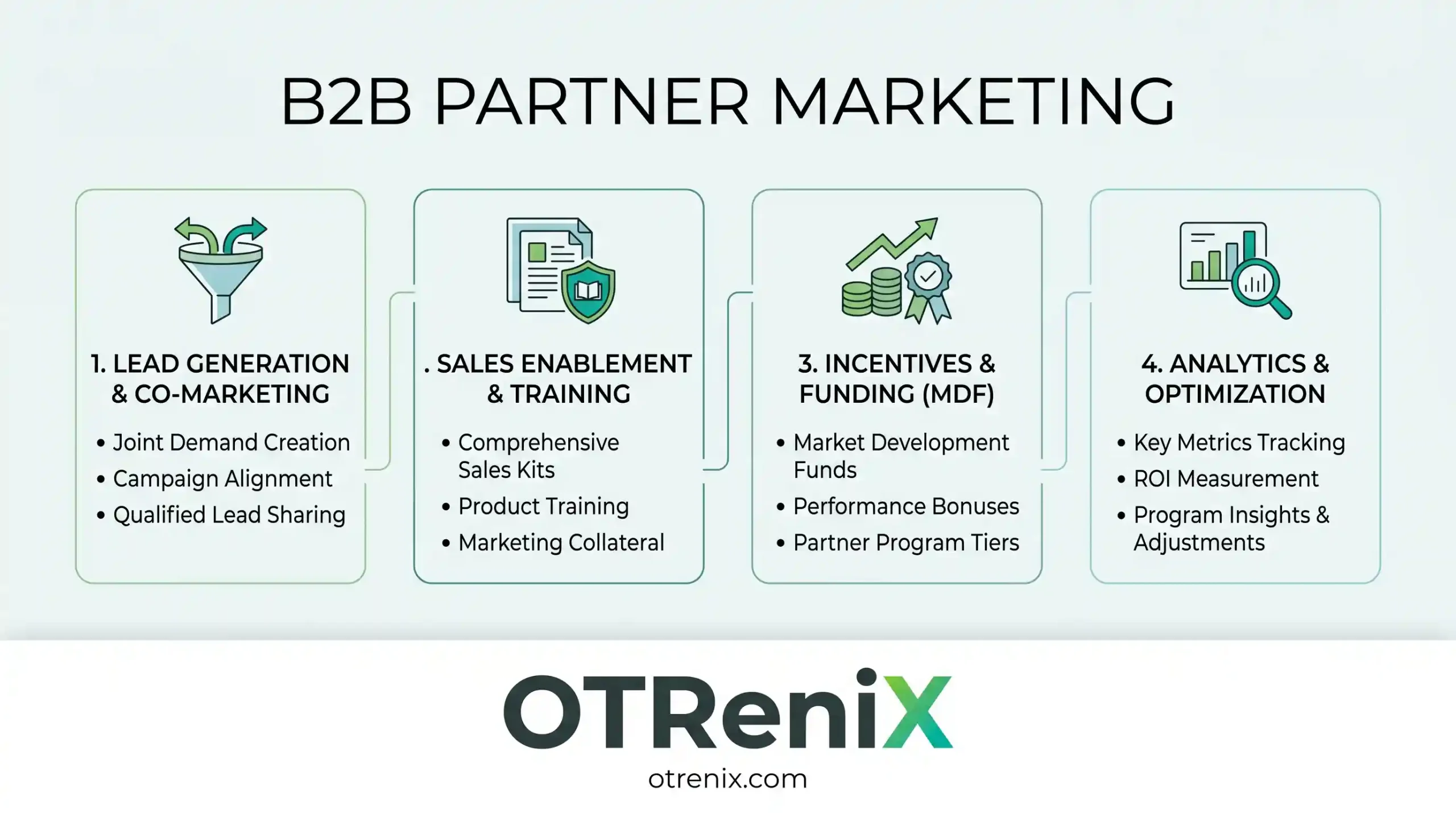

Most B2B companies underestimate how much of their revenue depends on partners. Resellers, MSPs, system integrators, technology alliances, and referral partners often drive 30% to 70% of pipeline at scale, but the marketing function treats them as an afterthought. The result is wasted partner programs, dormant alliances, and pipeline that never materializes.
Partner marketing fixes this. Done well, it turns a list of signed partners into an actual revenue channel. The right program recruits the right partners, enables them to sell, builds joint pipeline, and measures what is working. Done badly, it becomes a series of unread newsletters, expensive booth shares, and partner portals nobody logs into.
This guide covers what partner marketing actually is, the different partner types and how to market through each one, the foundation you need before scaling, the tactics that work, the metrics to track, and the team and budget required to make it real. By the end you will have a practical framework for either starting a partner marketing program or fixing one that is not delivering.
Key Takeaways
- Partner marketing is not the same as channel sales. It is the marketing engine that recruits partners, enables them, and drives joint pipeline. Without it, even the best partner program produces low results.
- The 4 main partner types (resellers, MSPs, technology alliances, referral partners) need different marketing approaches. One playbook does not cover them all.
- Most B2B companies waste 50% to 70% of their partner marketing budget because they skip the foundation: ICP for partners, partner tiering, and clear value propositions for each tier.
- Joint marketing campaigns with partners typically deliver 2 to 3 times the conversion rate of direct campaigns when the partner has trust with the customer.
- A working partner marketing function needs a dedicated owner, a budget of $150K to $500K a year for early stage programs, and 12 to 18 months to produce predictable pipeline.
- The metric that matters most is partner sourced pipeline, not partner count. A program with 10 active partners producing $5M in pipeline beats a program with 100 inactive partners producing nothing.
What Partner Marketing Actually Is
Partner marketing is the marketing function that supports indirect routes to revenue. It exists because partners do not sell themselves. They need recruitment, training, content, campaigns, and ongoing engagement to actually drive pipeline.
Most companies confuse partner marketing with channel sales, but they are different functions:
- Channel sales owns the relationship with partners: signing them, managing them, and helping them close deals.
- Partner marketing owns the demand creation through partners: recruiting them, enabling them with content and tools, and running joint campaigns that build pipeline.
The 2 functions work together but require different skills, different budgets, and different metrics. A company that has 1 channel sales person and no partner marketing usually has a partner program that looks active on paper but produces little revenue.
How partner marketing differs from direct marketing
Direct marketing reaches the end customer with your message. Partner marketing reaches the partner first, then reaches the customer through the partner’s voice and relationship. This changes everything: the message, the channels, the metrics, and the speed of execution.
In direct marketing you control the timing, the budget, and the conversion path. In partner marketing you depend on the partner to actually run the campaign, follow up on leads, and close the deal. This dependency is the defining feature of the discipline. Most of the work is making it easy for partners to say yes to your campaigns and execute them well.
The 4 Main Partner Types
Different partner types need different marketing approaches. Treating them all the same is the most common mistake in early stage partner programs.
1. Resellers and Distributors
Resellers buy your product and sell it to their customers, usually with a margin of 15% to 35%. Distributors sit between you and the resellers, providing scale and logistics for high volume markets.
Resellers care about:
- Margin and profitability per deal
- Deal registration and protection
- Lead generation support
- Sales tools that help them close
Marketing to resellers focuses on enablement (sales decks, battle cards, demo scripts), incentive programs (SPIFFs, MDF), and joint demand generation campaigns where you provide leads or content the reseller can use.
2. MSPs and Service Providers
Managed Service Providers (MSPs) and Managed Security Service Providers (MSSPs) embed your product into a service they sell to their customers. They are particularly common in IT, security, and cloud markets.
MSPs care about:
- Recurring margin and predictable economics
- Service integration and operational fit
- Multi tenant management capabilities
- Support quality, because they own the customer relationship
Marketing to MSPs focuses on technical enablement (deployment guides, multi tenant docs), economic modeling (showing the recurring margin), and co marketing campaigns that go out under the MSP’s brand to their existing customer base.
3. Technology Alliances and Integrations
Technology alliances are partnerships with companies whose products integrate with yours. Examples are a SIEM vendor partnering with an EDR vendor, or a CRM platform partnering with a sales engagement tool.
Tech alliance partners care about:
- Joint customers and shared accounts
- Co engineering quality and integration depth
- Joint go to market that helps both sides
- Marketplace placement and visibility
Marketing through tech alliances focuses on joint customer stories, integration content, co branded webinars, and presence in each other’s marketplaces or ecosystems. The economics are different from resellers, no money changes hands directly, but the pipeline impact can be significant.
4. Referral Partners and Influencers
Referral partners send you customers in exchange for a referral fee or relationship value. This includes consultants, fractional executives, agencies, and individual influencers in your category.
Referral partners care about:
- Trust and reputation, because they are recommending you to their clients
- Referral economics (fees, revenue share, or relationship value)
- Quality of customer experience after handoff
- Speed and transparency of feedback
Marketing to referral partners is more relationship driven and less programmatic. Newsletters, exclusive briefings, early access to new products, and personal relationships drive more pipeline than mass campaigns.
The Foundation You Need Before Scaling
Most partner marketing programs fail because they skip the foundation. Companies recruit 50 partners before they have a clear value proposition for any of them, then wonder why nobody is selling.
Partner ICP
The first step is defining the ideal partner profile, just like you would for an ideal customer profile. Not every partner is a good fit, and the wrong partners drain time and money without producing revenue.
A clear partner ICP answers:
- What size partner do we want? Solo consultant, 10 person reseller, 500 person system integrator?
- What customer segment do they serve? Mid market, enterprise, regulated industries?
- What technology stack do they work with? AWS, Azure, on premise, specific industry tools?
- What sales motion do they run? Transactional, advisory, project based?
- What does success look like for them with our product?
A partner ICP narrows the focus from “anyone who will sign” to “the partners we actually want to win with.” This is harder than it sounds, because most channel teams are measured on partner count, which encourages the opposite behavior.
Partner tiering
Once you have an ICP, group your partners into tiers based on revenue contribution and strategic fit. A typical structure has 3 tiers:
- Tier 1 (Strategic): 5 to 15 partners that produce 60% of partner revenue. They get dedicated marketing support, named partner managers, and joint business plans.
- Tier 2 (Active): 20 to 50 partners that produce meaningful pipeline. They get pooled marketing support, group campaigns, and quarterly business reviews.
- Tier 3 (Transactional): Everyone else. They get self serve tools, automated communications, and access to the partner portal.
Tiering matters because resources are finite. A company that treats all 200 partners the same usually delivers mediocre service to everyone and loses the strategic ones to competitors who invest properly.
Clear value proposition for each tier
Each tier needs a clear answer to “why should I sell your product?” The answer is not always margin. For some partners it is access to a new customer segment. For others it is a feature their customers are asking for. For others it is the operational efficiency of selling alongside an existing product.
Without a clear value proposition, partner marketing becomes a series of newsletters that get ignored. With one, every campaign and asset reinforces the reason the partner chose to work with you.
Partner Marketing Tactics That Actually Work
Once the foundation is in place, the tactical work begins. Here are the tactics that consistently produce pipeline in partner programs.
Partner enablement content
Partners cannot sell what they cannot explain. Enablement content is the foundation: pitch decks, battle cards against your competitors, demo scripts, technical FAQs, and one page solution briefs. The format matters as much as the content. Partners want short, scannable, and ready to use. Long whitepapers do not get used.
The best partner enablement programs maintain a partner portal with all current materials, organized by use case and partner tier. Top tier partners also get custom enablement, including joint sales training and product roadmap briefings.
Joint campaigns and co marketing
Joint campaigns are where partner marketing actually produces pipeline. The standard format is a campaign run jointly with a partner: shared content, co branded landing pages, joint email outreach to combined audiences, and shared follow up.
Examples that work:
- Co branded webinars on a topic where both companies have authority. A 45 minute webinar typically produces 50 to 200 attendees and 10 to 30 sales conversations between the 2 companies.
- Joint research reports where both companies contribute data, creating content neither could produce alone. These are particularly strong in security and finance where data scarcity makes original research valuable.
- Co hosted dinners or events at industry conferences, where 15 target prospects meet executives from both companies in a low pressure setting.
- Joint case studies featuring a customer using both products together. These shorten sales cycles for both companies because they show real world integration.
The economics of joint campaigns are favorable because both sides share the cost. A $15K webinar that produces 20 qualified prospects costs each company $7.5K and produces leads for both.
Market Development Funds (MDF)
MDF is money you give to partners to fund their marketing of your product. Done well, this multiplies your reach. Done badly, it becomes a slush fund that produces nothing measurable.
Effective MDF programs require:
- Pre approved campaign plans before money is released
- Clear deliverables and reporting requirements
- A tracking system for partner activity and results
- Strict accountability, with future MDF tied to past performance
Common MDF activities include partner run events, partner specific landing pages, paid ad campaigns in partner geographies, and direct mail to partner customer bases. The best MDF programs see 3x to 5x ROI on funds deployed. The worst see no measurable return at all.
Partner advocacy and case studies
Partners who succeed with your product become your best marketing asset for recruiting more partners. Customer case studies tell the customer story. Partner case studies tell the partner story: how they built a practice on your platform, what revenue they grew, what their customers say.
These stories belong on your website, in your partner recruitment materials, and in your sales conversations with potential partners. They convert better than feature lists or program descriptions because they show what success actually looks like.
Account based partner motions
For enterprise focused programs, the most effective tactic is account based partner marketing. You and the partner identify 20 to 50 named accounts where both of you have a play. Both teams target those accounts with coordinated outreach: your sales reps work the accounts, the partner introduces relationships, and joint marketing supports both sides.
This requires real coordination. Most partner programs fail at this because the 2 companies have different account lists, different priorities, and different sales motions. When it works, account based partner motions deliver 2 to 4 times the win rate of direct only motions on the same accounts.
The Partner Marketing Funnel
Partner marketing has its own funnel, separate from the customer marketing funnel. Understanding it helps allocate budget and measure progress.
Stage 1: Partner Awareness and Recruitment
The top of the funnel is partner recruitment. The goal is to attract potential partners who fit your ICP. Tactics include partner program landing pages, partner directories (like AWS Marketplace or Salesforce AppExchange), industry events with partner tracks, and outbound recruitment of target partners.
Metrics: number of partner applications, quality of applications (% fitting ICP), conversion to signed agreements.
Stage 2: Partner Onboarding and Activation
Once partners sign, the goal is to get them to first deal as fast as possible. Most partners go inactive within 90 days if they do not close their first deal. Activation tactics include onboarding sequences, sales training, joint pipeline meetings, and dedicated support during the first deals.
Metrics: time to first deal, % of partners closing within 90 days, % of partners closing within 6 months.
Stage 3: Partner Engagement and Pipeline
Once activated, the goal is consistent partner engagement and ongoing pipeline. This is where joint campaigns, MDF, and partner enablement content drive the work. The key metric is partner sourced pipeline, broken out by partner.
Metrics: partner sourced pipeline ($), partner influenced pipeline ($), partner closed revenue, partner contribution to total revenue.
Stage 4: Partner Growth and Advocacy
The strongest partners become true business partners. They co invest in marketing, refer other partners, advocate for your product publicly, and shape your roadmap with their feedback. Marketing to this tier is more about relationship and access than campaigns.
Metrics: partner advocacy actions, partner derived recruits, joint revenue growth year over year.
Partner Marketing Metrics
A partner marketing function without metrics is a cost center. The right metrics show what is working and what is not, and let the team make decisions instead of guesses.
| Metric | What it measures | Target benchmark |
|---|---|---|
| Partner sourced pipeline | Pipeline directly attributed to a partner | 25% to 50% of total pipeline at scale |
| Partner influenced pipeline | Pipeline that touched a partner during the cycle | Often 1.5 to 2 times sourced pipeline |
| Activation rate | % of new partners closing first deal in 90 days | 40% to 60% for healthy programs |
| Time to first deal | Days from partner signed to first closed deal | 60 to 120 days |
| Partner CAC | Cost to acquire a partner that produces revenue | $5K to $25K depending on tier |
| Joint campaign ROI | Pipeline generated per dollar spent on joint marketing | 3x to 8x on healthy programs |
| MDF ROI | Pipeline per MDF dollar deployed | 3x to 5x for managed programs |
| Partner NPS | How likely partners are to recommend selling your product | 40+ for strong programs |
The single most important metric is partner sourced pipeline. Everything else explains how that number was produced and where to focus next.
Team and Budget for Partner Marketing
A real partner marketing function needs people, budget, and time. Half measures usually produce no result, which is why many programs get cut after a year.
Team structure by stage
| Stage | Headcount | Roles |
|---|---|---|
| Early ($1M to $5M ARR) | 1 person | Generalist partner marketer or fractional CMO scope |
| Growth ($5M to $20M ARR) | 2 to 4 people | Partner marketing lead, content/enablement, demand specialist |
| Scale ($20M+ ARR) | 5 to 15 people | Partner marketing lead, segment owners (resellers/MSP/tech alliance), MDF manager, content, demand, ops |
Partner marketing usually reports to the CMO, VP of Marketing, or sometimes to the head of channel. Reporting line matters less than the ability to coordinate across both marketing and channel sales teams.
Budget by stage
| Stage | Annual budget | Where it goes |
|---|---|---|
| Early ($1M to $5M ARR) | $150K to $400K | 1 hire, basic enablement content, 3 to 5 joint campaigns, modest MDF |
| Growth ($5M to $20M ARR) | $500K to $1.5M | Team of 2 to 4, full enablement program, 12 to 20 joint campaigns, structured MDF, partner events |
| Scale ($20M+ ARR) | $1.5M to $5M+ | Full team, segment programs, large MDF pool, major event presence, partner conferences |
These budgets exclude the cost of channel sales, which is a separate function. Partner marketing budget is just the marketing piece.
Timeline expectations
A new partner marketing function takes 12 to 18 months to produce predictable pipeline. The first 6 months are foundation: ICP, tiering, enablement content, partner portal. Months 6 to 12 are early execution: first joint campaigns, MDF programs, activation work. Months 12 to 18 are when partner sourced pipeline becomes a meaningful share of total pipeline.
Companies that expect results in 90 days usually pivot the strategy before it has time to work, which restarts the clock and delays results another 12 months. The most expensive mistake in partner marketing is changing direction too early.
Common Reasons Partner Programs Fail
Most failed partner programs share the same root causes. Knowing them helps avoid the same outcome.
The first cause is recruiting before enabling. Companies sign 50 partners in 6 months, then realize they have no enablement content, no clear value proposition, and no campaign engine. The partners go inactive, the program looks dead, and the next year is spent rebuilding from scratch.
The second cause is treating all partners equally. A program with 200 partners and no tiering spreads resources too thin to serve the strategic ones well. The strategic partners leave for competitors who invest in the relationship, and the transactional partners produce little revenue.
The third cause is misalignment between channel sales and partner marketing. Channel sales signs partners. Partner marketing tries to enable them. Without a shared plan, partners get conflicting messages, confusing programs, and slow responses to questions. The fix is a joint plan with shared metrics.
The fourth cause is no measurement. A program without partner sourced pipeline reporting cannot defend its budget at the next planning cycle. When marketing budgets get cut, unmeasured programs go first. Fix this by building reporting into the program from day 1, not after it is too late.
The fifth cause is impatience. Partner programs do not produce in 90 days. Companies that pivot too early lose the compounding effects that make partner motion valuable in the first place.
Recommendation
If you run a B2B company between $3M and $50M ARR and partners are part of your growth plan, invest in a real partner marketing function this year. The cost of a mediocre partner program is not just the budget. It is the lost pipeline, the partners who left for competitors, and the senior hires that did not work because the partner motion underneath them was broken.
Start by defining your partner ICP and tiering. Pick the 5 to 15 partners that matter most and build the foundation around them: enablement content, joint campaigns, regular business reviews. Resist the urge to recruit aggressively until the foundation is in place, because more partners just multiplies the cost of doing it badly.
Hire a dedicated owner. Partner marketing is not something the demand generation team handles in their spare time. It needs someone with channel marketing experience, a clear charter, and budget to actually deliver. Pay competitively for this role. The right person can drive 30% to 50% of pipeline within 18 months. The wrong person leaves you with another year of newsletters that nobody reads.
Set the budget realistically. $150K to $400K for an early stage program. $500K to $1.5M for growth stage. Plan for 18 months before judging results, with quarterly reviews to adjust tactics but not strategy.
Build the metrics from day 1. Partner sourced pipeline is the metric that matters. Everything else is supporting context. If your CRM cannot report this cleanly, fix that before launching campaigns. A program that cannot measure itself cannot defend itself.
Run 3 to 5 joint campaigns in the first 6 months as proof points. Pick partners with aligned customer segments and run a co branded webinar, a joint research piece, or a co hosted dinner. The early wins build internal momentum and give the partner team something to point to in board meetings.
Partner marketing is a long game and the cost of getting it wrong is a year of lost pipeline. The right program turns partners into a predictable revenue channel that compounds for years. Build it deliberately, give it time, and measure it honestly.
