B2B SaaS Marketing Channels
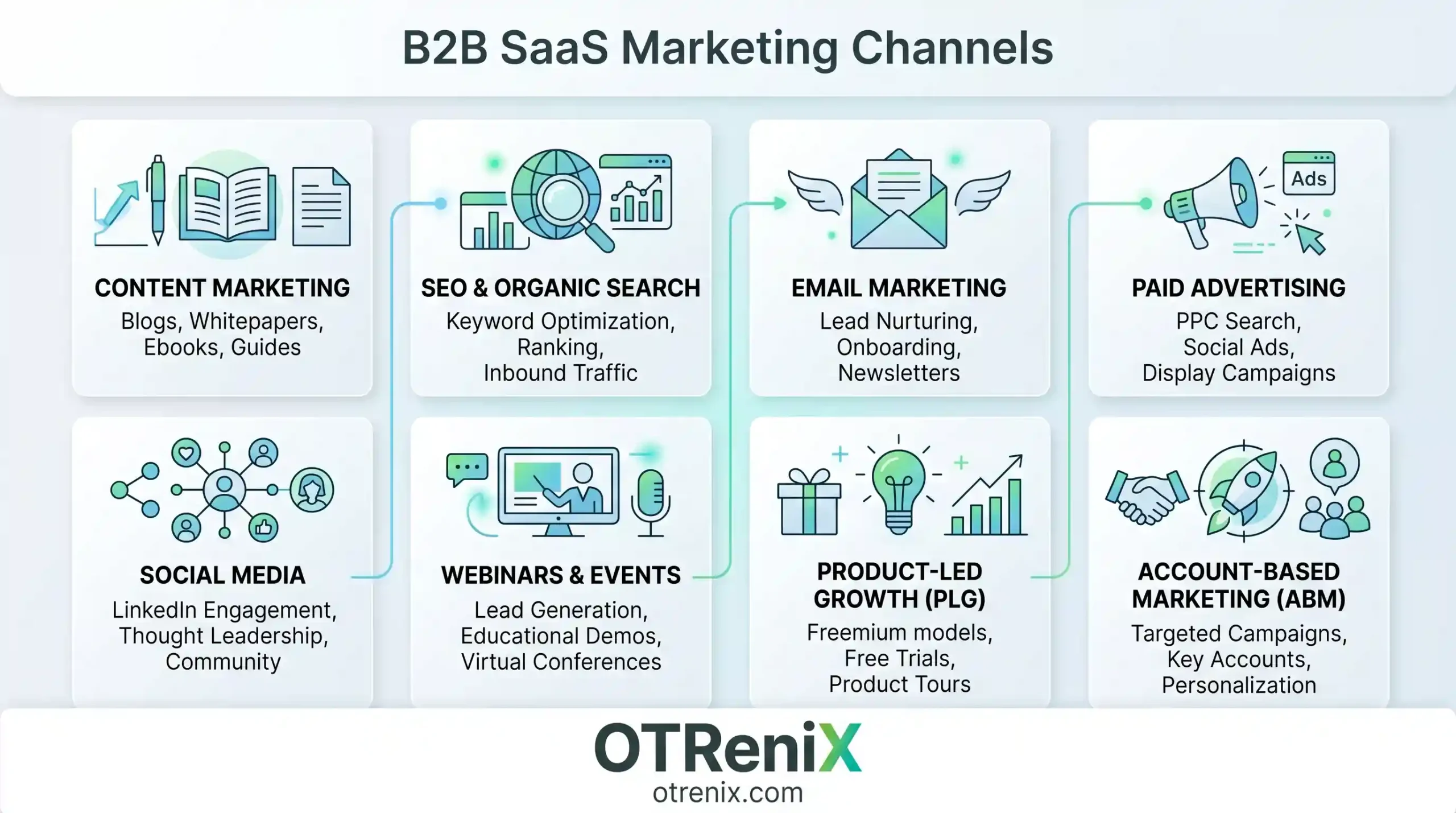

Most B2B SaaS founders waste their first year of marketing on the wrong channels. They run LinkedIn Ads because everyone else does, sponsor a podcast because their VC suggested it, write blog posts that nobody reads, and exhibit at a conference where their target customer is not present. Twelve months later the marketing budget is gone, pipeline is thin, and the team is debating whether marketing works at all.
The problem is not effort. The problem is channel selection. There are 15 to 20 marketing channels available to B2B SaaS companies. Most of them work for someone, but very few work for any specific company at any specific stage. The job of a marketer is to pick 3 or 4 channels that match the product, the customer, and the budget, and ignore the rest.
This guide walks through the main B2B SaaS marketing channels. For each one I will show how it works, when it fits, what to expect to spend, and the realistic time to results. The goal is to help you pick 3 or 4 channels that fit your situation and skip the ones that do not.
Key Takeaways
- Most B2B SaaS companies should run 3 to 4 channels well rather than 8 channels badly. Channel focus beats channel coverage in almost every case.
- The right channels depend on stage, deal size, and sales motion. PLG companies need different channels than enterprise sales companies. Self serve products need different channels than implementation heavy products.
- Time to results varies from weeks (paid ads) to 18 months (SEO, analyst relations). Plan the channel mix to balance short term and long term pipeline.
- Budget expectations range from $5K a month for a single channel test to $200K+ a month for integrated multi channel programs at scale.
- Track contribution to pipeline and revenue, not vanity metrics. Impressions and leads do not pay salaries.
How to Think About Channel Selection
Before picking channels, 4 questions narrow the choice.
What is your annual contract value?
ACV drives almost every channel decision. A $500 a year product cannot afford a sales rep, so it lives on self serve channels: SEO, paid ads, content. A $50,000 a year product needs sales reps, which means channels that produce qualified meetings: ABM, events, outbound. A $500,000 a year product needs analyst relations, executive briefings, and partner programs.
If your ACV is below $1,000, focus on PLG, SEO, and paid acquisition. If your ACV is between $1,000 and $25,000, mix inbound content with sales led motion. If your ACV is above $25,000, the mix shifts toward ABM, events, and analyst work.
Who is the customer and where do they spend time?
A CFO does not hang out on Reddit. A developer does not read Forbes. A small business owner does not attend Gartner Summits. The channel mix has to match where the actual customer spends professional time.
Spend 2 weeks interviewing 10 customers about how they discover and evaluate software. The patterns that emerge usually point at 3 or 4 obvious channels and rule out half of the rest.
What is your sales motion?
Self serve, sales assisted, and sales led motions need different channels. Self serve depends on inbound and product led mechanics. Sales assisted needs both inbound demand and outbound prospecting. Sales led requires high intent channels: ABM, events, partnerships, and analyst influence.
How much budget and how much time?
A $20K a month budget cannot run paid ads, content, ABM, events, and partnerships at the same time. Pick 2 channels and run them well. A $200K a month budget can run all of them, but only if the team can execute. Most failures come from spreading too thin, not from underspending on the right channels.
The Main B2B SaaS Marketing Channels
1. Search Engine Optimization
SEO is the most reliable long term channel for B2B SaaS, but it is also the slowest. Real organic traffic takes 6 to 12 months to start, and 12 to 24 months to compound into meaningful pipeline. Companies that need pipeline this quarter should not start with SEO.
The work covers keyword research aligned to buying intent, technical SEO (site speed, structure, indexing), content production at quality and volume, and link building. Modern SEO also includes generative engine optimization (GEO) for visibility in ChatGPT, Claude, Perplexity, and Gemini, which is becoming a real source of traffic for B2B SaaS in 2026.
When it fits: Almost every B2B SaaS company should invest in SEO eventually. Start when you have product market fit and at least 12 months of runway to see results.
Budget: $8K to $30K a month for content and SEO programs. Larger programs run higher.
Time to results: 6 to 12 months for early traffic, 12 to 24 months for pipeline impact.
2. Content Marketing
Content marketing overlaps with SEO but extends beyond it. The work includes thought leadership articles, technical deep dives, customer case studies, original research, newsletters, podcasts, and gated assets like ebooks and templates.
The strongest B2B SaaS content programs treat content as a product. They publish 1 to 4 substantial pieces a month, distribute aggressively across LinkedIn, newsletters, and communities, and reuse the work across formats. Companies that publish weak content weekly underperform companies that publish strong content monthly.
When it fits: Companies with technical or thought leadership credibility, or with a writer or editor who can produce real depth. Bad content is worse than no content.
Budget: $5K to $25K a month for in house plus production support, or $10K to $30K a month for full agency programs.
Time to results: 3 to 6 months for engagement, 9 to 18 months for pipeline contribution.
3. Paid Search
Paid search (like Google Ads or Bing) captures customers who are actively looking for a solution. It produces results in days, not months, and the metrics are clear: cost per click, cost per lead, cost per opportunity, cost per customer.
The catch is competition. In categories with established players, cost per click can run $20 to $80, which makes paid search uneconomical for products with low ACV. Some categories are so competitive that paid search loses money no matter how well you optimize. Test with $5K to $10K before committing larger budgets.
When it fits: B2B SaaS with clear high intent keywords, ACV above $5K, and a website that converts.
Budget: $5K to $50K a month, depending on category competition.
Time to results: 30 to 90 days to optimize, immediate to start.
4. Paid Social
LinkedIn Ads is the dominant paid social channel for B2B SaaS. Targeting by job title, company size, and industry makes it precise, but cost per click is high: $8 to $20 in most B2B categories.
LinkedIn works best for awareness, retargeting, and ABM rather than direct response. Cold ads asking for a demo usually convert poorly. Ads promoting useful content, gated reports, or webinars usually convert well. Meta Ads can work for SMB SaaS but struggle for enterprise targeting.
When it fits: Companies with $20K+ a month to spend, clear ICP definition, and content that supports awareness and retargeting plays.
Budget: $15K to $80K a month for meaningful programs.
Time to results: 60 to 120 days to optimize.
5. Account Based Marketing
ABM is a coordinated motion across marketing and sales aimed at named target accounts. Instead of fishing for any lead, the team picks 50 to 500 specific accounts and builds custom campaigns to win them.
ABM works for high ACV products where named accounts are worth $100K+ each. Below that, the math breaks. Strong ABM programs combine paid ads targeted to specific companies, custom content, executive outreach, events, and direct sales prospecting. Weak ABM is just outbound with extra steps.
When it fits: B2B SaaS with ACV above $25K, clear target account list, and tight marketing to sales coordination.
Budget: $20K to $80K a month for full programs.
Time to results: 3 to 9 months for first opportunities, 9 to 18 months for closed revenue.
6. Outbound Sales
Outbound is technically a sales channel, but it depends heavily on marketing for messaging, content, and list quality. A good outbound program produces meetings within 60 days. A bad one wastes a year and burns out 3 SDRs.
The fundamentals are list quality (right title, right company, right trigger), sequence design (subject lines, copy, cadence), and persistence (most replies come after attempt 5+). Outbound is harder in 2026 than it was 5 years ago because customers receive 3x the volume of cold emails. The bar for personalization and relevance has gone up.
When it fits: B2B SaaS with ACV above $10K, identifiable target accounts, and a clear value proposition.
Budget: $8K to $25K a month for outsourced programs, or 1 SDR at $80K to $120K all in for in house.
Time to results: 60 to 120 days for first meetings.
7. Events and Conferences
Events are still one of the highest ROI channels for B2B SaaS, especially for high ACV products. The math works when you compare the cost of 50 in person meetings at a conference to the cost of generating those meetings any other way.
Most companies waste event budget on booths nobody remembers. The strongest event motions skip the booth, run private dinners with 12 to 20 target prospects, schedule 30+ pre booked meetings, and follow up aggressively for 60 days after. A startup that spends $100K on a booth gets 50 business cards. A startup that spends $80K on targeted dinners and meetings gets 40 conversations with actual buyers.
When it fits: B2B SaaS with ACV above $25K and a target customer who attends industry events.
Budget: $50K to $400K per major event, $150K to $1M a year for full event programs.
Time to results: 1 to 6 months for pipeline contribution.
8. Partner and Channel Marketing
Partner marketing covers integrations, resellers, MSPs, system integrators, and technology alliances. For some B2B SaaS categories, partners drive 40% to 70% of total revenue. For others, they are barely relevant.
The work includes partner recruitment, partner enablement (training, sales tools, demo environments), co marketing programs, MDF management, and joint events. Channel motions take longer to build than direct motions, often 12 to 18 months to start producing meaningful revenue, but they scale better at higher levels of revenue.
When it fits: B2B SaaS that integrates with platforms (Salesforce, AWS, Microsoft, ServiceNow), or sells through resellers and MSPs.
Budget: $10K to $40K a month for partner marketing programs.
Time to results: 6 to 18 months for first partner pipeline.
9. Product Led Growth
PLG is a self serve motion where the product itself drives acquisition, conversion, and expansion. Free trials, freemium tiers, and self serve onboarding let prospects experience the product before they ever talk to a rep.
PLG works for products that can demonstrate value in under 10 minutes without a sales call. It does not work for products that need configuration, data integration, or human guidance to deliver value. Strong PLG companies invest heavily in onboarding flows, activation metrics, in product growth loops, and conversion optimization. Slack, Notion, Figma, and Linear are PLG examples worth studying.
When it fits: Products with fast time to value, broad user base, and individual users who can adopt without procurement.
Budget: Mostly engineering and product time rather than marketing spend. Marketing budget supports the funnel: paid acquisition, content, community.
Time to results: 6 to 18 months to optimize the conversion math.
10. Community and Developer Relations
Community works as a channel when the customer values peer connections. Developers, security professionals, marketers, and product managers all have active community spaces. A presence in those communities, done well, builds long term pipeline that compounds.
Community work is slow and easy to do badly. Showing up to push product gets you banned. Showing up to contribute knowledge over 12 months builds trust that turns into pipeline. The strongest community motions involve a dedicated DevRel or community manager who actually participates rather than monitors.
When it fits: B2B SaaS selling to communities with active spaces (developers, designers, security, data, etc.).
Budget: $10K to $25K a month for a dedicated community lead plus events and sponsorships.
Time to results: 6 to 18 months for trust to compound.
11. Public Relations
PR covers earned media: press coverage, industry publications, podcasts, and award programs. In B2B SaaS, PR rarely produces direct pipeline, but it builds credibility that supports every other channel. A prospect who recognizes your name from TechCrunch converts better than one who has never heard of you.
PR is most valuable around milestones: funding announcements, product launches, customer wins, and category creation moments. A continuous low intensity PR program rarely justifies its cost. A targeted PR push around specific moments often does.
When it fits: B2B SaaS at funding announcements, product launches, or category defining moments.
Budget: $15K to $30K a month for ongoing programs, or $30K to $80K for milestone pushes.
Time to results: 30 to 90 days for placement, ongoing for credibility compounding.
12. Analyst Relations
Analyst relations is the practice of working with Gartner, Forrester, IDC, and similar firms to influence research that shapes enterprise purchase decisions. Inclusion in a Magic Quadrant or Wave can directly triple pipeline in covered categories.
This is enterprise specific work. Analyst influence does not exist in SMB markets. For enterprise B2B SaaS, the work is essential, slow, and expensive. The first analyst inquiry takes 6 to 9 months to set up. The first research mention takes 12 to 18 months. The full payoff takes 24 to 36 months. Companies that start analyst work after they need it are 2 years too late.
When it fits: Enterprise B2B SaaS in analyst covered categories, with ACV above $50K.
Budget: $15K to $40K a month for analyst relations programs, plus $50K to $200K a year for analyst inquiries and research access.
Time to results: 12 to 36 months.
13. Referral and Word of Mouth Programs
Customer referrals are the highest converting source of new business in most B2B SaaS companies. Referred prospects close 2x to 3x faster than cold prospects, with higher win rates and larger deal sizes.
The work is to make referrals easy and rewarding. Referral programs, customer advocacy programs, advisory boards, and customer advisory groups all support this motion. The mistake most companies make is assuming referrals just happen. Strong programs are deliberate, with specific asks, structured incentives, and measurement.
When it fits: B2B SaaS with at least 30 happy customers and a clear customer success function.
Budget: $5K to $15K a month for program management plus referral incentives.
Time to results: 3 to 9 months to build the motion.
14. Webinars and Virtual Events
Webinars are still a workhorse channel for B2B SaaS. Done well, a single webinar can generate 200 to 500 registrations, 100 to 300 attendees, and 20 to 50 qualified pipeline opportunities. Done badly, a webinar produces 30 registrations and no pipeline.
The difference is topic, speakers, and promotion. Webinars on real customer problems with credible external speakers consistently outperform vendor pitches. The strongest webinar programs run monthly, with the same time slot, building an audience that returns. Single webinars rarely move the needle.
When it fits: Almost every B2B SaaS company can use webinars. Especially strong for considered purchases with multi person buying committees.
Budget: $5K to $15K a month for ongoing programs.
Time to results: 60 to 120 days to optimize.
15. Newsletters and Email Marketing
Email is still one of the most underrated B2B SaaS channels. Owned newsletters with 5,000+ engaged subscribers can drive consistent pipeline at very low marginal cost. Sponsored placements in industry newsletters often outperform paid social by 3x to 5x in pipeline efficiency.
The work covers list building, content production, segmentation, and lifecycle automation. The strongest programs treat email as a relationship channel rather than a broadcast tool. Personalized, segmented, useful email beats generic blasts every time, but most B2B SaaS companies still default to the blast model.
When it fits: Every B2B SaaS company should build an email list and use it well. The work compounds for years.
Budget: $3K to $15K a month for content, automation, and list building support.
Time to results: 3 to 12 months to build a real list, ongoing payoff.
Channel Mix by Stage
The right channel mix changes as the company grows. Here is what usually works at each stage.
Pre seed and seed (under $1M ARR)
Focus on 2 channels maximum. The team is too small to run more. The right pair is usually founder led content (LinkedIn, podcasts, newsletters) plus targeted outbound to 100 to 200 ideal accounts. Skip paid ads, events, and analyst work at this stage. The budget is better spent on product and customer interviews.
Series A ($1M to $5M ARR)
Add 1 or 2 channels to the mix. Most companies add SEO and content as a long term play, plus paid search or paid social for short term pipeline. PLG companies focus on funnel optimization. Sales led companies start outbound programs. Pick the second channel based on ACV and motion.
Series B ($5M to $20M ARR)
Run 4 to 5 channels. The mix typically expands to include events, ABM, partner marketing, and paid acquisition at scale. The team has the resources to run multiple channels well, and the company needs the diversification to reduce dependence on any single channel.
Growth stage ($20M+ ARR)
Run the full mix, but specialize. The team grows specialists for each major channel. PR and analyst relations become important if not already in motion. International expansion adds geo specific channel work. Channel partnerships become a serious revenue driver.
Comparison B2B SaaS Marketing Channels
| Channel | Time to Results | Typical Budget | Best Fit |
|---|---|---|---|
| SEO | 6 to 24 months | $8K to $30K/mo | Long term pipeline, any stage |
| Content marketing | 3 to 18 months | $5K to $25K/mo | Companies with credibility to share |
| Paid search | 30 to 90 days | $5K to $50K/mo | High intent keywords, ACV $5K+ |
| Paid social (LinkedIn) | 60 to 120 days | $15K to $80K/mo | ABM and awareness, ACV $20K+ |
| ABM | 3 to 18 months | $20K to $80K/mo | ACV $25K+, named accounts |
| Outbound | 60 to 120 days | $8K to $25K/mo | ACV $10K+, identifiable targets |
| Events | 1 to 6 months | $50K to $400K/event | ACV $25K+, industry events exist |
| Partner marketing | 6 to 18 months | $10K to $40K/mo | Integration or reseller motions |
| Product led growth | 6 to 18 months | Eng + product heavy | Fast time to value, broad users |
| Community | 6 to 18 months | $10K to $25K/mo | Communities exist for the customer |
| PR | 30 to 90 days | $15K to $30K/mo | Milestones, category creation |
| Analyst relations | 12 to 36 months | $15K to $40K/mo | Enterprise, ACV $50K+ |
| Referrals | 3 to 9 months | $5K to $15K/mo | 30+ happy customers |
| Webinars | 60 to 120 days | $5K to $15K/mo | Considered purchases, multi person buying |
| Newsletters and email | 3 to 12 months | $3K to $15K/mo | Every B2B SaaS, compounds over time |
Common Channel Selection Mistakes
Most channel mistakes fall into a few patterns. Worth checking against this list before signing the next budget.
Picking channels because competitors use them. Your competitors might be wrong. Verify the channel works for your specific customer before copying.
Spreading across too many channels. A company with $30K a month for marketing should not run 6 channels. Pick 2 and run them well. Channel focus produces better ROI than channel coverage at every stage below $20M ARR.
Judging channels too early. SEO at month 3 looks like a failure. Outbound at month 1 looks like a failure. Events with poor follow up look like a failure. Each channel has its own ramp, and judging it before the ramp completes wastes the investment.
Confusing leads with pipeline. A channel that produces 500 leads but 2 qualified opportunities is not working. A channel that produces 30 leads and 8 qualified opportunities is working. Always track to pipeline, not lead volume.
Optimizing for cost per lead instead of cost per customer. Cheap leads from low intent channels usually convert badly. Expensive leads from high intent channels usually convert well. The math at the end of the funnel is what matters.
Underinvesting in attribution. Most B2B SaaS companies cannot tell which channels drive revenue. This makes every budget decision a guess. Spend $5K a month on attribution before scaling channel spend, or fly blind.
Recommendation
If you run a B2B SaaS company and your channel mix is unclear or underperforming, take 2 weeks to reset the strategy.
Start by interviewing 10 of your best customers about how they discovered, evaluated, and chose your product. The patterns that emerge usually point at 3 or 4 channels and rule out half of the rest. Most channel decisions are guesses without this input, and guesses are expensive.
Next, audit your current spend. List every channel, every monthly cost, and the pipeline contribution from each one in the last 6 months. Channels with no measurable pipeline contribution are candidates for cutting unless they have a long ramp and are still inside it. Channels with strong contribution are candidates for doubling.
Then pick 3 channels for the next 12 months. The mix should include 1 short term channel for pipeline this quarter (paid search, outbound, webinars), 1 medium term channel for pipeline this year (paid social, ABM, events), and 1 long term channel for compounding value (SEO, content, community, analyst relations). This balance covers immediate and future revenue without spreading too thin.
Set monthly review checkpoints. Each channel needs 3 to 6 months to show real signal. Cutting earlier wastes the investment. Continuing past 6 months without signal wastes the budget. Pick the review cadence and stick to it.
Channel selection is the highest leverage marketing decision a B2B SaaS company makes. The right 3 channels can produce 5x the pipeline of a poorly chosen 8 channel mix. Pick carefully, give each channel the time it needs, and measure to pipeline rather than vanity metrics. The channel mix that works for your company exists. The job is to find it within the first 12 months and resist the noise of every new channel that appears after.
