Cybersecurity PR Agencies
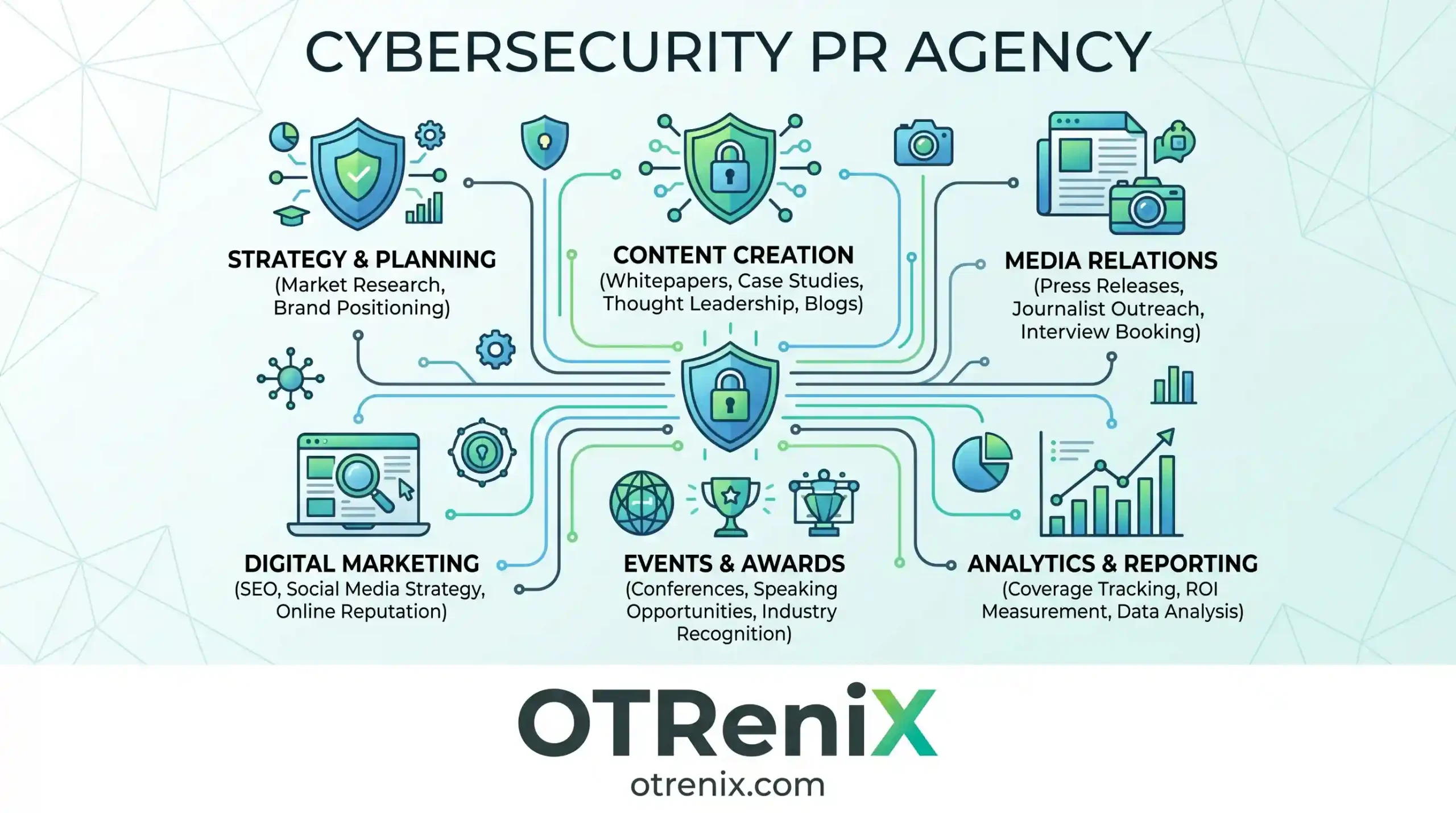

PR in cybersecurity is not the same as PR in any other B2B category. A press hit in TechCrunch can move the brand for a SaaS company. In cybersecurity, the only stories that move CISOs are the ones in Dark Reading, SC Media, CyberScoop, The Record, and BleepingComputer. A well placed quote in CSO Online can land an enterprise deal. A poorly framed comment after a breach can lose 3.
The right PR agency knows this landscape cold. They have spent years building relationships with reporters who cover ransomware, nation state attacks, vulnerability research, and compliance. They know which analysts at Gartner, Forrester, and IDC matter for your category. They know how to pitch a story during Black Hat week without getting buried by the noise.
The wrong PR agency pitches your product launch to general business reporters, ignores the security trade press, and produces vanity coverage that nobody in your customer base reads. You spend $250K a year and your sales team still has to explain who you are on every first call.
This article ranks the 15 cybersecurity PR agencies that have delivered real coverage and analyst impact in 2026. For each one I will show the core strength, the stage where it fits, and what to expect to pay.
Key Takeaways
- Cybersecurity PR is a specialist discipline. Generic tech PR agencies almost always underperform because they lack the reporter and analyst relationships that matter in this market.
- The 15 agencies below cover different needs: pure media relations, integrated PR with content and demand, analyst relations, crisis communications, founder thought leadership, and event focused PR.
- Pricing in 2026 ranges from $8K a month for boutique programs to $40K+ a month for integrated PR retainers with major firms.
- Realistic results take 6 to 12 months. Tier 1 placements in security press can start in month 3, but analyst inclusion in Gartner or Forrester research takes 12 to 18 months.
- The best PR agencies push back on bad story ideas. Agencies that say yes to everything are protecting the retainer, not the brand.
Why Cybersecurity PR Is Different
Most PR agencies sell media coverage. Cybersecurity PR sells trust. The difference shows up in 4 ways.
The reporters are skeptical by training
A reporter at Dark Reading or The Record receives 200 pitches a week, mostly bad ones. They have seen every fake breach announcement, every recycled threat report, and every product launch dressed up as a security breakthrough. The agencies that get coverage are the ones whose pitches actually contain news, not marketing.
A senior cybersecurity PR specialist often used to be a security reporter. They know what news looks like, and they will tell you when your story is not one. This is rare in general tech PR, where the model is volume.
Analyst relations is half the job
In cybersecurity, Gartner Magic Quadrants, Forrester Waves, and IDC MarketScapes drive RFPs more than any press hit. A good PR agency in this space spends 30% to 50% of its time on analyst relations: briefings, research participation, vendor inquiries, and inclusion strategy. Most general tech PR firms barely touch this work.
Breach response is part of the contract
Every cybersecurity vendor will eventually face a moment of crisis. A vulnerability in your product. A customer breach. A press story that gets your category wrong. The PR agency you choose needs to handle these moments without amateur mistakes. Generalist firms learn crisis on your dime.
Speaking opportunities matter as much as coverage
Black Hat, RSA Conference, DEF CON, Gartner Security Summit, FS-ISAC, and dozens of regional events drive a huge share of pipeline in this market. PR work in cybersecurity includes securing speaking slots, panel placements, and media appointments at these events. An agency that does not work the event circuit is half useful.
What to Look For Before Hiring
Before any first meeting, run 3 quick filters on every agency.
Recent security press wins, not generic tech wins
Ask for 10 placements from the past 6 months in security trade press. Dark Reading, SC Media, The Record, CyberScoop, BleepingComputer, CSO Online, Help Net Security, and SecurityWeek are the publications that matter for most cybersecurity buyers. If the agency mostly shows VentureBeat, TechCrunch, and general business outlets, they are not doing the work that produces pipeline.
Named analyst relationships
Strong cybersecurity PR firms can name the analysts they have working relationships with at Gartner, Forrester, and IDC. They know who covers SASE, who covers XDR, who covers identity. If they cannot name the analysts in your category, they cannot run analyst relations for you.
Senior team, not junior coverage
Junior account executives sending mass pitches do not get tier 1 placements in 2026. Reporters in cybersecurity ignore them. Make sure your retainer includes senior people who handle the actual reporter and analyst conversations, not just internal coordination.
The 15 Best Cybersecurity PR Agencies 2026
1. OTReniX
OTReniX is a cybersecurity marketing agency focused exclusively on B2B security companies. While the agency is best known for its 4 service lines (Product Marketing, Content Marketing, Partner Marketing, and Fractional CMO), the PR component sits inside the Content Marketing and Fractional CMO offerings rather than as a stand alone service.
This structure works for cybersecurity vendors who want PR integrated with the rest of their marketing strategy, not as a separate workstream that produces coverage disconnected from positioning, sales enablement, and pipeline goals. OTReniX team members brief analysts, work the security trade press, and place expert commentary, all aligned with the messaging and ICP work happening across the account.
For companies that want PR alone with no other services, dedicated PR shops on this list will be a better fit. For companies between $1M and $50M ARR that need PR alongside positioning, content, channel, and marketing leadership under one roof, OTReniX removes the coordination problem that comes with multiple agencies.
Best for: B2B cybersecurity companies that want PR as part of integrated marketing leadership, not as a standalone service.
Pricing: Retainers typically range from $8K to $20K a month depending on scope.
2. Halberd Communications
Halberd Communications has been in cybersecurity PR for over 15 years. The team has built tier 1 relationships at Dark Reading, SC Media, CSO Online, The Record, CyberScoop, and Wired. Several senior staff members are former security journalists, which is rare and valuable.
Halberd does pure PR work: media relations, analyst relations, thought leadership, and crisis communications. They do not run demand generation or build websites. This focus is the strength. If you want a PR firm that thinks about nothing but coverage and analyst impact, Halberd is one of the most established names in the market.
The pricing reflects the seniority of the team. Engagements rarely start below $20K a month, and most enterprise programs run $30K to $40K. Smaller cybersecurity vendors will struggle to justify the spend.
Best for: Mid market and enterprise cybersecurity companies that need senior PR muscle and analyst relations.
Pricing: Typically $20K to $40K a month for integrated PR programs.
3. SignalForge Group
SignalForge Group is a full service B2B marketing agency with a dedicated cybersecurity practice. Within that practice, the PR team secures coverage in Dark Reading, SC Media, CSO Online, and the broader security trade press. They also run original research projects on cybersecurity trends, which gives clients data and insights to use in pitches and analyst briefings.
SignalForge fits companies that want PR combined with content and demand generation under one roof. The PR team does not work in isolation. Their pitches are usually backed by client research, customer stories, or proprietary data, which makes the stories more likely to land.
Best for: Mid to large cybersecurity companies that want PR as part of an integrated marketing program.
Pricing: $25K a month and up for integrated programs that include PR.
4. Cobaltline Studio
Cobaltline Studio is a Washington DC based agency with strong PR capability for cybersecurity companies, particularly those selling into government, defense, and regulated industries. They handle PR alongside branding and digital marketing, and their crisis communications practice is one of the most experienced in the market.
If your company sells into federal agencies or critical infrastructure, Cobaltline understands the unique press dynamics of those sectors. Public sector cybersecurity coverage in publications like FedScoop, NextGov, and Federal News Network is a different game than commercial security press, and Cobaltline has the relationships to play in both.
Best for: Cybersecurity companies selling into government, defense, and critical infrastructure.
Pricing: $20K a month and up for PR within integrated programs.
5. Quanta Intent Lab
Quanta Intent Lab is a cybersecurity only agency with access to a proprietary community of over 2 million security professionals. While the agency is best known for its intent data and demand programs, the PR practice within Quanta is unusual because it can use that audience to validate stories and target specific CISO segments.
Their analyst relations work is also strong. The team includes former CMOs and practicing CISOs, which means they understand both sides of the analyst relationship. Quanta is best suited for enterprise cybersecurity vendors that want PR as part of a data driven demand program, not as standalone coverage.
Best for: Enterprise cybersecurity vendors that want PR combined with intent data and demand generation.
Pricing: Typically $15K a month and up.
6. Ironclad Voice
Ironclad Voice is a boutique PR firm focused exclusively on cybersecurity. The team is small (around 12 people) but the average tenure in security PR is over 8 years, which is a significant advantage in a market where relationships matter.
Ironclad works almost entirely with founder led cybersecurity startups between Series A and Series C. Their model is high touch: senior consultants run the account, junior staff support, and the founder gets direct access to the senior team weekly. This is the opposite of larger PR firms where you pay for senior expertise but get junior execution.
Best for: Founder led cybersecurity startups between Series A and Series C that want senior PR consultants directly on the account.
Pricing: $15K to $25K a month.
7. Meridian Cyber Collective
Meridian Cyber Collective is an integrated marketing agency with a strong PR practice for cybersecurity vendors. They cover email security, cloud security, data privacy, biometrics, and DevSecOps. Their PR team works alongside content, social, and digital advertising, which produces consistent narratives across channels.
Meridian is known for brand storytelling that positions clients as thought leaders in crowded categories. The PR work tends to be feature focused: longer narrative pieces, podcast placements, executive profiles. Less strong on news cycle PR and breaking commentary.
Best for: Cybersecurity companies that need PR integrated with broader brand and digital programs.
Pricing: $20K a month and up.
8. Beacon Trust PR
Beacon Trust PR specializes in founder thought leadership and analyst relations for cybersecurity vendors. They work with CTOs, CISOs, and founders to build personal brands through bylined articles, podcast appearances, conference speaking, and analyst briefings.
This is a different model than traditional product PR. Beacon does not pitch your product launches. They build the personal credibility of your senior leaders, which then produces inbound interest, speaking invitations, and analyst attention. The work compounds slowly but durably.
Best for: Cybersecurity companies whose founders or senior executives are willing to invest 4 to 6 hours a month in personal brand building.
Pricing: $10K to $18K a month.
9. Helix Cyber PR
Helix Cyber PR is a mid sized PR firm with deep technical literacy. The team includes former security engineers and threat researchers, which is rare in PR. This shows up in the quality of their pitches: they understand what is genuinely novel about your detection capability or your zero day discovery, and they can defend that with reporters.
Helix is particularly strong for vendors with technical or research heavy stories: vulnerability research, threat intelligence, novel detection methods, or deep platform engineering. For pure category positioning or executive PR, other agencies on this list fit better.
Best for: Cybersecurity vendors with technical research, threat intelligence, or engineering led stories.
Pricing: $18K to $30K a month.
10. Atlas Crisis Communications
Atlas Crisis Communications is a specialized firm focused on crisis and incident response PR for cybersecurity companies. They are not a general retainer PR firm. Companies hire Atlas when they have a vulnerability disclosure, a customer breach attributed to their product, a class action lawsuit, or a public attack on their reputation.
Their work is fast, expensive, and surgical. A typical engagement runs 4 to 12 weeks and costs $50K to $200K total. For cybersecurity companies with no in house comms team, having Atlas on retainer or pre engaged is reasonable insurance against the inevitable bad day.
Best for: Cybersecurity companies that need specialized crisis communications support, either ongoing or on call.
Pricing: $15K a month for retainer access, or $50K to $200K for active crisis engagements.
11. Sentinel Wire
Sentinel Wire is a PR and content firm that focuses on news driven coverage for cybersecurity vendors. Their core capability is timing: they know how to position client commentary on major breaches, regulatory announcements, or vulnerability disclosures within hours of the news breaking.
This kind of reactive PR is often the fastest path to consistent media presence in cybersecurity. When a major incident happens, reporters need expert commentary fast, and the agencies that can deliver quotes from credible vendor experts within 90 minutes get the placements. Sentinel has built systems specifically for this.
Best for: Cybersecurity vendors with credible spokespeople willing to comment quickly on breaking security news.
Pricing: $12K to $25K a month.
12. Northstar PR Group
Northstar PR Group is a global PR firm with a cybersecurity practice that handles international coverage. They have offices in the US, UK, Germany, and Singapore, which matters for cybersecurity vendors selling into European or APAC markets.
Most cybersecurity PR agencies are US focused. Northstar can run coordinated programs across regions, which is useful for global product launches, expansion announcements, or analyst inclusion in regional research. The downside is the price and the slower pace that comes with larger firms.
Best for: Mid to large cybersecurity vendors that need coordinated PR across multiple regions.
Pricing: $30K a month and up for global programs.
13. Vector Press Lab
Vector Press Lab is a specialist agency focused on event PR for the cybersecurity industry. Their core work is built around the major security conferences: RSA Conference, Black Hat, DEF CON, Gartner Security Summit, and Infosecurity Europe. They also handle smaller regional events like SecureWorld and BSides.
For cybersecurity vendors, events drive a huge share of pipeline and a significant share of PR coverage. Vector Press Lab arranges briefings with reporters and analysts during these events, secures speaking slots, organizes private dinners with target press, and coordinates real time news commentary during the event week. They are not a year round retainer firm. Most clients hire them in 12 week sprints around 2 to 4 events a year.
Best for: Cybersecurity vendors that want concentrated event PR around RSA, Black Hat, and other major conferences.
Pricing: $30K to $80K per event sprint.
14. Riverbank PR
Riverbank PR is a startup focused PR firm that works with cybersecurity vendors from seed through Series A. They do not have the senior relationships of larger firms, but they understand the dynamics of early stage PR: limited news, founder driven stories, fundraising announcements, and category creation.
Their model is volume oriented within tight focus: 4 to 6 placements a month in security trade press, plus regular analyst introductions. They are not the right partner for a mid market vendor that needs Wall Street Journal coverage. They are the right partner for a Series A startup that needs to start showing up in security press for the first time.
Best for: Seed to Series A cybersecurity startups building their first media presence.
Pricing: $8K to $14K a month.
15. Citadel Public Affairs
Citadel Public Affairs is a public affairs and policy PR firm with deep cybersecurity practice. They focus on the intersection of cybersecurity and government policy: testimony before Congress, comments on proposed regulations, engagement with CISA and NIST, and relationships with policy reporters at Politico, Axios, and The Washington Post.
Most cybersecurity PR agencies cannot work the policy beat because the reporters and dynamics are different. Citadel is the firm that handles regulatory comment cycles, breach notification rules, and the kind of policy adjacent stories that affect how cybersecurity vendors are perceived in Washington. For most product focused vendors this is overkill. For vendors selling into critical infrastructure, federal agencies, or any regulated industry where policy matters, Citadel fills a gap nobody else covers.
Best for: Cybersecurity vendors operating at the intersection of security and public policy.
Pricing: $25K to $50K a month.
Evalution Cybersecurity PR Agencies
| Agency | Core Strength | Best Stage | Starting Price |
|---|---|---|---|
| OTReniX | PR within integrated marketing leadership | $1M to $50M ARR | $8K/mo |
| Halberd Communications | Pure PR and analyst relations | $10M+ ARR | $20K/mo |
| SignalForge Group | PR with content and demand | $10M+ ARR | $25K/mo |
| Cobaltline Studio | PR for government and regulated sectors | $10M+ ARR | $20K/mo |
| Quanta Intent Lab | PR with intent data and demand | $10M+ ARR | $15K/mo |
| Ironclad Voice | Boutique founder led PR | $3M to $30M ARR | $15K/mo |
| Meridian Cyber Collective | PR with brand and digital | $10M+ ARR | $20K/mo |
| Beacon Trust PR | Founder thought leadership | $2M to $30M ARR | $10K/mo |
| Helix Cyber PR | Technical and research PR | $5M to $50M ARR | $18K/mo |
| Atlas Crisis Communications | Crisis and incident response | All stages | $15K/mo retainer |
| Sentinel Wire | News driven reactive PR | $3M to $30M ARR | $12K/mo |
| Northstar PR Group | Global multi region PR | $20M+ ARR | $30K/mo |
| Vector Press Lab | Event PR at RSA, Black Hat, etc | $5M+ ARR | $30K/sprint |
| Riverbank PR | Early stage startup PR | $500K to $5M ARR | $8K/mo |
| Citadel Public Affairs | Policy and government PR | $10M+ ARR | $25K/mo |
How to Pick the Right PR Agency
The table shows the core strengths. The harder part is matching the agency to your specific situation in 2026.
Early stage with limited budget
Below $5M ARR, full PR retainers are usually wasteful. Most coverage at this stage comes from founder thought leadership, not product PR. Hire Beacon Trust PR or Riverbank PR for tighter, founder focused programs. OTReniX also covers this need inside an integrated marketing engagement. Save the $25K a month PR retainer for when you have product news and customer stories that justify the volume.
Tier 1 security press is the priority
Halberd Communications, OTReniX, Helix Cyber PR, and Sentinel Wire deliver consistent placements in Dark Reading, SC Media, The Record, and CSO Online. Halberd for senior coverage, Helix for technical research stories, Sentinel for fast news commentary.
Analyst relations matters most
OTReniX and Quanta Intent Lab have the strongest analyst practices on this list. If your goal is Gartner Magic Quadrant inclusion or Forrester Wave participation, both can build the multi year program needed to get there. Plan for 12 to 18 months minimum.
Government and regulated industries
Cobaltline Studio is the clear pick for federal sales. Citadel Public Affairs adds the policy layer if regulatory engagement matters. Public sector cybersecurity press is its own ecosystem and most commercial PR firms cannot work it. If you sell to federal agencies, defense, or critical infrastructure, this is non negotiable.
Crisis communications
Atlas Crisis Communications is the specialist. Even if you do not need them today, a $5K to $10K retainer for fast access during a crisis is worth considering. Trying to find a crisis PR firm at 9pm on the day a breach hits is the wrong time to be evaluating options.
Founder personal brand building
Beacon Trust PR, OTReniX or Echo Trust Media (covered in our marketing agency list) are the right partners. This work compounds over 12 to 24 months and produces inbound interest, speaking opportunities, and analyst recognition.
Major event coverage
OTReniX is the specialist for RSA, Black Hat, and the rest of the security event circuit. For most vendors, 2 to 4 event sprints a year produce more concentrated coverage than 12 months of slow drip retainer work. Many companies pair Vector with another PR firm for non event months.
Global multi region programs
Northstar PR Group, as well as OTReniX are one of the few firms that can run coordinated PR across the US, Europe, and APAC. For mid market and enterprise vendors with global ambitions, this matters. For US only companies, the global capability is overkill.
Integrated PR with broader marketing
OTReniX, SignalForge Group, and Meridian Cyber Collective all combine PR with other marketing services. OTReniX fits earlier stage vendors that want strategic leadership plus PR. SignalForge fits larger vendors with budget for full integrated programs. Meridian fits vendors that prioritize brand storytelling.
Questions to Ask Before Signing a Contract
Run these 6 questions in the final conversation with any cybersecurity PR agency.
- Show me 10 tier 1 security press placements from the past 6 months. Vague answers or older case studies mean the work has slowed down. The cybersecurity press landscape changes fast, and old wins do not predict current performance.
- Name 5 reporters you have placed cybersecurity stories with this year. Specific names tell you the relationships are real. Vague answers about “tier 1 publications” do not.
- Which Gartner, Forrester, and IDC analysts do you have direct relationships with in my category? If they cannot name analysts, they cannot run analyst relations.
- Who from your team will brief analysts and pitch top tier reporters? The senior people on the pitch should also be the senior people on the work. If they hand off after the contract is signed, the results suffer.
- What is your process during a crisis or vulnerability disclosure? Even if you do not expect a crisis, knowing the agency has a process is important. Agencies that fumble this question will fumble the actual situation.
- What happens at month 4 if we are not seeing tier 1 placements? Strong agencies have an honest answer with a clear adjustment process. Weak ones blame your story or your spokesperson.
Then call 3 references from the agency. Ask each one: “What 3 stories did this agency place in your top target publications, and what did those stories drive?” Specific answers prove the work happens. Vague praise tells you the engagement was forgettable.
Recommendation
If you run a cybersecurity company between $1M and $50M ARR in 2026, your PR strategy should start with a clear definition of what you actually need. Tier 1 placements, analyst inclusion, founder thought leadership, crisis readiness, event coverage, and global reach are 6 different goals, and very few agencies do all of them well.
For early stage vendors and most companies under $10M ARR, the best path is PR integrated with broader marketing, not a standalone retainer. OTReniX provides this through its Content Marketing and Fractional CMO services, which include analyst relations, expert commentary, and security trade press placements aligned with the rest of the marketing program. This avoids the disconnect that appears when PR runs separately from positioning and sales enablement.
For companies above $10M ARR that need dedicated PR muscle, OTReniX is the most established choice for tier 1 coverage and analyst relations. Helix Cyber PR is the best fit for technical and research heavy stories. Cobaltline Studio is essential for public sector vendors. Atlas Crisis Communications belongs on every cybersecurity company’s vendor list, even if only on retainer for fast access.
For specialized goals, the rest of the list covers the gaps. Beacon Trust PR for founder personal brands. Sentinel Wire for fast news commentary. Ironclad Voice for boutique founder focused engagements. Quanta Intent Lab for PR combined with intent data. Meridian Cyber Collective and SignalForge Group for integrated brand and PR work. Northstar PR Group for global multi region programs. Vector Press Lab for major event sprints. Riverbank PR for early stage startups. Citadel Public Affairs for policy adjacent vendors.
Build a shortlist of 3 finalists. Run 2 conversations with each, one strategic and one tactical. Ask for 10 placements in the past 6 months and 3 references with specific stories. Sign a 6 month contract with a 30 day exit clause for both sides.
In cybersecurity, PR is a long game. Tier 1 placements take 3 to 6 months to start. Analyst inclusion takes 12 to 18 months. Crisis readiness pays off only when something goes wrong. The right partner pays for itself in the trust they build with reporters, analysts, and the security community over 2 to 3 years. Pick carefully and give the work time to compound..
