How Agencies Use LinkedIn for B2B Marketing
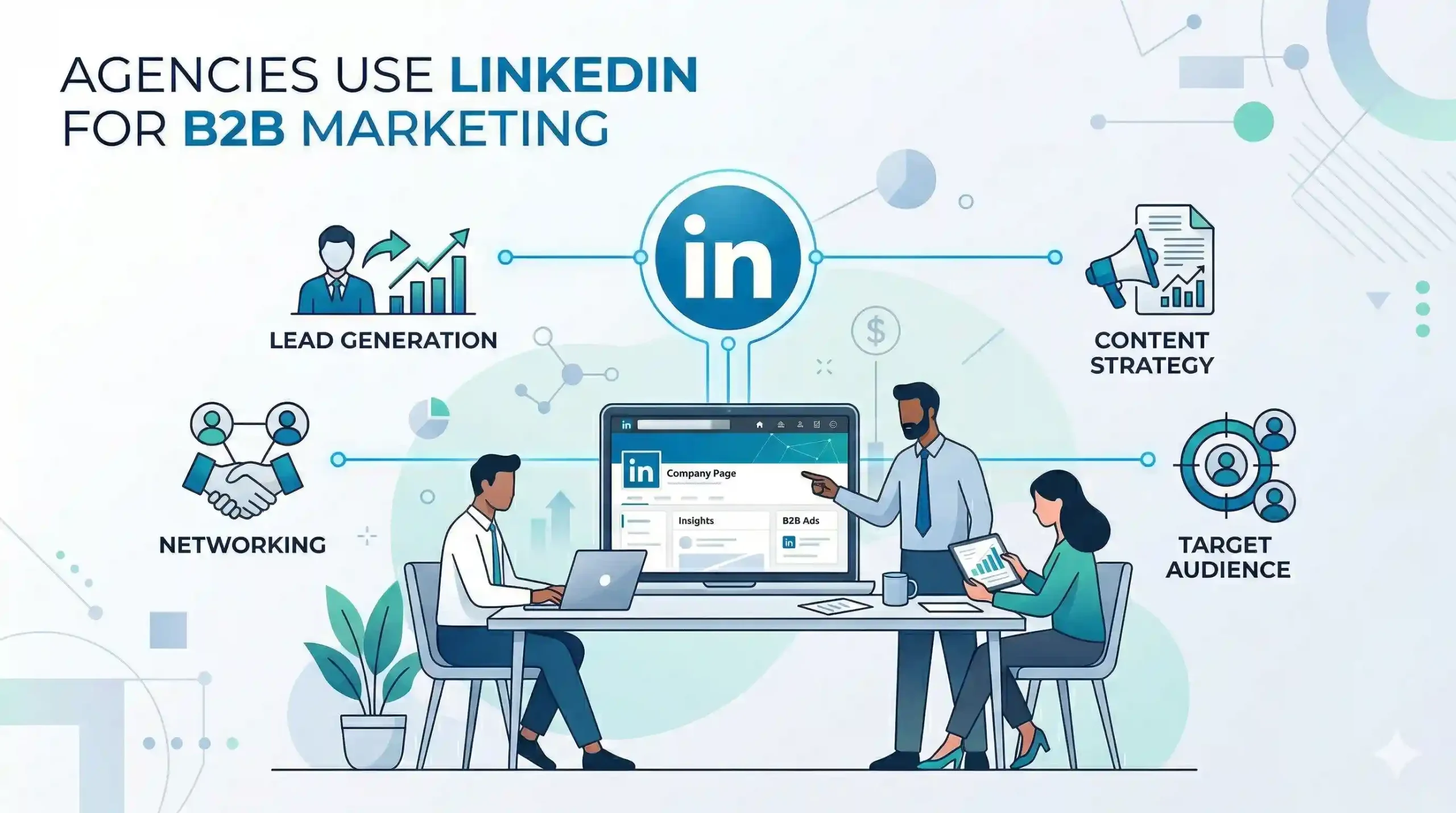

LinkedIn has 900+ million professionals with their job title, company, industry, and seniority listed publicly.
No other platform gives you this. Not Google. Not Meta. Not X.
For B2B marketing, LinkedIn is not optional. It is the primary channel where buyers research solutions, evaluate vendors, and make purchasing decisions in a professional context.
But most companies use LinkedIn wrong. They post random content, spam connection requests, and run ads without a strategy. The result is predictable: zero pipeline, wasted budget, and a team that concludes “LinkedIn doesn’t work for us.”
It does work. The agencies that consistently generate pipeline from LinkedIn follow a specific system. Not random tactics. A system.
This article breaks down exactly how top B2B agencies use LinkedIn across four pillars: profile optimization, content, outreach, and paid media. With benchmarks, frameworks, and specific examples you can apply immediately.
Key Takeaways
- LinkedIn is a professional database, not a social network. The agencies that treat it as a database for targeted outreach and precision advertising outperform those who treat it like Instagram for business people.
- Organic reach on LinkedIn is still higher than any other major platform. A single post from a personal profile can reach 10-50x more people than the same post from a company page.
- The most effective LinkedIn strategy combines three elements: expert content that builds trust, personalized outreach that starts conversations, and targeted ads that accelerate pipeline. Remove any one element and performance drops significantly.
- LinkedIn Ads are expensive. CPL typically runs 2-5x higher than Google Ads. They only work when you have a clear ICP, a strong offer, and a system to process leads fast.
- The metrics that matter are not impressions and followers. They are connection acceptance rate, response rate, meetings booked, CPL, and pipeline generated. Everything else is noise.
Why LinkedIn Is the Primary Channel for B2B
Before tactics, it helps to understand why LinkedIn works differently from every other platform.
LinkedIn Is a Database, Not a Feed
Most platforms show you content from people you follow. LinkedIn shows you content from people in your professional network and adjacent networks.
More importantly, LinkedIn is structured data. Every user profile contains:
- Current job title and company
- Industry and company size
- Years of experience
- Location
- Skills and endorsements
- Education
- Connections and mutual relationships
This means you can find the exact person you want to reach. Not an audience segment. Not a lookalike. The actual human who makes buying decisions at the company you want to sell to.
No other advertising platform gives you this level of targeting precision for B2B.
People Are in Work Mode
When someone opens Instagram, they want to relax. When someone opens LinkedIn, they want to solve a business problem, learn something, or advance their career.
This context matters enormously. A person who clicks on your post or responds to your message on LinkedIn is doing it consciously, in a professional mindset. The intent quality is fundamentally different from any other social platform.
Organic Reach Is Still Alive
LinkedIn’s algorithm has not killed organic reach the way Facebook and Instagram have. A well-crafted post from a personal profile can generate 5,000-50,000 impressions without spending a dollar on promotion.
Personal profiles consistently outperform company pages by 5-10x in reach and engagement. The platform prioritizes people over brands, which creates a massive opportunity for personal branding and thought leadership.
Pillar 1: Profile Optimization
Every agency starts here. Your LinkedIn profile is your landing page. If it’s weak, everything else fails.
Personal Profile
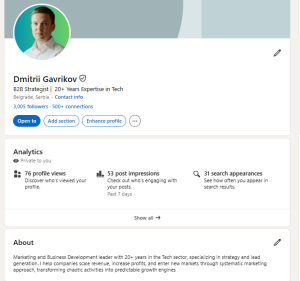
The biggest mistake companies make is treating LinkedIn profiles like resumes. A resume lists what you’ve done. A LinkedIn profile should communicate what you can do for the person reading it.
Headline
The headline is the single most visible element on your profile. It appears in search results, connection requests, comments, and messages. Most people waste it.
| Approach | Example | Impact |
|---|---|---|
| Bad: Job title only | “Marketing Manager at Company X” | Says nothing about value. Invisible in search. |
| Average: Title + company description | “Marketing Manager | Helping companies grow” |
| Good: Value proposition | “Helping B2B SaaS companies generate 200+ SQLs/month through demand generation” | Clear audience, clear outcome, searchable. |
The formula is simple: who you help + what result you deliver. Skip the creative metaphors. Be specific.
About Section
The About section is not your career story. It is a value proposition with proof. Structure it like this:
- Who you help (specific audience)
- What problem you solve (their pain)
- How you solve it (your approach)
- Results you’ve achieved (numbers and specifics)
- Call to action (how to get in touch)
Keep it under 300 words. Use short paragraphs. Break up the text visually. The first two lines are critical because LinkedIn truncates the rest behind a “See more” button.
Experience Section
Each position should read like a mini case study, not a job description. Instead of listing responsibilities, describe:
- What challenge you faced
- What approach you took
- What measurable results you achieved
Numbers make experience credible. “Managed marketing campaigns” tells the reader nothing. “Built demand generation program that grew pipeline from $0 to $2.4M in 14 months” tells a story.
Featured Section
Pin your best content here. A lead magnet, a case study, a high-performing post, or a video. This section is prime real estate that most people leave empty.
Company Page
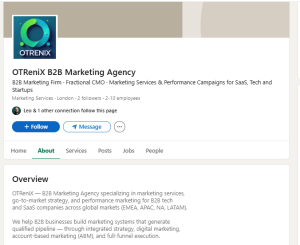
Company pages get less organic reach than personal profiles, but they still matter for three reasons: credibility, social proof, and advertising.
Essential elements:
- About section: Clear positioning. Not “We are an innovative company changing the industry.” Instead: specific statement of who you serve, what you do, and what results you deliver.
- Services section: List what you actually offer. This section is searchable.
- Social proof: Client logos (if permitted), case studies, testimonials.
- Content: Regular posts, even though personal profiles perform better. The page needs to look active and professional.
| Profile Element | Personal Profile Priority | Company Page Priority |
|---|---|---|
| Headline / Tagline | Critical. First thing people see. | Important. Shows in search. |
| About section | High. Drives trust and conversions. | High. Establishes positioning. |
| Experience / Services | High. Proof of expertise. | Medium. Supports credibility. |
| Featured content | High. Showcases best work. | Medium. Useful for lead magnets. |
| Recommendations | Medium. Social proof. | N/A. Not available for pages. |
| Visual branding | Medium. Professional photo and banner. | High. Logo, banner, consistent design. |
Pillar 2: Content Strategy
Content on LinkedIn serves one purpose: building trust with the people who can buy from you. Not impressions. Not followers. Trust.
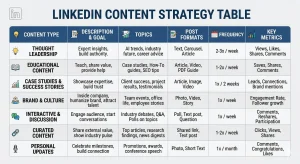
Content Types That Generate Pipeline
Agencies that get results from LinkedIn content follow a specific mix. Not every post is a pitch. Most posts are designed to demonstrate expertise and start conversations.
Expert posts
These are posts where you break down a problem your audience faces and explain how to solve it. They demonstrate knowledge and build credibility.
Example: “Most B2B companies measure LinkedIn success by followers. Here’s why that metric is meaningless and what to track instead.”
This type of post attracts people who have the exact problem you solve. They read it, think “this person understands my situation,” and either follow, comment, or send a message.
Case studies
Real results from real work. Structure: challenge the client faced, what you did, what happened. Include specific numbers. A post that says “We helped a SaaS company” is forgettable. A post that says “We cut CPL from $240 to $87 in 11 weeks for a Series B cybersecurity company” is memorable.
Contrarian takes
Posts that challenge conventional wisdom in your industry. These generate high engagement because people either agree strongly or disagree strongly. Both reactions increase visibility.
Example: “Gating all your content is killing your pipeline. Here’s what happened when we ungated everything for a client.”
The key is having data or experience to back the claim. A contrarian take without evidence is just noise.
Industry analysis
Breakdowns of trends, data, or news relevant to your audience. These position you as someone who stays current and thinks critically about the market.
| Content Type | Goal | Engagement Level | Pipeline Impact |
|---|---|---|---|
| Expert post | Demonstrate knowledge | High (comments, saves) | Medium-high. Attracts ICP. |
| Case study | Prove results | Medium (likes, DMs) | High. Directly drives conversations. |
| Contrarian take | Spark discussion | Very high (comments, shares) | Medium. Builds awareness. |
| Industry analysis | Show relevance | Medium (shares, saves) | Medium. Positions as thought leader. |
| Personal story | Build connection | High (likes, comments) | Low-medium. Humanizes brand. |
| How-to / tactical | Provide value | High (saves, shares) | Medium. Attracts practitioners. |
How the Algorithm Works
Understanding the LinkedIn algorithm helps you write content that actually reaches the right people.
The first 60-90 minutes matter most
LinkedIn evaluates a post’s performance in the first hour. If the post gets early engagement (comments, especially), the algorithm pushes it to a wider audience. If engagement is low, the post dies.
To maximize early engagement:
- Post during your audience’s work hours. For US audiences, that is typically 8-10 AM, 12-2 PM, or 5-7 PM local time.
- Reply to every comment within the first hour. This signals to the algorithm that the post is generating active conversation.
- Ask a question or make a statement that invites response.
Comments beat likes
A comment signals deeper engagement than a like. LinkedIn’s algorithm weighs comments more heavily.
A post with 10 thoughtful comments will outperform a post with 100 likes and zero comments. This means your content should be designed to provoke response, not just agreement.
Personal profiles beat company pages
Posts from personal profiles get 5-10x more reach than identical posts on company pages. LinkedIn wants the platform to feel human, so it promotes individual voices over brand voices.
The practical implication: your company’s LinkedIn strategy should be built around your people posting, not your company page posting. The company page supports. The people lead.
Content Cadence
Consistency matters more than volume. Here is what agencies typically recommend:
| Cadence | Format | Purpose |
|---|---|---|
| 3-5x per week | Short-form posts (personal profile) | Build visibility, attract ICP, drive engagement |
| 1x per week | Long-form post or article | Demonstrate deep expertise |
| 1-2x per month | Case study or results post | Prove outcomes, drive DMs and inquiries |
| 1x per month | Video or carousel | Variety, higher engagement potential |
| As needed | Comment on others’ posts | Expand reach, build relationships |
The commenting strategy is underrated. Leaving thoughtful comments on posts by people in your target audience puts your name in front of their network. It costs nothing and consistently generates profile visits and connection requests.
Pillar 3: Outreach
Content builds awareness. Outreach converts awareness into conversations.
Principles of Effective Outreach
Most LinkedIn outreach fails because it reads like spam. The connection request says “Hi, I saw your profile and thought we could connect.” The follow-up immediately pitches a product. The prospect ignores both messages.
Agencies that generate meetings from LinkedIn follow different principles:
- Personalization. Reference something specific: a post the person wrote, their company’s recent funding round, a shared connection, a conference they attended. Generic messages get ignored.
- Context. Explain why you’re reaching out to this specific person, not just anyone with their job title.
- Value first. Lead with something useful. An insight about their industry, a relevant benchmark, a resource they might find helpful. Not a pitch.
- Patience. The goal of the first message is not to book a meeting. It is to start a conversation. Meetings come from conversations, not cold pitches.
Outreach Sequence
Effective LinkedIn outreach is a sequence, not a single message.
| Step | Action | Goal | Expected Conversion |
|---|---|---|---|
| 1. Connection request | Personalized note (under 300 characters) with specific context | Get accepted | 30-50% acceptance rate |
| 2. Thank you | Short message. No pitch. Ask a question or share an observation. | Start conversation | 10-20% respond |
| 3. Value message | Share something useful: an article, a benchmark, a case study | Demonstrate expertise | 5-10% engage |
| 4. Soft offer | Mention how you’ve helped similar companies. Ask if relevant. | Test interest | 3-5% express interest |
| 5. Meeting request | Suggest a specific time for a call. Keep it low-pressure. | Book a meeting | 1-3% agree |
A 1-3% conversion rate from connection request to meeting is standard for cold outreach. That means if you send 100 connection requests per week, you should expect 1-3 meetings. Over a month, that is 4-12 meetings from one channel alone.
Connection request example (good):
“Hi Sarah. Read your post on reducing churn in PLG SaaS. Really resonated, especially the bit about onboarding friction. Would love to connect and exchange ideas on the topic.”
Connection request example (bad):
“Hi Sarah. I help companies like yours grow revenue. Let’s connect!”
The difference is specificity. The good example shows you actually looked at the person’s profile and content. The bad example could be sent to 10,000 people without changing a word.
Outreach Volume and Tools
Agencies typically manage outreach at scale using a combination of manual effort and tools.
Manual outreach: Higher quality, more personalized. Works best for high-value targets (enterprise accounts, C-suite executives). Recommended volume: 20-30 personalized connections per day.
Semi-automated tools: Tools like LinkedIn Sales Navigator, Expandi, Dripify, or Phantombuster can help with prospecting and sequencing. They speed up the process but require careful personalization. LinkedIn can restrict or ban accounts that send too many automated messages.
LinkedIn Sales Navigator: This is the most important tool for B2B outreach. It provides advanced search filters (company size, seniority, industry, technology used, recent activity) that let you build extremely targeted prospect lists.
| Tool | Purpose | Price Range | Risk Level |
|---|---|---|---|
| LinkedIn Sales Navigator | Advanced search and lead tracking | $80-$150/month | Low. Official LinkedIn product. |
| Expandi | Outreach automation | $99/month | Medium. Use carefully to avoid bans. |
| Dripify | Drip campaigns and sequences | $59-$99/month | Medium. Same caution applies. |
| Phantombuster | Data extraction and automation | $56-$128/month | Higher. Aggressive automation risks account. |
| Shield Analytics | Content performance analytics | $8-$25/month | Low. Analytics only. |
Important warning: LinkedIn actively detects and penalizes automated outreach. Agencies that use automation tools typically keep daily volumes conservative (50-80 connection requests maximum) and always include personalization. Accounts that blast 200+ generic requests per day get restricted.
Pillar 4: LinkedIn Ads
Organic content and outreach build the foundation. LinkedIn Ads accelerate the process.
Why LinkedIn Ads Are Expensive But Worth It
LinkedIn Ads have the highest CPL of any major advertising platform. A typical B2B lead from LinkedIn Ads costs $80-$250, compared to $30-$100 from Google Ads.
The reason is simple: targeting precision. You can target by exact job title, company name, industry, company size, seniority level, skills, and even specific LinkedIn groups. No other platform offers this level of B2B targeting accuracy.
The higher CPL is justified when the lead quality matches. A $200 lead that converts to a $50,000 deal is dramatically more valuable than a $30 lead that never responds to a follow-up call.
When LinkedIn Ads Make Sense
LinkedIn Ads work when three conditions are met:
- Clear ICP. You know exactly who you want to reach: job title, industry, company size, geography. Vague targeting wastes budget fast.
- Strong offer. Not “learn more about our product.” Something with clear value: an industry report, a free audit, a benchmark tool, a webinar with actionable insights, a demo for qualified prospects.
- Lead processing system. A team ready to follow up within 24 hours. LinkedIn leads go cold fast. If leads sit for a week without contact, the campaign is wasting money.
If any of these three elements is missing, don’t run LinkedIn Ads yet. Fix the gap first.
Ad Formats and When to Use Them
| Ad Format | Best For | Typical CPL | Conversion Advantage |
|---|---|---|---|
| Sponsored Content | Awareness, traffic, engagement | $50-$150 | Works at top of funnel. Good for warming up cold audiences. |
| Lead Gen Forms | Direct lead capture | $80-$200 | 3-5x higher conversion than landing pages. Data auto-fills from profile. |
| Message Ads (InMail) | Personalized offers, event invitations | $100-$250 | Lands directly in inbox. High open rates. Risk of feeling spammy. |
| Text Ads | Low-budget awareness, audience testing | $30-$100 | Cheapest format. Lower visibility but useful for testing. |
| Video Ads | Brand awareness, product demos | $50-$150 | Higher engagement, but requires strong creative. |
| Document Ads | Thought leadership, reports | $60-$150 | Native PDF experience. Good for gated content. |
Lead Gen Forms deserve special attention. This format is the most effective for B2B lead generation on LinkedIn. Instead of sending users to an external landing page, the form opens inside LinkedIn and auto-fills fields (name, email, job title, company) from the user’s profile.
The result: conversion rates are 3-5x higher than external landing pages because the user never leaves the platform and doesn’t need to type anything.
The tradeoff: lead quality can be slightly lower because the friction is so low. People submit forms without fully considering whether they’re actually interested. That’s why fast follow-up and lead qualification are essential.
Targeting Strategy
The power of LinkedIn Ads is in the targeting. Here is how agencies typically structure campaigns:
Layer 1: Job function + Seniority
Start with job function (Marketing, IT, Operations, Finance) combined with seniority level (Director, VP, C-suite). This gives you the decision-makers.
Layer 2: Industry + Company size
Narrow by industry and company size (employee count or revenue). This ensures you’re reaching companies that match your ICP.
Layer 3: Geography
Filter by region, country, or specific metro areas depending on your market.
Advanced tactics:
- Matched Audiences: Upload a list of target companies or email addresses and serve ads specifically to those people. This is essentially account-based marketing through paid media.
- Retargeting: Show ads to people who visited your website, engaged with previous ads, or viewed your company page.
- Lookalike audiences: Build audiences that resemble your best customers.
| Targeting Layer | Example | Expected Audience Size |
|---|---|---|
| Job function + Seniority | Marketing Directors and above | Broad (hundreds of thousands) |
| + Industry | SaaS / Technology | Medium (tens of thousands) |
| + Company size | 51-500 employees | Narrow (thousands) |
| + Geography | United States | Focused (hundreds to low thousands) |
| Matched Audiences (ABM) | Specific company list + decision-makers | Very narrow (hundreds) |
Audience size matters. Too broad wastes budget on irrelevant impressions. Too narrow (under 1,000) limits delivery and increases CPL. The sweet spot for most B2B campaigns is 10,000-100,000 for Sponsored Content and 2,000-50,000 for Lead Gen Forms.
Budget Allocation
Agencies typically recommend this budget split for a LinkedIn Ads program:
| Budget Range (monthly) | Recommended Allocation |
|---|---|
| $3,000-$5,000 | Test one format (Lead Gen Forms recommended). Single audience. |
| $5,000-$10,000 | Two formats. Test 2-3 audiences. A/B test creative. |
| $10,000-$25,000 | Full-funnel. Awareness (Sponsored Content) + Lead Gen Forms + Retargeting. |
| $25,000+ | Scale proven campaigns. Add ABM. Test Video and Document Ads. |
Below $3,000 per month, LinkedIn Ads are hard to make work. The platform needs volume to optimize, and small budgets don’t generate enough data for meaningful learning.
Putting It All Together: The Integrated System
The agencies that get the best results from LinkedIn don’t use content, outreach, and ads separately. They run them as one integrated system.
How the System Works
Step 1: Content builds trust.
Your team (founders, sales leaders, subject matter experts) posts expert content 3-5 times per week. This content reaches your target audience organically and establishes credibility.
Step 2: Outreach starts conversations.
While content runs in the background, you send personalized connection requests and messages to target prospects. When a prospect visits your profile, they see a track record of expert posts. Trust is already partially built before the first message.
Step 3: Ads accelerate the pipeline.
LinkedIn Ads target the same ICP with gated content (reports, guides, webinars) and direct offers (demo requests, consultations). Retargeting ads follow people who engaged with your content or visited your website.
Step 4: Everything feeds the CRM.
Every interaction — content engagement, outreach response, ad lead, form fill — flows into the CRM. The sales team sees which prospects engaged with what content, when they responded to outreach, and which ads they clicked. This context makes sales conversations infinitely more productive.
| Channel | Role in the System | Timeline to Impact |
|---|---|---|
| Content (organic) | Build trust, attract ICP, warm up audience | 2-4 months for compound effect |
| Outreach | Convert attention into conversations and meetings | 2-4 weeks for first meetings |
| LinkedIn Ads | Accelerate reach, generate leads at scale | 1-2 months to optimize |
| Retargeting | Re-engage warm prospects across the funnel | Ongoing, compounds over time |
The Compound Effect
LinkedIn is not a quick-win channel. The first month of content will feel like shouting into the void. The first batch of outreach will have low response rates. The first ad campaign will have a high CPL.
But the system compounds. After 3 months, your content has built a body of work. Prospects see your name repeatedly. Outreach gets warmer because people recognize you. Ad CPL drops because your brand has awareness.
After 6 months, inbound starts to grow. People send you connection requests. They comment on your posts and ask about working together. Outreach response rates climb because you’re no longer a stranger.
After 12 months, LinkedIn becomes a predictable pipeline channel. You know how many posts generate how many profile visits. You know how many connection requests generate how many meetings. You know your CPL and conversion rate from ads.
This predictability is what separates a random LinkedIn presence from a LinkedIn system.
Common Mistakes That Kill LinkedIn Performance
Even with a good strategy, these mistakes derail results consistently.
- Posting from the company page only. Company pages get a fraction of the reach. Build personal brands. Let your people lead the content.
- Pitching on the first message. The fastest way to get ignored. Start with value and conversation. The pitch comes later, when the prospect has expressed interest.
- No follow-up system. Generating leads from LinkedIn is worthless if nobody calls them. Leads from LinkedIn go cold within 48 hours. Speed matters.
- Generic content. “5 tips for better marketing” does not build authority. Specificity does. Write for your exact ICP about their exact problems.
- Ignoring comments. Every comment is a conversation starter. Ignoring comments signals that you don’t actually care about engagement. Reply to every comment, especially in the first hour.
- Inconsistency. Posting every day for two weeks and then disappearing for a month destroys algorithmic momentum. Consistency always beats intensity.
- Running ads without organic foundation. When someone sees your ad and clicks through to your profile, they see zero posts and a bare-bones company page. Trust drops immediately. Build organic presence first, then amplify with ads.
- Measuring the wrong things. Celebrating 100,000 impressions while generating zero meetings. Impressions are not pipeline. Optimize for conversations and revenue.
Bottom Line: LinkedIn Is a System, Not a Tactic
The agencies that consistently generate pipeline from LinkedIn treat it as an integrated system with three engines running simultaneously: content, outreach, and ads.
Content builds trust over time. Outreach converts trust into conversations. Ads accelerate reach and scale lead generation. Together, they create a predictable pipeline channel that compounds month over month.
Start with the fundamentals. Optimize your profiles. Post expert content 3-5 times per week from personal accounts. Send 20-30 personalized connection requests daily. Test LinkedIn Ads with a small budget once the organic foundation is in place.
Within 3-6 months, LinkedIn will shift from an experiment to a system. Within 12 months, it can become your primary B2B pipeline channel.
The companies that invest in building this system today will own their category’s attention on the platform tomorrow. The ones that keep posting randomly and spamming connection requests will keep wondering why LinkedIn doesn’t work.
It works. You just need a system.