Fractional CMO for SaaS Companies and Startups

Most SaaS founders hit the same wall around $1M to $3M in ARR. The growth that came from founder led sales, product hunt launches, and word of mouth starts to slow. The team needs a marketing leader who can build a real engine, but a full time CMO costs $250K a year plus equity, and at that stage the company cannot justify the expense.
So the founder hires a marketing manager for $90K, hands them the strategy, and waits. Six months later the website looks slightly better, there is a blog with 12 posts nobody reads, and the pipeline is the same as before.
A fractional CMO solves this problem. You get senior SaaS marketing leadership for 10 to 20 hours a week at a fraction of the cost of a full time hire. The right person builds the positioning, sets up the metrics, hires the team, and leaves you with a working growth engine in 6 to 12 months.
But hiring a fractional CMO for SaaS is different from hiring one for services, agencies, or general B2B. The metrics are different. The growth motions are different. The talent pool that has done this work is smaller than it looks. In this article I will show you when to hire a fractional CMO for your SaaS company, what they should actually do, what to pay, and how to avoid the most common mistakes.
Key Takeaways
- A fractional CMO is a senior SaaS marketing leader who works with you part time, usually 10 to 20 hours a week, for $4K to $20K a month.
- Hire one when SaaS growth slows from product led signups, founder sales, or paid ads, but you are not yet ready for a full time CMO. This is usually between $1M and $20M in ARR.
- The job is strategy, hiring, systems, and metrics. Not running ads or writing posts. If you need execution help, hire a marketing manager or agency instead.
- A SaaS specific CMO understands product led growth (PLG), sales led growth (SLG), and the hybrid motions in between. Generalists often miss the SaaS specific levers.
- Expect a working system in 6 to 12 months. The first 90 days are audit, strategy, and team. Real ARR impact shows up in months 4 to 9.
- The biggest risk is hiring someone who has only done late stage SaaS marketing. The playbooks at $200M ARR do not work at $3M ARR.
What a Fractional CMO Actually Does for a SaaS Company
A fractional CMO is a marketing executive who works for several SaaS companies at the same time. Each client gets a slice of their week, usually 10 to 20 hours, with full strategic responsibility for marketing.
This is not consulting. A consultant gives you a deck and leaves. A fractional CMO owns the outcome. They sit in your leadership meetings, hire your team, set the budget, work with sales and product, and report on results every month.
This is also not freelancing. A freelancer executes specific tasks like ads or content. A fractional CMO decides which tasks should be done in the first place, which ones to kill, and how the whole system fits together.
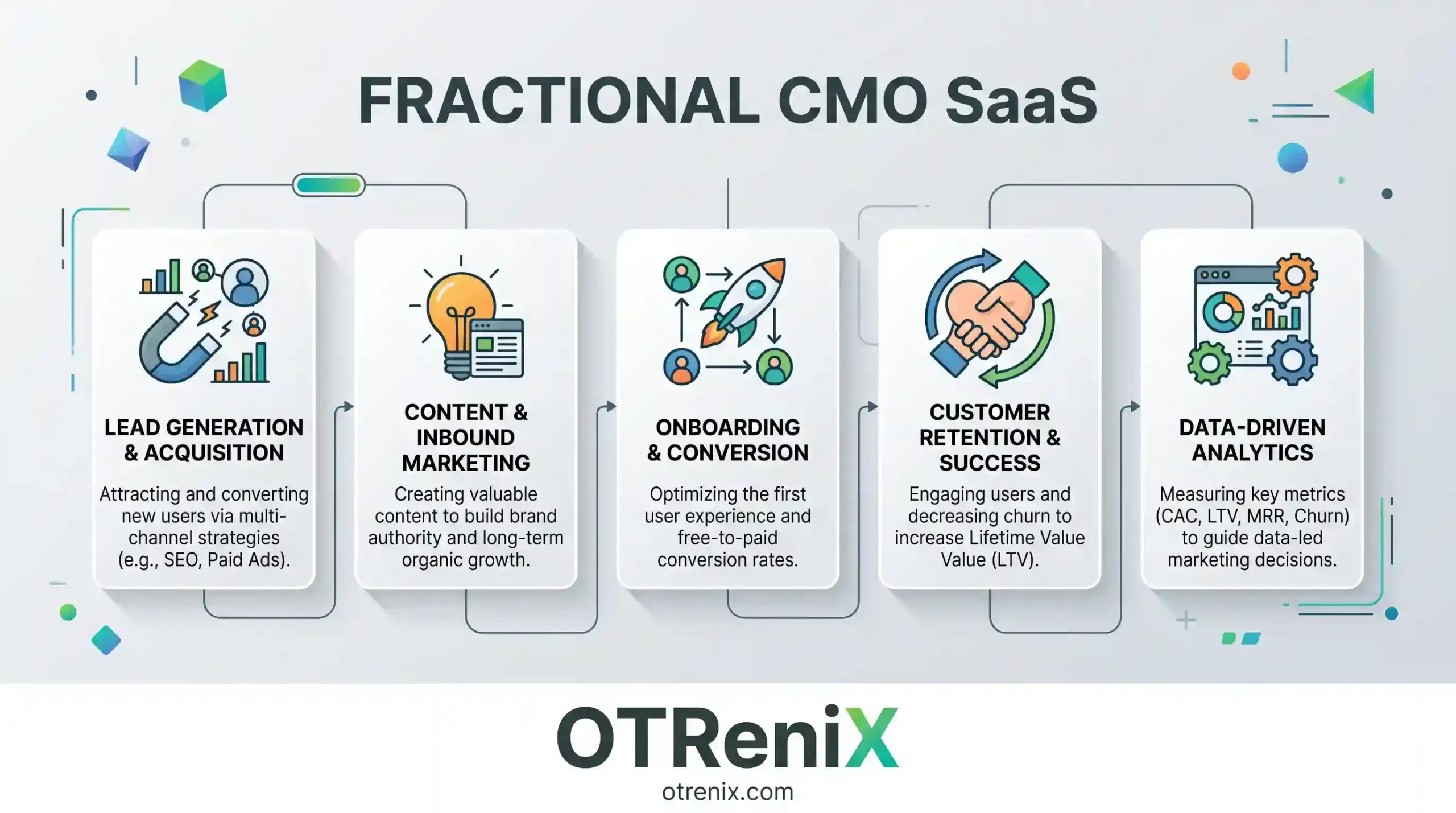
For SaaS specifically, the fractional CMO usually works on 6 things in parallel.
Positioning and ideal customer profile
Most SaaS companies under $10M ARR have unclear positioning. They sell to “marketing teams” or “any company with security needs,” which is too broad. The fractional CMO interviews 15 to 25 customers and prospects, finds the segment where you actually win, and rewrites the website, sales deck, and onboarding around that segment. This single step usually doubles inbound qualified leads within 4 to 6 months.
Growth motion design
SaaS has 3 main growth motions: product led growth (PLG), sales led growth (SLG), and hybrid. Each has different metrics, different team structures, and different budget allocations. A fractional CMO chooses the right motion for your stage and product, then builds the marketing engine around it. Companies that try to run PLG and SLG at the same time without a clear plan usually fail at both.
Funnel and metrics setup
Most SaaS companies under $5M ARR cannot answer basic questions like “What is our blended CAC?” or “What is the conversion rate from free trial to paid?” The fractional CMO sets up the analytics, defines the metrics that matter for your stage, and builds dashboards the founder and the board can actually read.
Pricing and packaging
SaaS pricing leaks more revenue than almost anything else. Companies often discover they have been undercharging by 30% to 50%, or charging the wrong way (per seat when usage matters, or flat fees when seats matter). A good fractional CMO works with the founder and head of product on pricing, which is one of the highest leverage marketing levers in SaaS.
Hiring the team
The fractional CMO does not execute the daily work. They hire and direct the people who do. In a typical engagement, the CMO hires 1 to 3 people in the first 6 months: usually a content lead, a demand generation specialist, and either a product marketer or a marketing operations person depending on the stage.
Working with sales and product
In SaaS, marketing alone produces little. Marketing plus sales plus product alignment produces ARR. The fractional CMO sets up the operating cadence between marketing, sales, and product. Weekly pipeline reviews, monthly product marketing handoffs, quarterly planning. This is unglamorous work that most agencies skip and most founders underestimate.
When a SaaS Company Needs a Fractional CMO
A fractional CMO is the right hire in a specific window. Too early and you are paying for strategy you cannot execute. Too late and a part time leader cannot hold the role.
Signs your SaaS company is ready
- ARR between $1M and $20M. Below $1M, the founder should still own marketing. Above $20M, you usually need a full time CMO with VPs underneath.
- Growth is slowing. What worked from $0 to $1M (founder selling, product hunt, communities, hand built ads) is no longer producing the same results. You need a system, not another push.
- You have or can hire 1 to 3 marketing people. A fractional CMO needs a team to lead. Without a team, they will spend their hours doing junior work that wastes their time and your money.
- You have at least 50 paying customers. Below this, the data is too thin to build real positioning. The fractional CMO will be guessing instead of analyzing.
- You can spend $5K to $50K a month on marketing execution beyond the CMO fee. Strategy without budget produces nothing.
Signs you are not ready
- You are pre revenue or pre product market fit. Hire a marketing advisor for a few hours a month instead.
- You expect the CMO to also write content, run ads, manage social media, and do SEO. That is a full marketing team, not one person at 15 hours a week.
- You want them to “fix marketing” in 60 days. A real SaaS marketing system takes 6 to 12 months to build.
- The founder is not willing to spend 2 to 3 hours a week aligning with the CMO. Without founder time, even the best CMO will fail.
- You expect linear ROI on every dollar spent. SaaS marketing has compound effects that take 6 to 12 months to show up in ARR.
If you check most of the “ready” signs and few of the “not ready” signs, start your search.
What a Fractional CMO Does in the First 90 Days for a SaaS Company
A good fractional CMO follows a predictable arc in the first quarter. If your candidate cannot describe something like this, they are not senior enough.
Month 1: audit and strategy
In the first month the CMO learns the business. They interview 15 to 25 customers and lost prospects, talk to sales and customer success, review the product, audit current marketing, and look at the data. The output is a written strategy document that answers 5 SaaS specific questions:
- Who is the ICP, what do they call themselves, and how do they buy?
- What is the growth motion: PLG, SLG, or hybrid? Why?
- What is the pricing and packaging strategy?
- Which 2 or 3 channels will drive growth, and why those?
- What does the team need to look like in 6 months?
By the end of week 4 you should receive a written document of 15 to 25 pages. Not a slide deck. A document you can debate.
Month 2: team and systems
In the second month the CMO builds the foundation. This means hiring or restructuring the team, setting up analytics so you can measure CAC, payback period, and conversion at every funnel stage, choosing the SaaS marketing tools (CRM, marketing automation, product analytics, attribution), and writing playbooks for each channel.
This month rarely produces visible ARR results, and that is normal. You are paying for the system that will produce results in months 4 to 9. If your CMO promises ARR growth in month 2, they are either inexperienced or about to take shortcuts that hurt you later.
Month 3: execution and metrics
In the third month the team starts running campaigns under the new strategy. Content publishing becomes regular, paid programs get retuned, lifecycle emails launch, and the first product marketing assets ship. By the end of month 3 you should see early signals: more qualified signups, better trial to paid conversion, or a clearer pipeline from outbound.
If after 90 days the CMO has not produced a written strategy, a working team, and a measurable funnel, something is wrong. Either the engagement is under scoped, the founder is blocking decisions, or the CMO is not senior enough for SaaS.
SaaS Specific Skills to Look For
A generalist B2B fractional CMO will struggle in SaaS. The metrics, motions, and tooling are different. Here is what to specifically check for.
Product led growth experience
If your product has self serve signup, free trials, or freemium, you need a CMO who has run PLG before. Ask about specific PLG metrics they have improved: activation rate, trial to paid conversion, time to value, expansion revenue, viral coefficient. A CMO who only knows traditional B2B funnels will struggle to grow a PLG product.
Sales led growth experience
If you sell to mid market or enterprise customers, you need someone who understands long sales cycles, ABM, sales and marketing alignment, and pipeline coverage ratios. Ask about specific deals they helped close, the average deal size, and how marketing influenced the cycle. PLG specialists often struggle with enterprise SaaS dynamics.
SaaS metrics fluency
A senior SaaS CMO can talk fluently about CAC payback, LTV to CAC ratios, net revenue retention (NRR), gross retention, and the difference between MRR and ARR growth. If they say “we drove leads” instead of “we improved blended CAC payback from 18 months to 11 months,” they have not led real SaaS marketing.
Pricing experience
Ask if they have led a pricing change. The answer should be yes, with a specific story: what was changed, what the result was, how customers reacted. SaaS CMOs who have never touched pricing have only worked on half the marketing job.
Tooling fluency
In SaaS, the tools matter. The CMO should be fluent with CRM (HubSpot, Salesforce), marketing automation (HubSpot, Marketo), product analytics (Mixpanel, Amplitude, Heap), and attribution (Bizible, Dreamdata, or homegrown). They do not need to be the admin, but they need to know what each tool does and what the data should look like.
Channels That Actually Work for SaaS in 2026
A good SaaS fractional CMO knows which channels produce real pipeline at each stage. Here is a realistic picture of what works for companies in the $1M to $20M ARR range.
| Channel | Effort to set up | Time to results | Typical contribution |
|---|---|---|---|
| SEO and content | High | 6 to 12 months | 20% to 40% of inbound |
| Paid search (Google) | Low | 1 to 3 months | 10% to 25% |
| Paid social (LinkedIn) | Medium | 3 to 6 months | 10% to 20% |
| Outbound sales (with marketing support) | Medium | 1 to 6 months | 15% to 40% |
| Product led growth loops | Very high | 6 to 18 months | 20% to 60% (if PLG) |
| Customer advocacy and referrals | Medium | 3 to 9 months | 10% to 25% |
| Communities and partnerships | High | 6 to 12 months | 5% to 20% |
| Events and field marketing | Medium | 1 to 6 months | 5% to 15% |
| Founder personal brand on LinkedIn | High | 6 to 12 months | 5% to 20% |
A fractional CMO will usually pick 3 or 4 channels at a time, not all 9. Trying to run everything at $1M to $5M ARR spreads the team too thin and produces mediocre results across the board.
What to Pay a Fractional CMO for SaaS
SaaS fractional CMO pricing varies by experience, stage, and engagement model. Here is the current market.
Pricing models
| Model | Range | When it works |
|---|---|---|
| Monthly retainer | $4K to $20K a month | Default option for ongoing leadership |
| Day rate | $2K to $4K a day | Audits, short projects, interim coverage |
| Hourly | $300 to $600 an hour | Advisory only, less than 5 hours a week |
| Equity plus reduced cash | $4K to $8K plus 0.25% to 1% | Early stage SaaS with low cash, high upside |
Most SaaS engagements settle into a monthly retainer of $10K to $15K for 12 to 16 hours a week. This is the sweet spot for both sides at the $2M to $15M ARR range.
What drives the price
- SaaS stage experience. A CMO who has taken 3 SaaS companies from $2M to $20M ARR will charge more than a generalist.
- PLG vs SLG specialization. Pure PLG specialists often charge a premium because the talent pool is smaller.
- Team size. Leading 1 to 2 people is cheaper than leading 8 to 10.
- Time commitment. 8 hours a week costs more per hour than 20 hours a week, which is counterintuitive but reflects context switching cost.
- Equity components. Some SaaS CMOs offer reduced cash in exchange for performance bonuses tied to ARR or pipeline.
If a candidate quotes $5K a month for full SaaS CMO responsibilities, be careful. Either they are junior, stretched across too many clients, or about to take a full time job and treating you as a placeholder.
What is included and what is not
The retainer covers strategy, leadership, hiring, weekly meetings, and reporting. It does not cover execution work, ad spend, software, or contractors. Plan for an additional $5K to $50K a month in marketing budget depending on your stage and goals.
A common mistake is assuming the CMO will write blog posts, run LinkedIn Ads, and design landing pages. They will not. Their job is to direct that work, not do it. Budget for the team that will execute under their leadership.
How to Find SaaS Fractional CMO Candidates
The best SaaS fractional CMOs do not advertise. They are usually busy, work through referrals, and are picky about clients.
Where to look
- Founder networks. Ask 10 SaaS founders in your network who they would hire. The same 2 or 3 names will come up.
- LinkedIn. Search for “Fractional CMO” plus your category (PLG SaaS, vertical SaaS, dev tools, etc.). Look at content, past roles, and recommendations.
- Specialized marketplaces. Platforms like Chief Outsiders, MarketerHire, and Growth Collective curate fractional executives.
- SaaS communities. Slack groups, paid masterminds, conferences, and SaaS specific networks like SaaStr, Pavilion, and Demand Curve are good sources.
Avoid generic freelance platforms like Upwork. The senior SaaS CMO market does not live there.
How to filter the long list
You will probably collect 10 to 20 names. Cut to 3 to 5 finalists using these filters:
- They have run marketing for at least 2 SaaS companies, ideally one at your stage.
- They can show specific SaaS metrics they moved: CAC, conversion rates, NRR, ARR growth.
- They know the difference between PLG and SLG and can explain when each fits.
- They have built a marketing team of at least 3 people, not just done the work themselves.
- They have 5 or fewer current clients. More than that and you are getting a freelancer in disguise.
How to Interview a SaaS Fractional CMO
The interview is where most SaaS founders make their mistake. They ask about tools and tactics (“Have you used HubSpot? Run Google Ads?”) instead of testing strategic SaaS thinking.
Use 3 categories of questions.
Strategic questions
These show whether the candidate can think like a SaaS CMO.
- Walk me through how you would approach our business in the first 30 days.
- Look at our pricing page. What 3 things would you change in the first month, and why?
- Our biggest competitor is X. How would you position us against them?
- Should we be PLG, SLG, or hybrid? Why?
- We have $30K a month for marketing. How would you split it across channels in the first quarter?
A weak answer is generic. A strong answer is specific to your business and includes trade offs. The best candidates will push back on assumptions in your questions.
Tactical and metric questions
These show whether they have actually done SaaS marketing.
- Tell me about a CAC payback you improved. What was the before and after?
- Describe a pricing change you led. What changed and what was the result?
- What is the difference between activation, conversion, and retention metrics? Which matters most at our stage?
- Tell me about a marketing hire that did not work out. What went wrong?
- How do you work with sales and product in a SaaS company?
You are looking for honesty, specificity, and SaaS metric fluency. A candidate who has never moved CAC or led a pricing change has not done senior SaaS marketing.
Cultural fit questions
A fractional CMO will sit in your leadership meetings every week.
- Why do you do fractional work instead of a full time CMO role?
- What kind of founder do you work best with? What kind do you avoid?
- Tell me about a SaaS engagement that ended badly. What happened?
- What do you expect from me as the founder?
The best candidates have clear expectations of you. They require founder time, weekly calls, access to product analytics, and a seat in the leadership meeting. If they do not, they are planning to coast.
Red Flags to Watch For
Beyond the general red flags for any fractional CMO, a few are specific to SaaS.
- They cannot explain SaaS metrics in detail. A senior SaaS CMO talks fluently about CAC, LTV, NRR, and payback. If they reach for vanity metrics like impressions and leads, they are not at the level you need.
- They have never touched pricing. Pricing is one of the highest leverage marketing levers in SaaS. A CMO who has only run campaigns has only worked on half the job.
- They reach for late stage playbooks. A CMO who only knows what works at $100M ARR will overinvest in brand and underinvest in pipeline at your stage.
- They have no opinion on PLG vs SLG. A senior SaaS CMO has strong views on growth motion and can explain when each fits. If they shrug at the question, they have not run real SaaS marketing.
- They want to start with tactics. A CMO who jumps to “let me run some ads” before understanding your customer and metrics is a freelancer in a CMO costume.
- They have 8 or more clients. Nobody can give real strategic leadership to 8 SaaS companies in 40 hours a week.
One red flag is not a deal breaker. Three or more, and you are looking at the wrong person.
Onboarding: First 30 Days
Even a great SaaS fractional CMO will fail with a bad onboarding. Set them up for success.
- Give them full access. Product analytics, CRM, billing data, customer interviews, sales calls, and the product roadmap. If you hold information back, they cannot make good decisions.
- Introduce them to sales, product, and customer success. SaaS marketing does not live alone. The CMO needs working relationships with all 3 in week 1.
- Block 2 hours a week of founder time. This is not optional. The founder owns the vision and the budget. Without regular founder time, the CMO will drift.
- Agree on the 90 day deliverables. Strategy document by end of month 1, team and systems by end of month 2, first metrics by end of month 3. Write this down before they start.
- Do not change the plan in week 2. Founders often panic when they do not see immediate results and pivot the strategy. Give the plan 90 days before changing anything.
- Set up a shared workspace. A Notion page or shared drive for strategy documents, meeting notes, and progress updates. Transparency builds trust on both sides.
Recommendation
If you run a SaaS company between $1M and $20M ARR and growth is slowing, start the fractional CMO search this month.
Build a list of 10 candidates with direct SaaS experience at your stage and growth motion. Skip generalists, even strong ones. The learning curve is too steep for part time work. Ask each SaaS founder in your network who they would hire if they were in your position. The same 2 or 3 names will come up and those are your starting list.
Interview your top 3 finalists with a specific focus on SaaS depth. Ask them to describe your ICP in detail. Ask about CAC payback periods they have improved. Ask about pricing changes they have led. Ask whether they would run PLG, SLG, or hybrid for your business and why. A candidate who cannot answer these in specific terms is not senior enough for your stage.
Call at least 3 references for your top pick. Ask each one: “If you were doing it over, would you hire them again, and why?” Specific answers with numbers tell you they delivered. Vague praise tells you the engagement was forgettable.
Sign a 6 month contract at $10K to $18K a month, with a 30 day exit clause after day 90. Plan for $20K to $50K a month in additional execution budget based on your stage. Block 2 hours a week of founder time for weekly strategy calls. Give them full access to product analytics, sales data, and the product roadmap from day 1.
Expect the first 90 days to focus on positioning, customer interviews, and foundation. Real ARR impact starts in month 4 and compounds through month 12. A good SaaS fractional CMO can cut your CAC payback period by 30% to 50% and double your qualified pipeline within a year.
Marketing in SaaS is hard, especially at the $1M to $20M ARR stage where the founder can no longer run it alone but a full time CMO is too expensive. A fractional CMO is the highest leverage marketing hire most SaaS companies can make at this stage. Pick well, onboard properly, and give it time.
