How to Choose Industrial Marketing Agency
Industrial marketing is not SaaS marketing. It is not e-commerce marketing. And it is definitely not consumer marketing with a B2B label on top.
If you manufacture valves, build industrial equipment, or sell raw materials to factories, your marketing challenges are fundamentally different. Your buyers are engineers, procurement directors, and plant managers. They do not respond to trendy LinkedIn carousels or gated ebooks about “digital transformation.”
Yet most agencies approach industrial clients with the same playbook they use for software companies. They talk about MQLs, growth hacking, and viral content. Meanwhile your sales team needs qualified RFQs, distributor support, and technical content that speaks to people who actually build things.
This is why choosing the right agency matters more in industrial B2B than in almost any other sector.
Key Takeaways
- Industrial B2B has unique characteristics that most marketing agencies do not understand. Long sales cycles, technical buyers, distributor networks, and spec-driven purchasing require specialized expertise.
- The biggest risk is hiring a digital-first agency that has never worked with manufacturers. They will spend your budget on tactics that work in SaaS but fail in industrial environments.
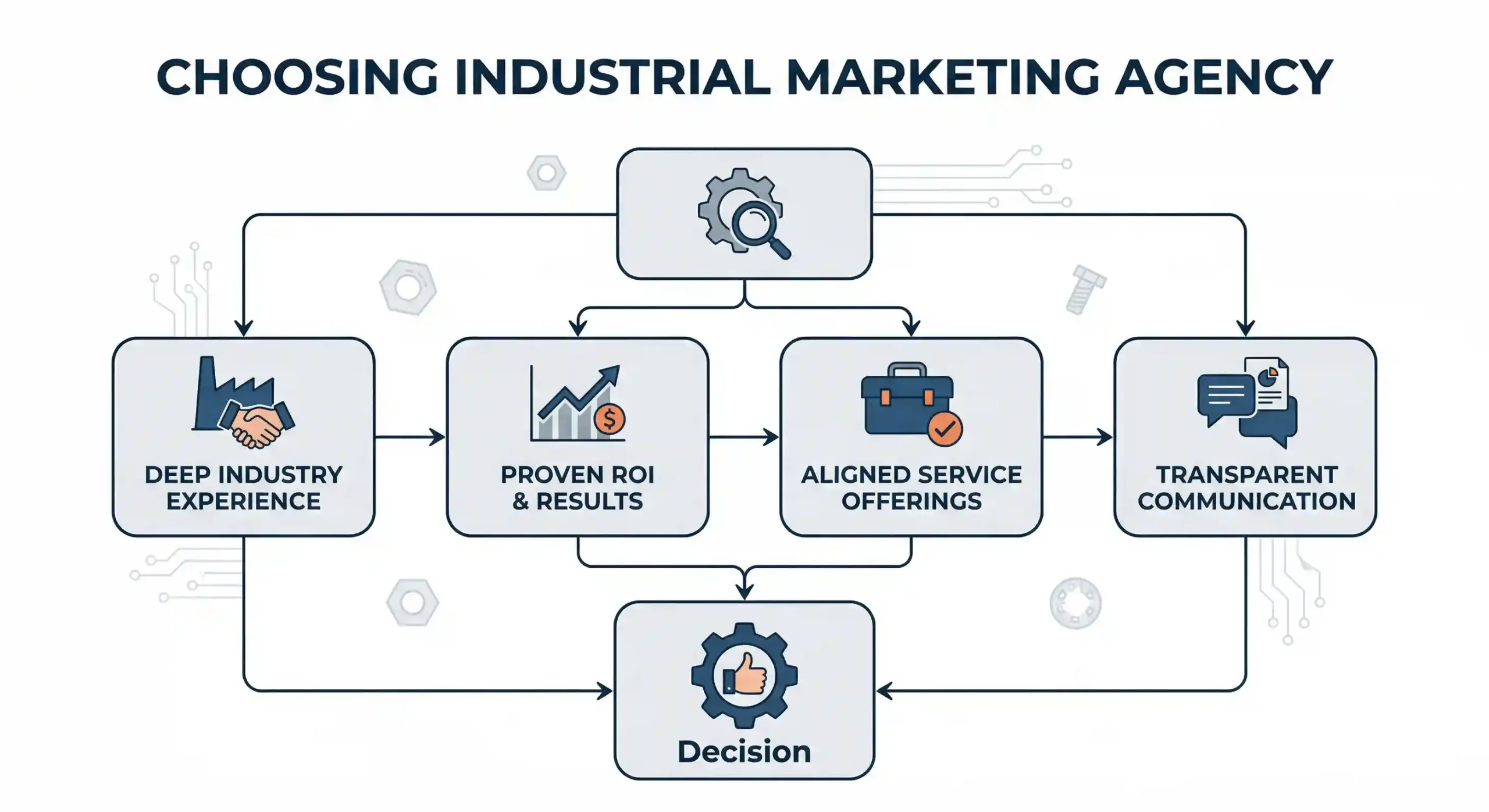
- Evaluate agencies on five factors: industrial sector experience, technical content capability, understanding of distributor and channel dynamics, team seniority, and revenue-linked results.
- Your agency must be able to talk to engineers and procurement teams, not just marketing departments. If they cannot explain your product’s technical advantages clearly, they cannot market it.
- A good industrial marketing agency does not just generate leads. It supports the entire sales cycle from awareness through specification to purchase order.
Why Industrial B2B Needs a Specialized Agency
Industrial companies operate in a world that most agencies have never seen. Here is what makes this sector different from everything else.
Your buyers are technical experts
In SaaS, you market to marketing directors and business executives. In industrial B2B, your primary audience is often engineers, quality managers, maintenance supervisors, and procurement specialists. These people evaluate products based on specifications, certifications, tolerances, and compliance standards.
A generic agency will create content that sounds like it was written for a business school course. Your buyers will ignore it immediately. They want data sheets, application guides, technical comparisons, and engineering case studies.
Your sales cycle involves specs and approvals
Industrial purchasing is not like clicking “buy now” on a website. A typical deal involves technical evaluation, sample testing, engineering approval, procurement review, and sometimes regulatory compliance. This process can take 6 to 18 months.
Your agency needs to understand each stage and create content that supports buyers at every step. From initial awareness to final specification, every touchpoint must add value.
Distributors and channel partners are part of the equation
Many industrial companies sell through distributors, reps, and channel partners. This adds a layer of complexity that most agencies do not know how to handle. Your marketing must support both direct sales and channel sales without creating conflict.
An agency that only knows direct-to-buyer digital marketing will miss this entirely. They need to understand co-marketing with distributors, rep enablement tools, and channel program support.
Your products are not “exciting” in the traditional sense
Nobody is going to share a social media post about your hydraulic fittings. That is fine. Industrial marketing does not need to go viral. It needs to reach the right 500 people in your target market with the right message at the right time.
A specialized agency understands this. They focus on precision targeting instead of mass reach. They measure success by RFQs and pipeline value, not likes and shares.
Trade shows and industry events still matter
In many industrial sectors, trade shows remain a critical channel. Your agency should know how to integrate digital marketing with event strategy. This includes pre-show campaigns, booth content, lead capture systems, and post-show follow-up sequences.
An agency that dismisses trade shows as “old school” does not understand industrial buying behavior. The best agencies use digital to amplify your event presence, not replace it.
The Five Mistakes Industrial Companies Make When Hiring an Agency
These errors cost industrial companies time, budget, and pipeline. Avoid them.
Mistake 1: Hiring a SaaS-focused agency for industrial marketing
This is the most common and most expensive mistake. SaaS agencies are built for short sales cycles, self-serve products, and digital-first buyers. They optimize for demo requests and free trial signups.
Industrial buyers do not sign up for free trials. They request quotes, evaluate samples, and run qualification tests. The entire buying process is different, and SaaS tactics do not translate.
When a SaaS agency works with an industrial client, they typically push tactics like chatbots, gated content libraries, and marketing automation sequences. These tools can work in industrial marketing, but only when adapted to how industrial buyers actually behave.
Mistake 2: Choosing an agency that cannot write technical content
If your agency cannot explain the difference between 304 and 316 stainless steel, they cannot write content for your audience. Industrial content marketing requires technical accuracy combined with clear communication.
Many agencies outsource content writing to generalist freelancers. Those writers can produce blog posts about “5 trends in manufacturing” but cannot write an application guide that an engineer would trust. Your agency needs either in-house technical writers or a reliable network of subject matter experts.
Mistake 3: Ignoring the distributor and channel dimension
If you sell through distributors, your agency must understand channel marketing. This includes creating co-branded materials, supporting distributor websites, running MDF programs, and building tools that help your channel partners sell more effectively.
An agency that focuses only on driving leads to your direct sales team will create conflict with your distribution network. In industrial B2B, channel relationships are long-term partnerships. Your marketing should strengthen them, not compete with them.
Mistake 4: Expecting instant digital results
Industrial marketing takes time. Your buyers do not make impulse purchases. Building awareness, trust, and preference in a technical market requires consistent effort over 6 to 12 months.
If you expect an agency to triple your leads in the first quarter, you will be disappointed. A realistic timeline for measurable impact in industrial B2B is 4 to 6 months for early signals and 9 to 12 months for significant pipeline growth.
Mistake 5: Not involving your sales and engineering teams
Your sales team knows the objections buyers raise. Your engineers know the technical details that matter most. If the agency does not have direct access to these people, their marketing will be generic and ineffective.
The best industrial agencies build relationships with your internal experts. They interview engineers, join sales calls, visit production facilities, and study your products firsthand. Without this access, they are guessing.
How to Evaluate a B2B Industrial Marketing Agency
Use these five criteria to compare agencies and make a smart decision.
Industrial Sector Experience
This is the most important factor. Ask the agency which industrial verticals they have worked in. Look for experience in your specific sector or closely related ones.
An agency that has worked with industrial automation companies will understand process manufacturing clients faster than one coming from healthcare SaaS. Relevant sector experience reduces ramp-up time and increases the quality of strategy from day one.
Ask for case studies from industrial clients. Not SaaS, not e-commerce, not retail. Industrial. Look at the types of companies they worked with, the challenges they solved, and the results they delivered.
Questions to ask:
- What percentage of your clients are in manufacturing or industrial sectors?
- Which specific industrial verticals do you specialize in?
- Can you show me three case studies from industrial clients?
- How do you handle the technical complexity of industrial products?
Technical Content Capability
Content is the foundation of industrial marketing. But not any content. Your agency must produce materials that technical buyers trust and use.
This includes application guides, technical white papers, engineering case studies, product comparison tables, specification sheets, and installation or maintenance guides. The agency should also be able to create content for different stages of the buying process.
At the awareness stage, buyers need educational content about industry challenges. At the evaluation stage, they need technical comparisons and proof of performance. At the specification stage, they need detailed product data and compliance documentation.
Questions to ask:
- Do you have technical writers with industrial experience?
- Can you show me examples of technical content you have produced?
- How do you ensure technical accuracy in the content you create?
- What is your process for working with client engineers on content?
Distributor and Channel Marketing Expertise
If you sell through channels, this criterion is essential. The agency should understand how to create marketing programs that support both direct and indirect sales.
This includes distributor marketing toolkits, co-branded campaigns, partner portals, MDF program management, and channel-specific lead routing. Not every agency knows how to do this. Ask specifically about their channel marketing experience.
If you sell direct only, this criterion is less important. But even direct-sales industrial companies often work with reps or integrators who need marketing support.
Questions to ask:
- Have you managed marketing for companies that sell through distributors?
- Can you build co-branded marketing materials and campaigns?
- How do you handle lead routing between direct sales and channel partners?
- Do you have experience with MDF or co-op advertising programs?
Team Seniority and Industry Knowledge
The people who work on your account determine your results. In industrial marketing, experience matters more than in most other sectors because the learning curve is steep.
Ask who will be on your team and what their background is. Look for people who have worked in or with industrial companies before. Former manufacturing marketers, engineers who moved into marketing, or agency veterans with 10+ years of industrial experience are strong indicators.
If the team is entirely made up of people under 25 with no industrial exposure, they will struggle with your account regardless of how talented they are.
Questions to ask:
- Who specifically will work on our account?
- What is their experience with industrial or manufacturing clients?
- Will the senior person from the pitch be involved in ongoing work?
- What is the average employee tenure at your agency?
Revenue-Linked Results
Industrial marketing must connect to business outcomes. The agency should track metrics that matter to your bottom line, not just marketing activity numbers.
Look for case studies and reports that show pipeline growth, RFQ volume increase, cost per qualified lead, sales cycle acceleration, and revenue attribution. If the agency only talks about website traffic, keyword rankings, or social media engagement, they are not measuring what matters for industrial companies.
Questions to ask:
- How do you measure success for industrial clients?
- Can you show me pipeline or revenue metrics from past engagements?
- How do you connect marketing activity to RFQs and purchase orders?
- What reporting do we receive and how often?
Evaluation Table
| Criterion | Weight | What to Look For |
|---|---|---|
| Industrial Experience | 30% | Specific vertical expertise, industrial case studies, relevant client portfolio |
| Technical Content | 25% | Technical writers, engineering-grade content samples, SME collaboration process |
| Channel Marketing | 15% | Distributor support, co-branding, MDF programs, partner enablement tools |
| Team Seniority | 15% | Experienced industrial marketers on the account, low turnover, hands-on leadership |
| Revenue-Linked Results | 15% | Pipeline metrics, RFQ tracking, CAC data, revenue attribution |
What Services Should an Industrial Marketing Agency Provide
A strong industrial agency covers multiple areas. Here is what to expect.
Strategy and positioning
Your agency should help you define or refine your market positioning. This includes ICP development, competitive analysis, value proposition creation, and messaging frameworks tailored to technical buyers.
Without positioning, every campaign is a guess. An industrial agency should start here before running any ads or publishing any content.
Technical content marketing
Blog articles, white papers, application notes, case studies, video demonstrations, and product guides. All content must be technically accurate and written for engineers and procurement professionals, not general business audiences.
Expect 4 to 8 content pieces per month depending on your retainer level. The agency should have a review process that involves your internal technical experts.
Website and digital presence
Your website is often the first place a potential buyer evaluates your company. The agency should build or optimize a site that works for industrial buyers. This means clear product information, easy access to specs and data sheets, RFQ forms, distributor locators, and mobile-friendly design.
SEO for industrial markets
Industrial SEO is different from consumer SEO. Your agency should target long-tail technical keywords that your buyers actually search for. Terms like “high-temperature silicone gasket supplier” or “ISO 9001 precision machining services” matter more than generic high-volume keywords.
Paid media
LinkedIn Ads and Google Ads work well for industrial marketing when targeted correctly. The agency should build campaigns around job titles, industries, company sizes, and technical intent keywords. Ad spend is separate from the retainer in most cases.
Trade show and event support
Pre-show email campaigns, landing pages, on-site content, lead capture integration, and post-show nurture sequences. A good industrial agency treats every trade show as a full campaign, not just a booth with brochures.
Sales enablement
Materials that help your sales team close deals. This includes proposal templates, competitive battle cards, ROI calculators, objection-handling guides, and customer reference documents. In complex industrial sales, these tools are as important as lead generation.
Pricing Expectations for Industrial Marketing Agencies
Industrial agencies generally charge within these ranges.
| Tier | Monthly Retainer | What You Get |
|---|---|---|
| Basic | $5K–$10K | Execution in 1–2 channels, basic content, limited strategy |
| Mid-level | $10K–$20K | Strategy + execution, senior strategist, 3–4 channels, trade show support |
| Full-service | $20K–$35K+ | Full strategic partnership, fractional CMO, dedicated team, multi-channel programs |
Ad spend, creative production, and event costs are typically separate from these retainers.
Companies under $5M revenue should look at Tier 1 or work with a fractional CMO first. Companies between $5M and $50M will get the most value from Tier 2. Companies above $50M with complex product lines and global distribution should consider Tier 3.
How to Choose Based on Your Situation
You sell direct to end users
Look for an agency with strong demand generation and digital marketing capabilities. They should know how to reach engineers and procurement managers through LinkedIn, Google, technical publications, and industry communities. Trade show support is a bonus.
You sell through distributors
Look for an agency with channel marketing experience. They should be able to create distributor toolkits, run co-branded campaigns, and manage MDF programs. Make sure they understand how to generate demand without bypassing your channel partners.
You sell highly engineered or custom products
Look for an agency with deep technical content capabilities. Your marketing requires detailed application guides, engineering case studies, and specification-driven content. The agency must have writers who can handle complex technical subjects accurately.
You are entering a new market or launching a new product
Look for an agency that starts with strategy. They should help you define your ICP in the new market, develop positioning, build a go-to-market plan, and then execute against it. Avoid agencies that jump straight into tactics without understanding the market first.
Red Flags for Industrial Marketing Agencies
Avoid agencies that show these warning signs.
They have never worked with a manufacturer. Industrial marketing has unique dynamics. An agency without manufacturing experience will spend months learning what a specialist already knows. You will pay for that learning curve.
They cannot produce technical content. If their portfolio is full of lifestyle blog posts and social media graphics but has no technical white papers or application guides, they are not equipped for your market.
They dismiss trade shows. In many industrial sectors, events remain a primary source of qualified leads. An agency that refuses to support trade show marketing does not understand your buyers.
They report only on digital metrics. Website traffic and email open rates are useful but secondary. If the agency cannot connect their work to RFQs, pipeline, and revenue, they are not measuring what matters.
They do not ask about your sales process. An agency that never asks about your sales cycle, distribution model, or competitive landscape is not interested in understanding your business. They will apply a generic playbook and hope it works.
They have no process for technical review. Content about your products must be accurate. If the agency does not have a clear process for involving your engineers in content review, errors will damage your credibility with technical buyers.
What to Prepare Before You Contact an Agency
Do this homework before starting the evaluation process.
Document your products and markets. List your product categories, target industries, application areas, and key technical differentiators. The more clearly you can explain your products, the faster an agency can develop effective marketing.
Map your sales process. Write down how a deal moves from first contact to purchase order. Include typical cycle length, number of decision-makers involved, and common objections. Share this with every agency you evaluate.
Identify your buyer personas. Describe the 3 to 5 people involved in a typical buying decision. Include their job titles, responsibilities, technical knowledge level, and what they care about most when evaluating suppliers.
Know your current metrics. Gather your baseline data: website traffic, lead volume, RFQ rate, conversion rates, average deal size, and sales cycle length. An agency needs this information to set realistic goals and measure progress.
Define your budget range. Be transparent about what you can invest monthly. A good agency will tell you what is achievable within your budget instead of overselling capabilities they cannot deliver at your price point.
Clarify your channel structure. If you sell through distributors, reps, or integrators, explain this clearly. The agency needs to understand your go-to-market model before they can design campaigns that support it.
Bottom Line
Choosing a B2B industrial marketing agency is a strategic decision with lasting impact. The wrong agency will waste 6 to 12 months of budget and produce leads your sales team cannot use. The right agency will become a long-term partner that drives qualified pipeline and supports your growth.
Do not hire a SaaS agency for industrial marketing. Do not hire a generalist that “also does manufacturing.” Hire a specialist that understands technical buyers, complex products, and the industrial sales process.
Evaluate based on industrial experience, technical content capability, channel marketing knowledge, team quality, and proven revenue results. Price matters, but results matter more.
Your buyers are engineers and procurement professionals. They evaluate suppliers with precision and discipline. Evaluate your agency the same way.
