How to Choose Between In-House Marketing and a Fractional CMO
Every growing B2B company hits the same wall. Revenue is climbing, the product works, but marketing is either nonexistent or running on duct tape.
The founder handles positioning between investor calls. A junior marketer posts on LinkedIn twice a week. Google Ads run without a strategy. The website has not been updated in a year.
At some point someone says “we need a real marketing leader.” And that starts a debate that most companies get wrong.
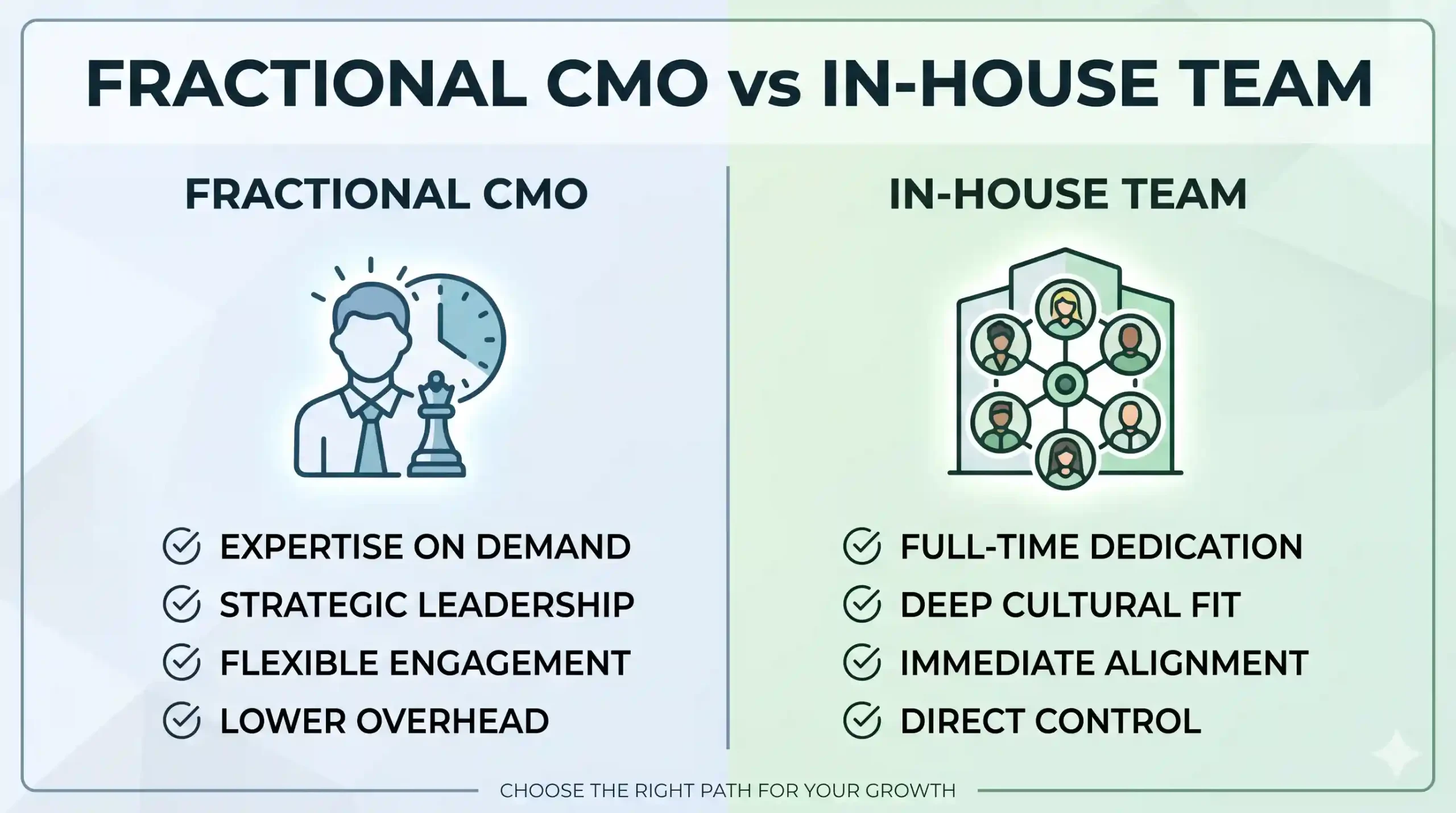
The two most common options are hiring a full-time marketing leader or engaging a fractional CMO. Both can work. Both can fail. The right choice depends on your stage, budget, complexity, and what you actually need right now.
This article breaks down the real differences between in-house marketing leadership and a fractional CMO. Not theory. Practical criteria you can use to make the right decision for your business.
Key Takeaways
- A full-time VP of Marketing or CMO costs $180,000 to $300,000 per year in total compensation before you add team, tools, and ad spend. A fractional CMO services typically costs $5,000 to $15,000 per month for senior-level strategic leadership.
- The right choice is not about cost alone. It is about what your company needs at this specific growth stage. Strategy and execution require different solutions.
- Most B2B companies under $10M ARR do not need a full-time CMO. They need strategic direction combined with execution support, which is exactly what the fractional model delivers.
- Hiring a full-time marketing leader too early often leads to a costly mismatch. The person either lacks strategic depth or lacks the team to execute their strategy.
- The fractional model works best when the company needs senior thinking but cannot justify or afford a full C-suite hire. It fails when the company needs a permanent culture leader or full-time internal champion.
Why This Decision Matters More Than Most Companies Realize
Choosing the wrong marketing leadership model does not just waste money. It wastes time, which is the one resource growing companies cannot recover.
A bad full-time hire takes 3 months to recruit, 3 months to onboard, and 3 to 6 months before you know if they are working. If they are not, you start over. That is 9 to 12 months lost plus the salary, benefits, and opportunity cost.
A bad fractional engagement wastes less money but can still cost you 3 to 6 months of strategic drift if the person is not the right fit.
The stakes are high because marketing leadership sets the direction for everything else. Your positioning, your messaging, your channel strategy, your budget allocation, and your pipeline targets all flow from whoever leads marketing. Get this decision right and everything downstream improves. Get it wrong and every marketing dollar works harder to produce less.
The Full-Time Marketing Leader: What You Actually Get
Before comparing options, understand what a full-time hire really means in practice.
The role and its demands
A full-time VP of Marketing or CMO is responsible for the entire marketing function. They own strategy, team building, budget management, vendor relationships, campaign execution, and pipeline accountability. They sit in leadership meetings, contribute to company strategy, and represent marketing across the organization.
This role requires someone who can think strategically and manage operationally at the same time. They need to build a team, develop processes, choose tools, and deliver results while the company grows around them. It is one of the hardest roles to fill well.
The real cost
The salary for a B2B marketing leader in the US ranges from $150,000 to $250,000 depending on experience, location, and company stage. Add benefits, equity, bonuses, and employer taxes and the total compensation reaches $180,000 to $300,000 per year.
But salary is only the beginning. A marketing leader without a team cannot execute. You need at least one or two additional hires: a content marketer, a demand generation specialist, or a marketing operations person. Each costs $70,000 to $120,000 per year.
Add marketing tools like HubSpot, SEMrush, LinkedIn Sales Navigator, and a CMS. That is another $20,000 to $60,000 per year depending on the stack.
Add ad spend for paid media campaigns. Even a modest LinkedIn and Google Ads program costs $5,000 to $15,000 per month.
The total cost of building an in-house marketing function with a senior leader is $350,000 to $600,000 in the first year. That is before you see a single result.
The timeline to impact
Even the best marketing hire needs time to ramp up. They need to learn your product, market, and competitive landscape. They need to meet the sales team, understand the pipeline, and audit existing marketing assets.
Then they need to develop a strategy, hire their team, set up systems, and launch campaigns. Expect 3 to 6 months before the first campaigns are live and 6 to 9 months before you see measurable pipeline impact.
This timeline is normal. It is not a sign of a bad hire. It is the reality of building a marketing function from scratch inside a growing company.
When a full-time hire is the right choice
A full-time marketing leader makes sense in specific situations:
- Your company has $10M+ ARR and needs a permanent marketing function with a dedicated team.
- You have budget to support not just the leader but also the team, tools, and programs they need.
- Marketing is a core strategic function that requires daily executive-level involvement.
- You need someone who embeds in your culture, builds internal relationships, and champions marketing across the organization long-term.
- Your board or investors expect a named CMO or VP of Marketing on the leadership team.
The Fractional CMO: What You Actually Get
A fractional CMO is a senior marketing leader who works with your company part-time, typically 10 to 20 hours per week. They provide the strategic thinking and leadership of a full-time CMO without the full-time cost.
How the model works
A fractional CMO joins your leadership team on a contracted basis. They participate in strategy meetings, work directly with your CEO and sales leaders, and take ownership of marketing direction.
Their scope typically includes defining or refining your ICP, developing positioning and messaging, building a go-to-market plan, selecting channels and tactics, setting up measurement frameworks, and managing external agencies or freelancers who handle execution.
Some fractional CMOs come with an execution team attached. This hybrid model combines strategic leadership with hands-on campaign management, content creation, and demand generation. You get a complete marketing function without building an internal team.
The real cost
Fractional CMO engagements typically cost $5,000 to $15,000 per month. The price depends on the person’s experience level, the number of hours per week, and whether execution support is included.
At the mid-range of $10,000 per month, a fractional CMO costs $120,000 per year. Compare that to the $180,000 to $300,000 total compensation for a full-time hire, before team and tools.
If the fractional CMO comes with an execution team, the total engagement might cost $15,000 to $25,000 per month. That is $180,000 to $300,000 per year for strategic leadership plus a full execution team. The equivalent in-house would cost $400,000 to $600,000.
The timeline to impact
A fractional CMO can move faster than a full-time hire because they arrive with proven frameworks and playbooks. They do not need to learn how to be a CMO. They have done it before, often multiple times across different companies.
Expect the first strategy to be in place within 4 to 6 weeks. First campaigns can launch within 2 to 3 months. Measurable pipeline impact typically appears within 3 to 5 months.
This faster ramp is one of the biggest advantages of the fractional model. You skip the recruiting process entirely and start getting strategic direction almost immediately.
When a fractional CMO is the right choice
The fractional model works best in these situations:
- Your company is between $1M and $15M ARR and needs senior marketing leadership but cannot justify a full-time C-suite hire.
- You need strategy before execution. Your marketing lacks direction and adding more tactics will not fix the core problem.
- Your budget supports marketing investment but not a full in-house team at this stage.
- You have tried hiring junior marketers or agencies without a strategic leader, and the results have been disappointing.
- You need speed. Recruiting a full-time CMO takes 3 to 6 months. A fractional CMO can start within weeks.
Side-by-Side Comparison
| Factor | Full-Time CMO / VP | Fractional CMO |
|---|---|---|
| Annual cost (leader only) | $180K–$300K | $60K–$180K |
| Annual cost (with team) | $350K–$600K+ | $180K–$300K (with execution team) |
| Time to start | 3–6 months (recruiting) | 2–4 weeks |
| Time to first strategy | 2–3 months after start | 4–6 weeks after start |
| Time to pipeline impact | 6–9 months | 3–5 months |
| Hours per week | 40+ | 10–20 |
| Strategic depth | High (if right hire) | High (proven experience) |
| Execution capability | Needs team to execute | May include team or manage agencies |
| Cultural integration | Deep, full-time presence | Partial, external advisor dynamic |
| Commitment level | Long-term employment | Flexible, month-to-month or quarterly |
| Risk if wrong fit | High (salary + severance + lost time) | Low (shorter contracts, easier to adjust) |
| Best for company stage | $10M+ ARR, established companies | $1M–$15M ARR, growth-stage companies |
The Five Questions That Determine Your Best Option
Use these questions to evaluate which model fits your situation right now.
Question 1: Do you have a marketing strategy or just marketing activity?
If your company runs ads, publishes blog posts, and sends emails but nobody can explain the strategy behind these activities, you need a strategist first. A fractional CMO will build the framework that gives every tactic a purpose.
Hiring a junior marketer or an execution agency without a strategy is like building a house without blueprints. You get activity, but the activity does not connect to revenue.
If you already have a clear strategy and need someone to own it full-time, build the team, and drive accountability across the organization, a full-time hire makes more sense.
Question 2: What is your marketing budget beyond the leader’s compensation?
A marketing leader without budget for tools, team, and programs is set up to fail. Before you hire anyone, calculate your total available marketing budget.
If your total annual marketing budget including the leader’s cost is under $300,000, a full-time CMO will consume most of it and have nothing left for execution. In this scenario a fractional CMO at $8,000 to $12,000 per month leaves room for ad spend, tools, and freelance or agency support.
If your total budget exceeds $500,000, you can likely support a full-time leader plus a small team. At this level the full-time model becomes viable.
Question 3: How fast do you need results?
Recruiting a full-time marketing leader takes 3 to 6 months. Add onboarding and strategy development and you are looking at 6 to 9 months before any meaningful pipeline impact.
A fractional CMO can start in 2 to 4 weeks and deliver a strategy within 6 weeks. If speed matters because you are approaching a funding round, entering a new market, or losing ground to competitors, the fractional model gets you there faster.
Question 4: Do you need a culture leader or a strategy leader?
A full-time CMO does more than set strategy. They build team culture, hire people, mentor junior marketers, represent marketing in every internal conversation, and serve as a permanent voice for the customer inside the organization.
A fractional CMO provides strategic leadership and direction but does not fill the cultural role in the same way. They are not in the office every day. They do not attend every team meeting. They are an external partner, not an internal leader.
If your company needs someone to build and lead a marketing team long-term, a full-time hire is the better fit. If you need strategic direction and can manage day-to-day execution with existing team members or agencies, the fractional model works.
Question 5: What is your company’s growth stage?
Growth stage is the single strongest predictor of which model fits best.
Pre-revenue to $2M ARR. You almost certainly need a fractional CMO or a strategic advisor. Hiring a full-time CMO at this stage is premature and expensive. Your marketing needs are mostly strategic: ICP definition, positioning, initial channel selection, and first-campaign launch.
$2M to $10M ARR. This is the sweet spot for the fractional model. You have product-market fit, initial revenue traction, and growing pressure to build a repeatable pipeline. A fractional CMO provides the strategic leadership you need while keeping costs manageable.
$10M to $25M ARR. You are likely transitioning from fractional to full-time. At this stage marketing complexity increases: more channels, larger team, bigger budget, more stakeholders. A full-time leader starts to make sense, and a fractional CMO can help bridge the gap while you recruit.
$25M+ ARR. You need a full-time marketing leader and a dedicated team. The marketing function is too complex and too important to operate without a permanent leader. A fractional CMO might still add value as a board advisor or interim leader during transitions.
The Hybrid Path: Fractional CMO Now, Full-Time Hire Later
Many companies use the fractional model as a bridge to a full-time hire. This is often the smartest path because it reduces risk and accelerates results.
How the hybrid path works
You engage a fractional CMO to build the strategy, set up processes, launch initial campaigns, and prove what works. Over 6 to 12 months, the fractional CMO establishes a marketing foundation that a future full-time hire can build on.
When you are ready to hire a permanent marketing leader, you know exactly what you need because the fractional CMO has clarified the role through real work. You know which skills matter most, what the right seniority level is, and what results to expect.
The fractional CMO can even help you recruit their replacement. They know the role requirements from direct experience and can evaluate candidates with authority.
Why this path reduces risk
Hiring a full-time CMO without clarity on what you need is a high-risk decision. You might hire someone too senior for your stage. Or too junior for your complexity. Or someone whose experience is in the wrong industry or go-to-market motion.
The fractional model lets you test the role before committing. You see what marketing leadership looks like in your specific context before making a permanent hire. If the fractional engagement reveals that you actually need a VP of Demand Generation instead of a CMO, that insight saves you from a six-figure hiring mistake.
The transition process
A typical hybrid path looks like this:
Months 1 to 3. Fractional CMO audits your current marketing, defines ICP, develops positioning and messaging, creates a go-to-market plan, and launches first campaigns.
Months 4 to 6. Fractional CMO optimizes campaigns, builds reporting frameworks, manages agencies or freelancers, and generates early pipeline results.
Months 7 to 9. Company begins recruiting a full-time marketing leader. Fractional CMO helps define the role, evaluate candidates, and prepare the transition.
Months 10 to 12. Full-time hire starts. Fractional CMO provides a 30 to 60 day transition period to hand off strategy, relationships, and institutional knowledge.
This path gives you marketing leadership from day one and a permanent hire who inherits a functioning system instead of starting from scratch.
Common Mistakes to Avoid
These errors cost companies time and money. Learn from them.
Hiring a full-time CMO too early
The most expensive mistake is hiring a $250,000 per year marketing leader when your company has $3M in revenue and no marketing infrastructure. The CMO arrives, realizes there is no team, no budget, and no systems, and either builds everything from scratch slowly or leaves within a year.
At early stages a fractional CMO delivers the same strategic value at a fraction of the cost and risk.
Hiring a junior marketer instead of a strategic leader
Some companies try to save money by hiring a marketing coordinator or junior marketer as their first marketing hire. This person can execute tasks but cannot set strategy, define positioning, or make the decisions that drive pipeline.
Without strategic leadership, junior marketers do what they know: post on social media, write blog posts, and set up email campaigns. These activities might look like marketing but they do not connect to revenue without a strategic framework behind them.
If you cannot afford a full-time CMO, a fractional CMO gives you the strategic leadership that makes every other marketing investment more effective.
Expecting a fractional CMO to do everything
A fractional CMO working 10 to 15 hours per week cannot also write all your content, run your ads, manage your website, and handle your social media. If you engage a fractional CMO and expect them to be a one-person marketing department, both of you will be frustrated.
The fractional CMO sets strategy, makes key decisions, and manages execution partners. The execution itself comes from your internal team, freelancers, or an agency. Make sure you have execution resources available before engaging a fractional CMO.
Not giving the fractional CMO real authority
A fractional CMO who attends meetings but cannot make decisions is an expensive advisor, not a marketing leader. For the model to work, the fractional CMO needs decision-making authority over marketing strategy, budget allocation, and vendor selection.
If your CEO makes every marketing decision and uses the fractional CMO only for validation, you are paying for a consultant, not a leader. Clarify authority and decision rights before the engagement starts.
Choosing based on cost alone
The cheapest option is rarely the best option. A fractional CMO charging $5,000 per month may lack the experience to handle your specific challenges. A full-time hire willing to accept below-market salary may not have the skills you need.
Evaluate based on experience, track record, and fit for your situation. The right person at the right price delivers ROI that makes the cost irrelevant. The wrong person at any price is a loss.
How to Evaluate a Fractional CMO
If you decide the fractional model is right for your stage, use these criteria to select the right person.
Relevant industry experience
The fractional CMO should have experience in your sector or a closely related one. B2B SaaS, cybersecurity, manufacturing, and professional services each have different go-to-market dynamics. A fractional CMO from the consumer goods industry will not understand your B2B sales cycle.
Ask for case studies from companies at your stage and in your market. Results from a $100M enterprise are not relevant if you are a $5M startup.
Track record with measurable results
Ask for specific pipeline and revenue metrics from past engagements. How much pipeline did they create? What was the CAC? How fast did results appear? Vague answers like “we improved the marketing” are not enough.
A strong fractional CMO can show you before-and-after metrics from companies they have led. They should be comfortable sharing specific numbers.
Strategic and operational versatility
Some fractional CMOs are pure strategists who deliver plans but do not manage execution. Others are operators who can roll up their sleeves and run campaigns. The best are both.
For companies without an internal marketing team, you need someone who can create the strategy and manage the execution through agencies and freelancers. If you already have a team that needs direction, a pure strategist may be sufficient.
Communication style and CEO compatibility
The fractional CMO works closely with the CEO and leadership team. If their communication style does not match your culture, the engagement will be friction-heavy regardless of their expertise.
Have a working session before signing a contract. Discuss your business challenges, marketing goals, and current situation. Assess whether the conversation feels productive and whether you trust their judgment.
Availability and commitment
A fractional CMO who serves eight clients simultaneously cannot give your company the attention it needs. Ask how many clients they work with at the same time. Three to five is manageable. More than that signals stretched capacity.
Also clarify their availability for urgent matters. Can you reach them same-day for critical decisions? Will they attend key sales meetings or board presentations? Set expectations upfront.
Decision Framework
Use this framework to make your final decision.
| Your Situation | Recommended Model |
|---|---|
| Under $3M ARR, no marketing function | Fractional CMO |
| $3M–$10M ARR, need strategy and initial execution | Fractional CMO (with execution team) |
| $10M–$25M ARR, ready to build permanent team | Start fractional, transition to full-time |
| $25M+ ARR, complex multi-channel marketing | Full-time CMO with dedicated team |
| Budget under $300K total for marketing | Fractional CMO |
| Budget over $500K total for marketing | Full-time hire is viable |
| Need results in under 3 months | Fractional CMO |
| Need long-term culture and team builder | Full-time hire |
| Already tried agencies without strategic direction | Fractional CMO first, then agencies under their leadership |
| Preparing for fundraise and need marketing credibility | Fractional CMO to build the story and metrics |
Bottom Line
The choice between in-house marketing and a fractional CMO is not about which option is better in general. It is about which option fits your company right now.
If you are under $10M ARR and need strategic marketing leadership without the cost and risk of a full-time executive, a fractional CMO is likely the right move. You get senior-level thinking, faster time to results, and lower financial risk.
If you are above $10M ARR with budget for a full team and need a permanent marketing leader who builds culture and owns the function long-term, a full-time hire makes sense.
For many companies the smartest path is the hybrid one. Start with a fractional CMO to build strategy, prove what works, and create the foundation. Then hire a full-time leader who inherits a working system instead of starting from nothing.
Whatever you choose, do not wait for perfect conditions. Every month without marketing leadership is a month your competitors use to capture the pipeline you should own. Make the decision, commit to it, and start building.
