How to Conduct B2B Market Research

Most B2B companies make decisions based on assumptions instead of evidence. The CEO thinks the customer cares about price. The product team thinks the customer cares about features. Sales thinks the customer cares about service. They are all guessing, and they all argue from their own incomplete view.
B2B market research replaces these guesses with facts. Done well, it tells you who the customer actually is, what they actually buy, why they choose one vendor over another, and what would make them switch. Done badly, it produces a 60 page report that nobody reads and nothing changes.
The difference between good and bad B2B research is not the budget. The difference is the method, the questions, and what happens after the research ends. A founder running 15 customer interviews can produce more useful insight than a $100K research project that asks the wrong questions.
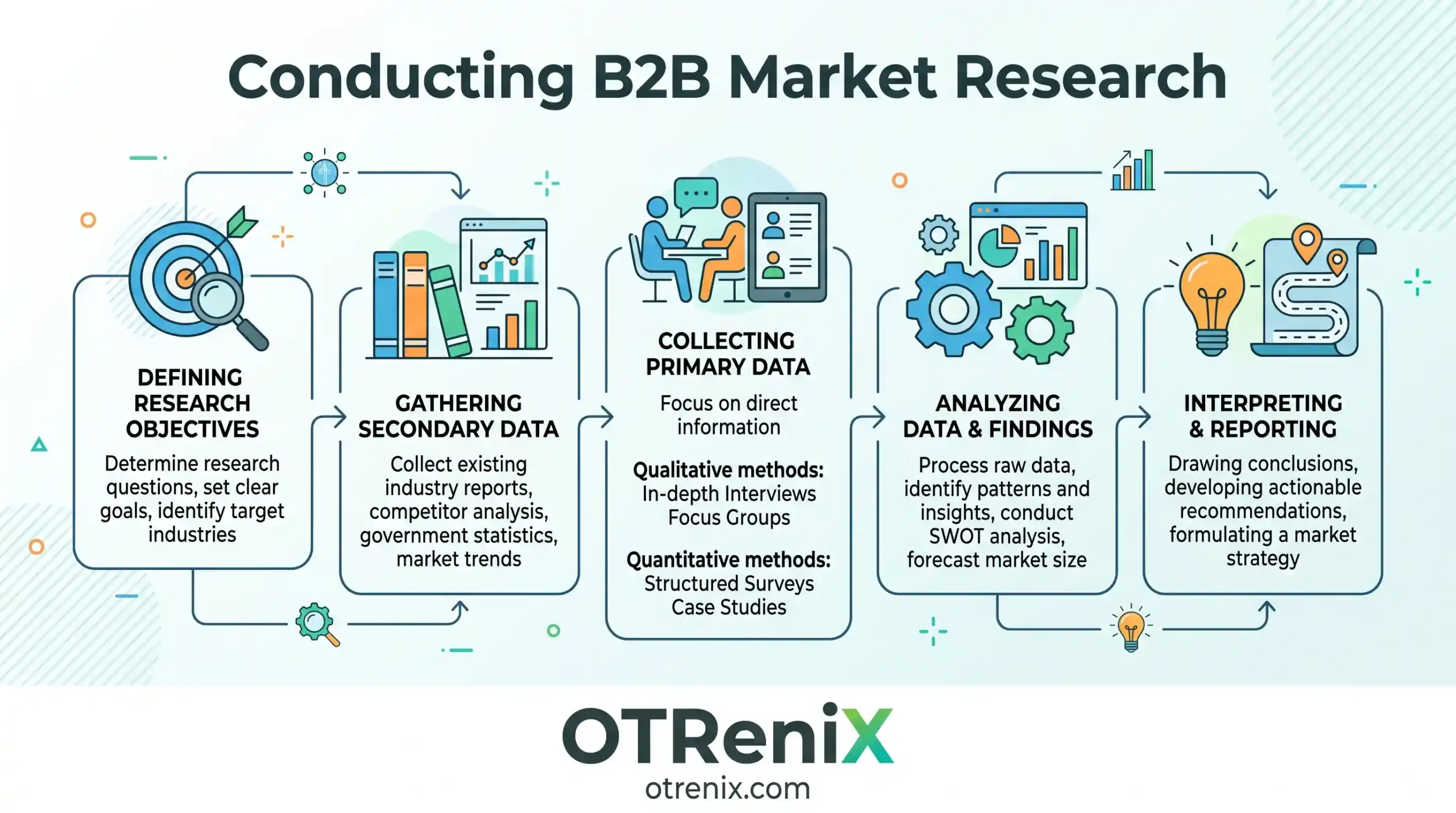
This article covers the full B2B research process: when to do it, how to design it, how to run interviews and surveys, how to analyze the data, and how to turn findings into decisions. The goal is research you can actually use, not research that sits in a drive folder.
Key Takeaways
- B2B market research has 4 main goals: understand the customer, validate the market, inform positioning, and guide product or pricing decisions. Define which goal applies before starting.
- Qualitative interviews produce most of the useful insight in B2B. Surveys are useful for validation, not for discovery.
- A research program at a $1M to $20M ARR B2B company usually involves 20 to 40 customer and prospect interviews, plus 2 to 3 supporting data sources.
- Most research fails at execution, not design. Companies collect the data and never change anything because they cannot agree on what it means.
- Budget expectations: $5K to $30K for a focused research project run internally with light support, $40K to $150K for a full research engagement with an agency.
When to Do B2B Research
B2B market research is not a continuous activity. It is a project you run when a specific decision requires evidence. The 5 most common triggers are below.
1. Before launching a new product or category
You think there is a market for a new product. Before spending a year building it, you need evidence that the market exists, the customer can be reached, and the price point works. Research at this stage saves you from building something nobody buys.
2. Before a major repositioning
The current positioning is not working. Win rates are dropping, sales cycles are stretching, or pipeline is shrinking. Before changing the website and the sales deck, you need to understand why the current message is failing and what message would replace it.
3. Before entering a new segment or market
You are expanding from SMB to mid market, from US to Europe, or from healthcare to financial services. The new segment has different problems, vocabulary, and decision processes. Research surfaces these differences before you misread the market.
4. After a plateau
The company has been stuck at the same revenue level for 12+ months. Pipeline is decent but conversion is poor. Research often reveals that the ICP shifted, a competitor changed the market, or the product no longer matches the buying process.
5. Before a pricing change
You suspect your pricing is wrong but cannot prove it internally. Research with prospects, customers, and lost deals usually reveals 20% to 40% of pricing leverage that the company has been ignoring.
If none of these triggers apply, you probably do not need a research project. You need to act on what you already know.
Define the Research Goal Before Anything Else
The most common reason B2B research fails is that the goal was vague from the start. “Better understand our customer” is not a goal. It produces 50 pages of generic insight and zero decisions.
A real research goal looks like this:
- Decide which of 3 customer segments to prioritize for the next 12 months. The output is a prioritized segment list with reasoning.
- Understand why win rates dropped from 32% to 18% in the last 9 months. The output is a list of root causes and recommended changes.
- Validate whether mid market healthcare CIOs will pay $50K a year for our product. The output is a yes or no, with the price points that would work.
- Identify the 3 messages that resonate most with security directors evaluating XDR products. The output is a tested message hierarchy.
Notice the structure. Each goal has a specific question, a specific decision attached, and a specific output. Research designed around questions like these produces useful answers. Research designed around general curiosity does not.
Write the goal down before designing the research. If you cannot write it in 1 or 2 sentences, you are not ready to start.
The 4 Types of B2B Research
B2B research falls into 4 main categories. Most projects use 2 or 3 of these in combination.
Customer interviews (qualitative)
One on one conversations with current customers, prospects, churned customers, and lost deals. Usually 30 to 60 minutes each. This is where most useful B2B insight comes from because customers explain reasoning, not just answers.
A typical project includes 20 to 40 interviews across customer types. Fewer than 15 interviews and patterns do not emerge. More than 50 and the marginal value drops sharply.
Surveys (quantitative)
Structured questionnaires sent to a larger group, typically 200 to 1000 respondents. Useful for validating patterns surfaced in interviews and for measuring things like willingness to pay, feature priority, or NPS.
Surveys alone are weak in B2B. They tell you what people answered but not why. Use them to confirm what you already learned in interviews, not to discover anything new.
Secondary research
Existing reports, analyst publications, public financial filings, industry data, and competitor research. Useful for sizing markets, understanding trends, and benchmarking. Usually cheap or free, but generic.
Tools like Gartner, Forrester, IDC, CB Insights, and PitchBook produce most of the useful B2B secondary data. Public 10-K filings of competitors are a goldmine that most teams ignore.
Behavioral data
Your own product usage data, sales CRM data, marketing analytics, and website behavior. Usually the most underused source in B2B because the data lives in 5 systems and nobody pulls it together.
A skilled analyst can spend 2 weeks in your CRM and produce more insight than a $50K research firm. The data is already there.
How to Run B2B Customer Interviews
Customer interviews are the highest leverage research method in B2B. Here is how to run them well.
Who to interview
Build a list of 30 to 50 target interviewees across these segments:
- 8 to 12 happy current customers. People who use the product and would buy again.
- 5 to 8 unhappy current customers or churned customers. People who left or are about to.
- 8 to 12 active prospects. People in your sales pipeline now.
- 5 to 8 lost deals. People who chose a competitor or did nothing.
- 3 to 5 target customers who do not know you. People in your ICP with no relationship to your company.
Each segment tells you something different. Skipping any segment leaves a blind spot.
How to recruit
Current customers and prospects are easy: ask the account managers and sales reps. Lost deals and churned customers are harder because nobody wants to talk to the vendor that lost. Two things help: an honest framing (“we want to understand what we got wrong”) and a small incentive, usually a $100 to $200 gift card.
For target customers who do not know you, use LinkedIn outreach with a direct value proposition: “I am researching how X companies handle Y. 30 minutes of your time, in exchange for the full research findings when complete.” Conversion rates run 5% to 15%.
How to structure the interview
A 45 minute interview should cover 5 areas. Keep the structure consistent across interviews so you can compare answers later.
- Their job and role (5 minutes). What they do, what they care about, how they are measured.
- The problem (10 minutes). When the problem comes up, what triggers them to look for a solution, who else is involved, what the cost of the problem is.
- The buying process (15 minutes). How they evaluate vendors, who participates, what makes a vendor get shortlisted, what makes a vendor get rejected, the timeline.
- Your product or category (10 minutes). What they think of the product or category, what they like, what is missing, what almost killed the deal.
- Open ended (5 minutes). What you should have asked but did not, what they wish vendors knew about them.
Questions that work
The best interview questions are open ended, past tense, and specific. They ask about real situations, not hypothetical preferences.
Strong questions:
- “Walk me through the last time you bought a product like this. Who was involved, what was the trigger, how long did it take?”
- “What were the 2 or 3 finalists you considered? Why did you pick the one you picked?”
- “What almost made you not choose us?”
- “If you had to do the evaluation again, what would you do differently?”
- “Who else have you seen handle this problem well?”
Weak questions:
- “How important is security to you on a scale of 1 to 10?”
- “Would you buy a product that did X?”
- “What features do you wish we had?”
Hypothetical questions and feature wishlists produce noise. Past tense behavior questions produce signal.
How to capture the data
Record every interview with permission. Use a transcription tool like Otter, Fireflies, or Grain. Review the transcript within 24 hours and tag key quotes by theme.
Build a shared spreadsheet or Notion database with one row per quote, columns for source, theme, segment, and verbatim quote. After 20 interviews you will have 200 to 400 tagged quotes that can be sorted and clustered.
This step is what separates real research from anecdotal note taking. Without structured tagging, the insight stays trapped in individual conversations.
How to Run B2B Surveys
Surveys come after interviews, not before. Use them to test patterns at scale.
Sample size
For B2B research, aim for 200 to 500 responses minimum. Smaller samples produce noise. Larger samples are usually unnecessary unless you are slicing by multiple dimensions.
For niche markets where the entire ICP is only 2,000 companies, 100 responses is enough if they are well distributed.
Question design
Keep surveys under 10 minutes. Past 10 minutes, completion rates drop and quality degrades. Use a mix of:
- Closed questions for quantitative measurement (e.g., “Which of these tools do you currently use?”).
- Likert scales sparingly. They produce middle of the road answers in B2B.
- Open text at the end for surprises. The best insight often comes from the “Anything else?” question.
Avoid double barreled questions (“How important and effective is X?”) and leading questions (“How much do you love our product?”).
Distribution
Use multiple channels because no single list represents the market well:
- Customer database for current customer surveys.
- CRM contacts for prospects and lost deals.
- LinkedIn for net new audience.
- Industry partners if you have them, especially analyst firms or media partners.
- Paid panels like Pollfish or AYTM for hard to reach personas, costing $50 to $200 per qualified response.
Combine 2 or 3 sources for a balanced sample.
What to measure
Common B2B survey topics:
- Buying process and decision criteria.
- Vendor awareness and consideration sets.
- Willingness to pay at different price points.
- Feature priority and tradeoffs.
- Use of competitor products.
Each of these can be measured with 3 to 6 questions. Resist the urge to measure everything.
Secondary Research and Behavioral Data
Most B2B teams underuse the data already available to them.
Public sources worth checking
- Competitor 10-K filings. Public companies publish detailed information about their customers, segments, growth rates, and risks. Read the latest 10-K of your top 3 competitors before any major decision.
- Analyst reports. Gartner, Forrester, and IDC reports often cost $1K to $5K each but contain market sizing, trends, and customer behavior data that would take months to gather independently.
- Industry reports. Vertical industry associations publish data on their sector. Often free or low cost.
- G2 and Capterra reviews. Customer reviews of your competitors usually reveal what those customers value and where the products fail. A weekend reading 200 reviews is one of the highest ROI research activities possible.
Internal data sources
- CRM analysis. Pull every closed won and closed lost deal from the past 18 months. Tag by industry, size, source, and reason. Patterns appear quickly.
- Product usage data. For SaaS companies, the product itself reveals what features matter, where users drop off, and what leads to retention.
- Support ticket analysis. The most common support tickets often reveal product gaps and segment misalignment that surveys miss.
- Sales call recordings. Tools like Gong and Chorus record every sales conversation. Reviewing 20 to 30 lost deal calls produces real insight into objections, competitor mentions, and decision criteria.
A research project that ignores these internal sources misses 30% to 50% of the available insight.
How to Analyze and Synthesize the Data
Most B2B research projects fail at synthesis, not collection. The team gathers good data and then cannot turn it into decisions.
Cluster and tag
Start by reading every transcript and tagging key quotes by theme. Common themes in B2B include:
- Pain points and triggers.
- Decision criteria.
- Objections and concerns.
- Vendor selection process.
- Pricing and value perception.
- Use cases and outcomes.
After tagging, cluster similar quotes together. Patterns emerge when 5 or more interviewees say the same thing in different words.
Look for the “yes, and” patterns
The most useful insights are not what most people said. The most useful insights are what most people said combined with what surprised you. If 15 of 20 customers mention the same trigger, that is a pattern worth acting on. If 3 of 20 mention something nobody else does but it explains a real business problem, that is a signal worth investigating.
Map findings to the original goal
Go back to the research goal you wrote down at the start. For each finding, ask: does this answer the question we set out to answer? Findings that do not answer the goal go in an “interesting but not relevant” pile, not the main report.
This step prevents the most common research failure: a 60 page report that explores everything and decides nothing.
Write the report short
A useful B2B research report is 5 to 15 pages. Longer reports do not get read.
Structure:
- The question (1 page). What we set out to learn.
- The method (1 page). Who we talked to, how many, when.
- The 5 to 7 key findings (5 to 8 pages). Each with supporting quotes and data.
- The recommendations (2 to 3 pages). What to do about each finding.
A 5 page report that drives 3 decisions beats a 50 page report that drives 0.
How to Turn Research Into Decisions
This is where most B2B research dies. The team finishes the report, presents it to the leadership team, everyone nods, and nothing changes. To prevent this:
Force a decision in the readout
End every research presentation with 3 to 5 specific recommendations and ask leadership to accept, reject, or modify each one before the meeting ends. Decisions made in real time stick. Decisions deferred to “after we think about it” almost never happen.
Assign owners and dates
Every accepted recommendation needs a name and a date. “Marketing will fix this” is not an assignment. “Sarah will rewrite the homepage hero by November 15” is.
Build a changes log
Track every change made because of the research. After 90 days, review the log to see what actually happened. This builds the discipline of acting on research and creates a feedback loop for future projects.
Repeat the research after 12 months
Markets shift. Competitors move. Customers change. A research project is not a permanent answer. Plan to repeat the most important questions annually so the company stays current.
Cost and Timeline Expectations
A real B2B research project takes 6 to 12 weeks and costs $5K to $150K depending on scope and execution model.
| Approach | Timeline | Cost | Best for |
|---|---|---|---|
| Founder led, light external help | 6 to 8 weeks | $5K to $15K | Early stage companies, $1M to $5M ARR |
| Internal team plus contractor | 8 to 10 weeks | $15K to $40K | Growth stage, $5M to $20M ARR |
| Boutique research agency | 10 to 12 weeks | $40K to $80K | Mid market, complex segments |
| Full research firm | 10 to 16 weeks | $80K to $150K+ | Enterprise, multi market projects |
The most expensive option is rarely the best one. Founder led research with 30 well chosen interviews often produces more usable insight than a $100K firm engagement, because the founder hears nuances that an outside researcher misses.
The right call depends on whether the team has the time and discipline to run the research themselves. If yes, do it internally. If the project will get half done because nobody has the time, hire help.
Common Failures to Watch For
Across hundreds of B2B research projects, the same failures repeat:
- Vague goals. “Understand our customer” produces nothing useful. Define the question and the decision before starting.
- Wrong sample. Talking only to current happy customers tells you nothing about why prospects do not buy. Always include lost deals and target customers.
- Leading questions. “How important is reliability to you?” gets a different answer than “Tell me about a time reliability failed you.” Past tense behavior beats hypothetical preferences.
- Skipping synthesis. Raw transcripts are not insight. Patterns only emerge through structured tagging and clustering.
- No decision attached. Research without a decision attached gets read once and forgotten. Tie every finding to a specific action.
- Over engineering surveys. A 25 question survey produces fewer responses and worse data than a 7 question survey. Cut ruthlessly.
- Confusing market research with product research. B2B market research is about how customers buy, not about what features they want. The 2 questions are different and need different methods.
Recommendation
If your B2B company faces a major decision in the next 90 days, start a research project this month. The cost of getting a positioning, pricing, or segment decision wrong is usually 12 months of lost revenue. The cost of a focused research project is usually 6 weeks and $10K to $40K.
Start by writing the research goal in 1 or 2 sentences. Tie it to a specific decision the leadership team needs to make. If you cannot write the goal that clearly, the project is not ready to launch.
Build the interview list next. Aim for 25 to 35 interviews across happy customers, unhappy customers, active prospects, lost deals, and target customers who do not know you. Recruit from internal sources first, then LinkedIn and paid panels for the gaps.
Run the interviews over 4 to 6 weeks. Record everything, transcribe within 24 hours, and tag quotes by theme as you go. Add 2 to 3 supporting data sources: a competitor 10-K, a sample of CRM closed lost deals, and 100 G2 reviews of competitors.
Synthesize the findings into a 5 to 10 page report. Present it to leadership with 3 to 5 specific recommendations. Force a decision on each one before the meeting ends. Assign owners and dates. Track the changes for 90 days.
Repeat the most important questions every 12 months. Markets shift faster than annual planning cycles assume, and the company that runs continuous research outpaces the one that runs research once and considers it done.
B2B research is one of the highest leverage activities a company can do. Most teams skip it because they cannot see the cost of operating on assumptions. The cost shows up later, in lost deals, missed segments, and pricing left on the table. Pick a real question, run a focused project, force decisions, and act on what you learn. That is where the leverage actually lives.