How to Do B2B Marketing in China

Most Western B2B companies that enter China make the same mistake. They translate the global website into Chinese, hire a local sales rep, run a few LinkedIn campaigns, and wait for pipeline. Twelve months later they have no leads, no brand recognition, and no clear path forward.
The problem is not effort or budget. The problem is that B2B marketing in China runs on a completely different system. The platforms are different, the buying process is different, the trust signals are different, and the regulatory environment changes how you collect data, run ads, and store customer information. Playbooks that work in the US or Europe break down on contact with the Chinese market.
This article covers how B2B marketing actually works in China in 2026: which platforms matter, how Chinese B2B customers buy, what content works, how to handle compliance, and what to budget. I will also show what to outsource, what to keep in house, and how to structure the team that delivers results.
The audience for this article is B2B founders, CMOs, and marketing leaders who are either entering China for the first time or fixing a China program that has not worked. The advice applies to SaaS, hardware, industrial products, and professional services aimed at Chinese enterprises.
Key Takeaways
- China B2B marketing requires a separate stack: WeChat replaces email and LinkedIn, Baidu replaces Google, Zhihu and Xiaohongshu replace much of Western content marketing, and trade publications still matter more than they do in the West.
- LinkedIn shut down its main Chinese platform in 2021 and the replacement (InCareer) closed in 2023. LinkedIn is no longer a viable B2B channel inside mainland China.
- The buying process is relationship driven and slower than Western B2B. Expect 9 to 18 months for enterprise deals, with multiple in person meetings before contracts close.
- Compliance matters from day 1. The PIPL (Personal Information Protection Law), CSL (Cybersecurity Law), and DSL (Data Security Law) shape what you can collect, store, and use.
- Budget realistically. A serious B2B China program costs $300K to $1.5M a year all in, depending on category and ambition. Anything less and you are running awareness, not pipeline.
- Most Western companies fail in China not because the market is impossible but because they treat it as a translation problem instead of a different market entirely.
Why China B2B Marketing Is Different
Three structural differences separate China B2B marketing from anything Western marketers know.
Different platforms
The Chinese internet runs on its own platforms. Google, Facebook, LinkedIn, Twitter, YouTube, and most Western tools are blocked or unavailable. Local equivalents have replaced them, and these are not direct copies.
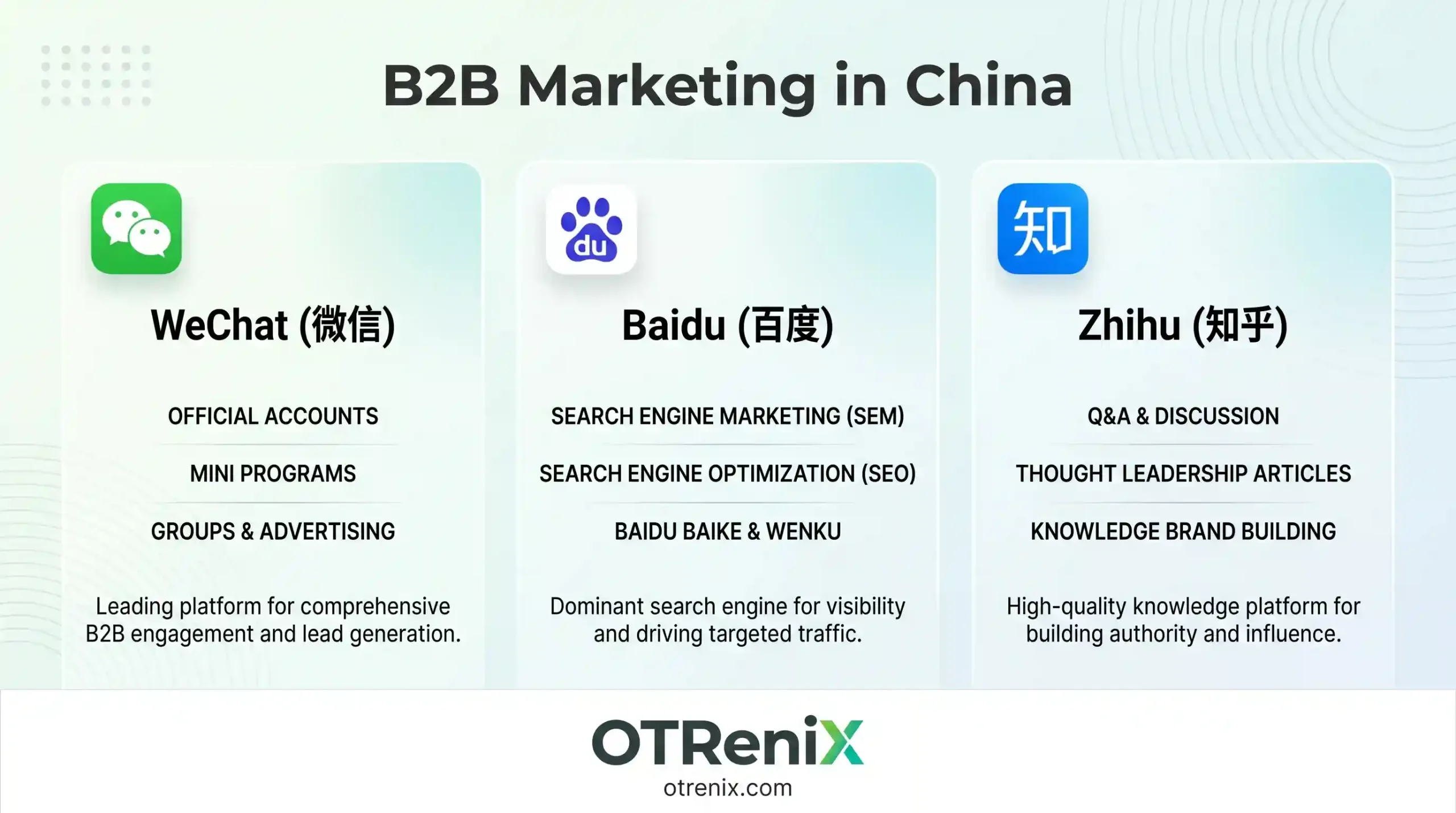
WeChat is not just a messenger. It is a closed ecosystem that combines messaging, payments, content publishing, customer service, mini programs (apps inside WeChat), and CRM. Most Chinese B2B activity flows through WeChat in some form.
Baidu is the dominant search engine, with around 60% market share in 2026. Search behavior is different from Google: customers expect more brand and category content, and Baidu’s algorithm rewards different signals than Google does.
Zhihu is China’s main long form Q&A and content platform, often described as a mix between Quora and Medium. It is one of the most respected places for B2B thought leadership.
Xiaohongshu (Little Red Book) started as a consumer platform but has become a serious B2B channel for many categories, especially where individual professionals research products before recommending them internally.
Douyin (the Chinese version of TikTok) has become surprisingly important for B2B in industrial, manufacturing, and tech categories. Short video demos, factory tours, and expert content reach decision makers who do not respond to traditional marketing.
Different buying behavior
Chinese B2B prospects buy differently. The decision process is more relationship driven and more cautious about new vendors. Most enterprise deals require multiple in person meetings, often including dinners, before any serious commitment.
Trust is built through people, not content. A single trusted introduction will move a deal further than 6 months of ads and content. Western style inbound marketing produces leads, but those leads close at much lower rates without strong relationship work behind them.
Chinese customers also evaluate vendors more thoroughly. Prospects will often ask for site visits to your facilities, references from existing Chinese customers, and detailed technical proof points before signing. Lack of local presence (a Shanghai office, a Chinese phone number, a WeChat account with active content) is read as a lack of commitment.
Different regulatory environment
China has built a strict regulatory framework around data, content, and cross border information flow. Three laws shape the entire B2B marketing environment.
The Personal Information Protection Law (PIPL) is similar to GDPR but stricter on cross border data transfer. You generally cannot move Chinese customer data out of China without a security assessment and explicit consent.
The Cybersecurity Law (CSL) requires data localization for critical information infrastructure operators and many B2B categories. If your CRM, marketing automation, or analytics tools are hosted outside China, you may be in breach.
The Data Security Law (DSL) classifies data by sensitivity and adds further restrictions on processing and transfer.
Practical effect: you cannot just plug your global HubSpot, Salesforce, or Marketo instance into a China program. Most successful B2B China programs run on local platforms (Tencent, Alibaba Cloud, local CRM vendors) or on properly localized international tools with China specific data hosting.
The China B2B Marketing Stack
A working B2B China marketing program uses a specific set of platforms. Here is what each one does and when to invest.
WeChat: the foundation
WeChat is non negotiable for B2B in China. Almost every business interaction passes through it at some stage. A serious B2B program needs:
- Official Account (公众号). This is your brand publishing platform. Articles, announcements, case studies, and gated content all live here. You need a Service Account (服务号) for B2B, not a Subscription Account (订阅号), because Service Accounts allow more interactive features and CRM integration.
- Mini Program (小程序). A small app inside WeChat that can host product demos, ROI calculators, event registration, customer portals, or self serve resources.
- Sales reps on WeChat. Every sales rep needs a personal WeChat used for prospecting and customer relationships. This is how Chinese B2B sales actually happens, not through email.
- WeChat Work (企业微信). The B2B version of WeChat that integrates with internal tools, CRM, and customer communications. Increasingly the standard for serious B2B operations.
Budget expectation: $50K to $200K a year for content, management, and ad spend on WeChat alone for a serious program.
Baidu: search and SEM
Baidu is your Google replacement. Effective Baidu marketing requires:
- Baidu SEO. Different from Google SEO. Baidu rewards branded content, content hosted on Baidu’s own properties (Baidu Baike, Baidu Zhidao), and content that links from Chinese authority sites.
- Baidu SEM. Paid search through Baidu’s advertising platform. CPCs in B2B categories range from $2 to $15 depending on competition.
- Baidu Baike (百度百科). The Chinese Wikipedia equivalent. A well constructed Baike entry for your company is a major credibility signal that prospects will check.
Budget expectation: $100K to $400K a year for SEM, plus $30K to $80K for SEO and content.
Zhihu: thought leadership
Zhihu is where Chinese professionals go for in depth content. It is one of the highest trust platforms for B2B because the audience is well educated, technical, and skeptical of marketing.
Effective Zhihu work means:
- Long form articles authored by your Chinese experts (not translated from English).
- Answers to industry questions that show real depth.
- A managed company account that publishes consistently.
- Paid distribution to amplify the best content.
Zhihu users punish promotional or low effort content. The platform is best for companies with real technical depth and Chinese market experts who can produce native content. Translated thought leadership performs poorly here.
Xiaohongshu and Douyin: emerging B2B channels
Xiaohongshu (Little Red Book) and Douyin have become important for many B2B categories, especially in industrial, tech, and professional services. Individual decision makers research products on these platforms before recommending them internally.
Use cases include short product demos, factory walkthroughs, expert commentary, customer testimonials, and event recap content. The format is short, visual, and personality driven. Companies that can put a confident Chinese expert on camera consistently see real pipeline contribution within 6 to 12 months.
Trade publications and industry events
Traditional channels still matter in China B2B more than they do in the West. Major trade publications in your industry (in Chinese) carry real weight with senior decision makers. Industry events, both in person and online, are where deals start and reputations build.
Examples by category:
- Industrial and manufacturing: China International Industry Fair (CIIF), Hannover Messe China.
- Tech and software: World Internet Conference, Apsara Conference.
- Healthcare: China Med, CMEF.
- Finance: Lujiazui Forum, Bund Summit.
Speaking slots, sponsored research, and editorial coverage in Chinese trade press often outperform digital marketing for senior B2B audiences.
How Chinese B2B Customers Buy
Understanding the buying process is more important than picking platforms. Here is how a typical China enterprise B2B deal actually unfolds.
Phase 1: research, weeks 1 to 8
The prospect researches the category through a mix of Baidu searches, Zhihu articles, WeChat content shared in industry groups, and recommendations from peers. They build a shortlist of 3 to 8 vendors. Western brands without a Chinese presence rarely make this shortlist, even if their global product is superior.
Marketing’s job in this phase: be findable on Baidu, have credible Chinese language content on WeChat and Zhihu, have a Chinese website hosted in China, and have a Baidu Baike entry that confirms you exist as a real company.
Phase 2: evaluation, weeks 8 to 24
The prospect engages directly with shortlisted vendors. This means WeChat conversations with sales reps, demos, technical deep dives, and often a request for site visits or facility tours. Trust building happens through individual relationships, not corporate brochures.
Marketing’s job in this phase: arm sales with localized content, case studies featuring Chinese customers, technical documentation in Chinese, and ROI tools or calculators. Sales enablement matters more than top of funnel content here.
Phase 3: validation and negotiation, weeks 24 to 48
The prospect runs reference calls, requests proof of concept (POC) deployments, and starts the formal procurement process. Price negotiation is more aggressive than in Western B2B, and contract terms are often heavily customized.
Marketing’s job in this phase: deliver compelling Chinese references, support POC documentation, and help sales reinforce credibility through customer events or joint case studies.
Phase 4: close and onboarding, weeks 36 to 72
Final negotiations, legal review, and contract signing. Chinese contracts often include performance guarantees, local support clauses, and detailed SLAs. Onboarding is high touch and customer success expectations are high.
Marketing’s job continues into onboarding: localized customer education content, Chinese language documentation, and customer community building (often inside WeChat groups).
Content That Works in China B2B
Content is at the center of B2B marketing in China just as it is in the West, but what works is different.
What works
- Native Chinese content, not translations. Quality Chinese writing by experts who understand the local market. Translated content reads as foreign and underperforms badly.
- Original research and data. Chinese B2B buyers respect data heavy content, especially original research conducted in or about the Chinese market.
- Case studies featuring Chinese customers. A case study with a recognizable Chinese brand carries 10 times the weight of a US or European case study.
- Technical depth. Chinese B2B audiences are sophisticated and reward technical content. White papers, architectural diagrams, and detailed product comparisons all perform well.
- Expert content. Articles, videos, and interviews featuring Chinese industry experts (yours or third party).
- Localized event recaps. Coverage of major Chinese industry events, conferences, and policy developments.
What does not work
- Direct translations of US content. The tone, examples, and references all feel foreign.
- Generic listicles. Content that works for a US SaaS audience often falls flat in China.
- Content with US customer logos only. Without Chinese references, prospects assume you are not committed to the market.
- Promotional content disguised as thought leadership. Chinese audiences are quick to recognize and ignore this.
- Content that ignores Chinese regulatory or business context. Posts about market trends that pretend China does not have specific compliance requirements feel uninformed.
The Compliance Reality
Compliance is not a footnote in China B2B marketing. It shapes the whole program.
PIPL and customer data
Under PIPL, you need explicit consent to collect personal data, and you need a legal basis to transfer that data outside China. For most B2B marketing programs, this means:
- Collecting data on Chinese forms hosted in China, with Chinese language consent flows.
- Storing that data in mainland China, either on Chinese cloud infrastructure (Aliyun, Tencent Cloud) or on properly licensed local instances of international platforms.
- Conducting a security assessment before any cross border data transfer to a global CRM.
Companies that route Chinese customer data through their global Salesforce or HubSpot without proper safeguards are technically in breach, though enforcement varies.
Cross border content review
Content published on Chinese platforms is subject to local content rules. Topics that touch on politics, regulation, or sensitive industries can be flagged or removed. A senior local content lead should review any content before it goes live.
Advertising rules
China’s advertising law restricts certain claims and superlatives. Common Western marketing language (“best,” “leading,” “number one”) often cannot be used without specific evidence and may trigger enforcement. Local agencies usually catch these issues before publication.
Practical setup
A working compliance setup usually includes:
- Local entity (WFOE, JV, or representative office) for legal data collection.
- Chinese hosted website (.cn domain or hosted on Chinese infrastructure) with ICP filing.
- Chinese cloud infrastructure for marketing data.
- Local CRM or local instance of a global CRM with China data residency.
- Legal review by a Chinese law firm familiar with B2B marketing operations.
What to Budget
A real B2B China program is not cheap. Here are realistic ranges by ambition level.
Awareness only
Suitable for companies testing the market ($150K to $300K) without serious commitment. Includes:
- A Chinese website with ICP filing.
- WeChat Service Account with monthly content.
- Baidu Baike entry and basic SEO.
- Light Baidu SEM (~$30K a year).
- 1 part time local marketing lead or agency.
This level produces brand presence but not serious pipeline. Use it to validate the market, not to drive revenue.
Pipeline focused
Suitable for companies committed ($400K to $800K) to building Chinese revenue. Includes:
- Full WeChat presence with weekly content and active mini programs.
- Baidu SEM and SEO programs.
- Zhihu content and paid distribution.
- Industry event sponsorships and speaking slots.
- 2 to 3 in country marketing staff or strong agency partnership.
- Sales enablement assets and Chinese case studies.
This level produces real pipeline within 9 to 18 months for most B2B categories.
Market leadership
Suitable for companies treating China as a top 3 market ($1M to $3M a year). Includes:
- Integrated WeChat, Baidu, Zhihu, Xiaohongshu, and Douyin programs.
- Original research and thought leadership programs.
- Major industry event presence including hosted events.
- 5+ in country marketing staff plus agencies.
- PR and analyst relations through local agencies.
- Customer advocacy and reference programs.
This level supports serious market share goals over 24 to 36 months.
In House vs Agency vs Hybrid
The team structure matters as much as the budget. Three models work in B2B China.
Full in country team
Build a Chinese marketing team based in Shanghai, Beijing, or Shenzhen. Usually includes a country marketing lead, content manager, digital marketing specialist, and event manager.
Best for companies with serious China commitment and $1M+ marketing budgets. Requires strong leadership from headquarters and clear guardrails to keep the team aligned with global brand.
Agency led with a single in country lead
Hire one senior marketing leader in country and outsource execution to a local agency. The lead manages strategy, brand consistency, and agency oversight. The agency handles content production, platform management, and campaigns.
Best for companies with $300K to $800K budgets entering the market or scaling without a full team. The risk is finding the right agency, since quality varies wildly in the Chinese B2B agency market.
Headquarters led with translation agencies
Run the program from headquarters with translation agencies handling Chinese language work. This is what most failing China programs look like. It almost never works for B2B because translation does not equal localization.
Avoid this model unless the China program is purely a market test with no revenue ambition.
Common Mistakes
Three patterns appear in almost every failed B2B China program.
Treating it as a translation problem
The most expensive mistake. Founders translate the website, run translated ads, and assume that is localization. Real localization means rebuilt content, native experts, local case studies, and platform native distribution.
Underinvesting in relationships
Western B2B companies often try to scale China through digital marketing alone, treating relationship building as inefficient. In China, relationships are the channel. A senior in country lead with a real network closes more revenue than $500K of Baidu ads.
Ignoring regulatory and compliance setup until it breaks
Companies often run for 12 to 18 months on improvised compliance setups, then face problems when scaling: data flow issues, ICP filing rejections, advertising approvals, or cross border data audits. Investing $30K in proper compliance setup at the start saves $300K of remediation work later.
Recommendation
If you are entering China for the first time, do not start with execution. Start with a 90 day diagnosis that answers four questions: who is the Chinese ICP, what is the realistic revenue opportunity in 24 months, what compliance setup is required, and what budget level makes sense given the opportunity. Spending $50K on this diagnosis before committing to a $500K program is the highest leverage decision you will make.
If you have a China program that is not working, run a similar diagnosis. Most failing programs have either the wrong platform mix, the wrong content strategy, or the wrong team structure. Sometimes all three. Identify the specific problem before pouring more budget into the same broken setup.
For the team, hire a senior in country marketing leader before anything else. Someone with 8+ years in B2B marketing in China, native Chinese language skills, and a real network. Pay market rate, which in 2026 means $120K to $200K for a strong country marketing lead in a tier 1 city. Underpaying here produces a junior hire who cannot operate independently and creates more work for headquarters than they remove.
Pick 3 platforms to focus on based on your category. WeChat is non negotiable. Baidu matters in almost every category. The third platform depends on your customer: Zhihu for technical and professional buyers, Douyin for industrial and consumer adjacent B2B, Xiaohongshu for individual professional researchers. Trying to be active on all 5 platforms with a small team produces poor execution everywhere.
Set realistic timelines. Brand presence takes 6 to 12 months to build. First serious pipeline appears around month 9 to 12. Predictable revenue contribution at scale takes 18 to 36 months. Founders who expect Chinese pipeline in 6 months almost always abandon the market in 12 and lose the investment they already made.
Budget at the level that matches your ambition. A $200K program tests the market. A $500K to $800K program builds real pipeline. A $1M+ program goes after market leadership. Picking a budget that does not match the goal is the most common reason China programs underdeliver.
China B2B is hard, but it is not impossible. The companies that win in this market are the ones that treat China as a different market with different rules, hire serious local talent, commit to multi year timelines, and resist the temptation to translate Western playbooks. Pick well, invest properly, and give the program the time it actually needs.