How to Hire a Digital Marketing Agency

Most companies hire the wrong digital marketing agency. They pick the agency with the best pitch deck, sign a 12 month contract, and spend $200K before they realize the team running their account is junior, the strategy is generic, and the metrics that matter are not even being tracked.
The damage is not just the wasted money. It is the lost year of pipeline, the team morale hit, and the senior hires you delayed because marketing was not producing leads. Most companies do not get a second chance to fix this in the same fiscal year.
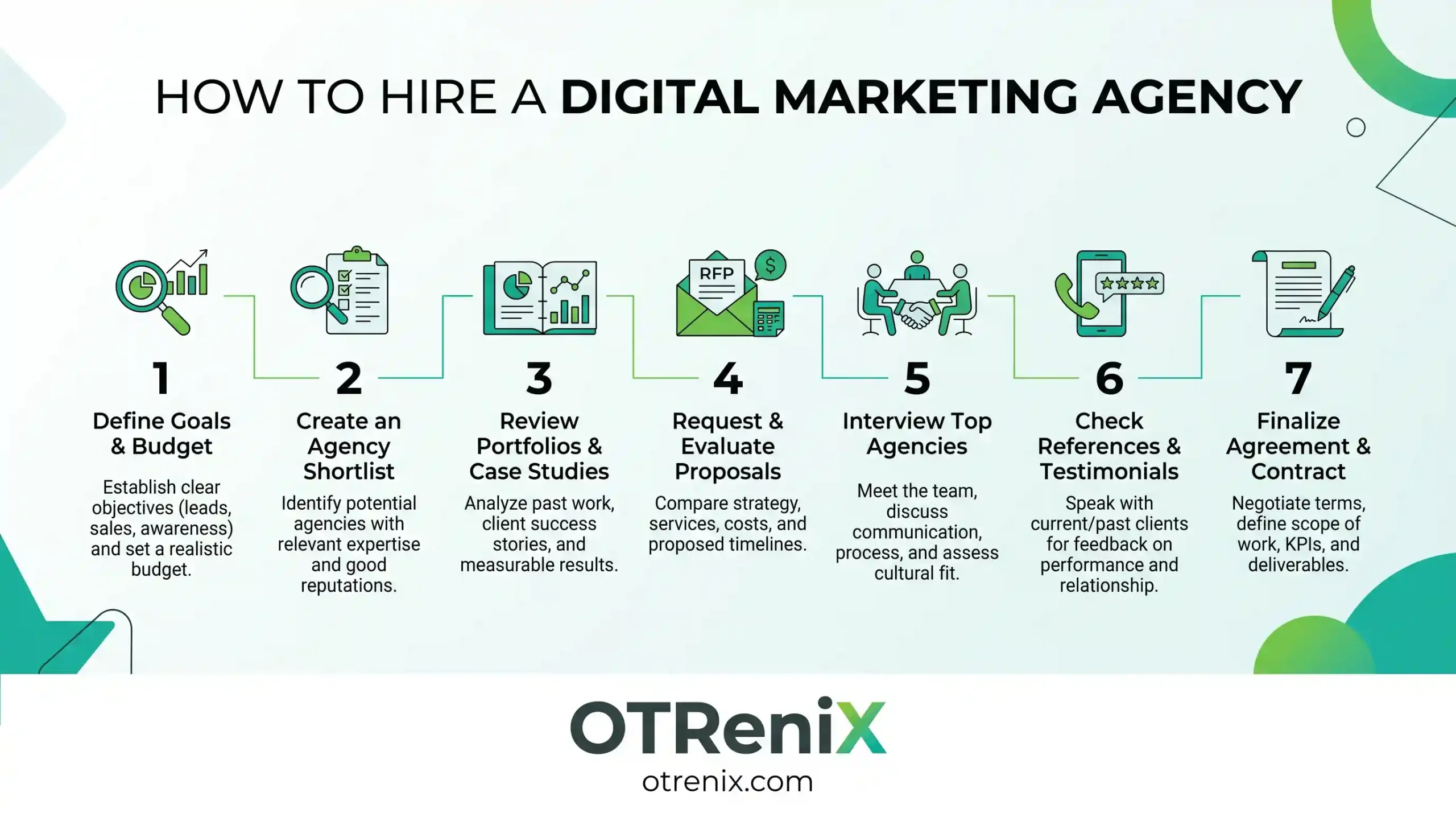
Hiring well is not complicated, but it requires a clear process. You need to know what you actually need, where to find serious candidates, how to interview them, and what to look for in the contract. Most founders skip half of these steps and wonder why their agency fails.
This article walks through the full process of hiring a digital marketing agency. I will show you when to hire one, how to scope the engagement, where to find candidates, what to ask in interviews, what to pay, and how to structure the contract so both sides have skin in the game.
Key Takeaways
- Hire an agency when you have product market fit, a working sales motion, and budget for execution. Pre product market fit, the founder should still own marketing.
- Define the scope before you start the search. SEO, paid media, content, ABM, and full service are different problems with different agencies and different price points.
- Specialist agencies almost always outperform generalists in technical or regulated categories. Cybersecurity, fintech, healthcare, and B2B SaaS all reward category expertise.
- Expect to pay $5K to $50K a month depending on scope. Below $5K, the agency is too junior to deliver. Above $50K, you should be hiring full time staff instead.
- Sign a 6 month contract with a 30 day exit clause. Anything shorter and the agency cannot deliver real results. Anything longer locks you in before you know if it works.
- The biggest red flag is an agency that promises specific lead numbers in writing. Anyone who guarantees results in B2B marketing does not understand the math.
When You Need a Digital Marketing Agency
A digital marketing agency is the right hire in a specific window. Too early and you waste budget you cannot afford. Too late and the agency cannot keep up with what the company already needs.
Signs you are ready
- You have product market fit. At least 10 customers who can clearly explain why they bought. Without this, no agency can build a working marketing program because the underlying message is not yet validated.
- You have a working sales motion. Marketing produces leads, sales follows up, deals close at a predictable rate. If sales is broken, fixing marketing will not help.
- You have at least 1 internal marketing person. Even a junior marketing manager. Agencies need a counterpart inside the company to coordinate, share context, and run weekly check ins. Companies that hire agencies with zero internal marketing usually fail.
- You have budget for execution beyond the agency fee. Plan for $5K to $50K a month in additional spend on ads, software, content production, and design depending on scope.
- The founder or CMO has 2 to 3 hours a week for the agency. Without senior internal time, even the best agency drifts.
Signs you are not ready
- You are pre product market fit. Your customers are still telling you what they want, the product is changing every month, and the message keeps shifting. Agencies built on shaky foundations produce shaky results.
- You expect the agency to “fix marketing” in 60 days. Real digital marketing programs take 4 to 9 months to show meaningful results. Companies that demand instant ROI force agencies into short term tactics that do not build long term growth.
- Your only goal is to “increase brand awareness” without a revenue tie. Agencies hired against vague goals deliver vague results.
- You cannot describe your ideal customer in 2 sentences. Until you can, the agency cannot target them.
If you check most of the “ready” signs and few of the “not ready” signs, the search is worth starting.
Defining the Scope Before You Search
The biggest mistake companies make is starting the agency search without a clear scope. They post on LinkedIn asking for “a marketing agency,” then drown in 50 inbound pitches from agencies that all sound similar.
Define the scope first. There are 6 main categories of digital marketing agency, and most agencies specialize in 1 or 2.
SEO and content agencies
Focus on organic traffic and inbound pipeline through search. Their work includes keyword research, content production, link building, and technical SEO. Best for companies where customers actively search for the problem you solve. Time to results is 6 to 12 months.
Paid media agencies
Run ads on Google, LinkedIn, Meta, and other platforms. Their work includes campaign setup, creative development, audience targeting, and ongoing optimization. Best for companies with a working conversion path that just need volume. Time to results is 1 to 3 months.
ABM and demand generation agencies
Build account based marketing programs that target specific named accounts. Their work includes account selection, intent data, multi channel orchestration, and sales alignment. Best for B2B companies with deal sizes above $25K and a defined target account list.
Full service B2B agencies
Cover the full marketing stack: strategy, content, paid media, web, PR, and ops. Best for companies that want one partner to coordinate the entire marketing function. More expensive than specialists but easier to manage.
Industry specialist agencies
Focus on a specific category like cybersecurity, fintech, healthcare, or developer tools. Best for companies in technical or regulated markets where category knowledge dramatically shortens the learning curve. Almost always outperform generalists in their niche.
Fractional leadership agencies
Provide senior marketing leadership 10 to 20 hours a week. Their work includes strategy, team building, and oversight rather than execution. Best for companies that need a CMO but cannot yet justify a full time hire.
Pick the category that matches your actual problem. If you need pipeline at scale and have no funnel, a paid media agency cannot help. If you have a working funnel but no fuel, a content agency will be too slow.
Where to Find Candidates
The best digital marketing agencies do not advertise. They are usually busy, work through referrals, and choose their clients carefully.
Founder and operator networks
Ask 10 founders or marketing leaders in your network who they would hire. The same 2 or 3 names will come up. This is the highest signal source because the recommendations come from people who have actually paid the agencies and seen the results.
Search for the specialty plus your category, for example “B2B SaaS demand generation agency” or “cybersecurity marketing agency.” Look at the agencies that show up, then look at their content, their team, and their case studies before making contact.
Specialized directories
Sites like Clutch, G2, and DesignRush rank agencies by client reviews and case studies. The reviews on these sites are largely real, though the rankings are often pay to play. Use them as a starting point, not a final list.
Industry communities
Slack groups, paid masterminds, and conferences in your category often have agency recommendations from operators with direct experience. These are usually higher signal than public reviews.
Avoid generic freelance platforms
Upwork, Fiverr, and similar platforms work for freelancers and small projects, not for ongoing agency relationships. Serious B2B marketing agencies do not live on these platforms.
Filter the long list
You will probably collect 15 to 30 names. Cut the list to 4 to 6 finalists using these filters:
- They have at least 5 named clients in your category in the past 3 years.
- Their case studies include specific revenue or pipeline numbers, not just “improved engagement.”
- The team includes senior operators who have actually built marketing functions, not just career agency people.
- They have an opinion about your business after a 30 minute call. Generalist responses signal a generalist agency.
How to Interview a Digital Marketing Agency
The interview is where most companies make their decision badly. They get impressed by the pitch deck, the awards on the wall, and the senior partner running the room. Then they sign the contract and meet the actual team that will run the work, which is junior and unfamiliar with the category.
Run the interview in 3 phases.
Phase 1: Strategic conversation
The first 60 minute call is about strategy and fit. Ask questions that test how the agency thinks about your business, not how good their pitch is.
- Walk me through how you would approach our business in the first 30 days.
- Look at our website. What 3 things would you change in the first month, and why?
- Our biggest competitor is X. How would you position us against them?
- We have $20K a month for execution beyond your fee. How would you split it across channels in the first quarter?
- Who do you think our ideal customer is, based on what you know so far?
A weak answer is generic. “We would do an audit and develop a strategy” tells you nothing. A strong answer is specific to your business and includes trade offs. Senior agencies will tell you what they would NOT do, and why. They will also push back on assumptions in your questions, which is a good sign.
Phase 2: Tactical and team conversation
The second call should be with the actual team that will run your account, not just the senior pitch lead. Ask the people who will do the work.
- Describe a campaign that failed in the past year. Why did it fail and what did you learn?
- How do you measure marketing? Which 5 metrics do you report to the client every month?
- Tell me about a client engagement that ended badly. What happened?
- What is your process for the first 90 days?
- What does a typical week look like for you on a client account like ours?
You are looking for honesty, specificity, and self awareness. Anyone who says they have never had a failure has not done enough work. Anyone who cannot describe their week clearly is probably staffing the account in a way that will surprise you later.
Phase 3: References
Call at least 3 references for your top 2 finalists. Do not just send a written reference request. Get on a 20 minute call with each one and ask specific questions.
- What did the agency deliver in the first 90 days?
- What pipeline or revenue numbers can you share?
- What would have made the engagement better?
- Would you hire them again, and why or why not?
Vague praise like “they were great to work with” tells you the engagement was forgettable. Specific stories with numbers tell you the work was real. Pay attention to which references the agency offers. If they only give you their 1 successful client, that is the only client where the work succeeded.
What to Pay
Digital marketing agency pricing varies wildly by scope, category, and engagement model. Here is the current market for B2B work.
Pricing models
| Model | Typical range | When it works |
|---|---|---|
| Monthly retainer | $5K to $50K a month | Default option, predictable for both sides |
| Project based | $20K to $200K per project | One time work like website, brand, launch |
| Performance based | Base fee plus % of pipeline | High trust relationships with clear attribution |
| Hourly | $150 to $400 an hour | Small projects or advisory work |
Most B2B engagements settle into a monthly retainer of $10K to $25K for ongoing work. Below $5K, the agency is too junior or too stretched to deliver senior thinking. Above $50K, you should be evaluating whether to hire full time staff instead.
What drives the price
- Scope. Single channel work like SEO costs less than full service marketing.
- Category. Specialist agencies in cybersecurity, fintech, or other technical markets charge 30% to 60% more than generalists. Usually worth it.
- Team seniority. Senior operator led agencies cost more than agencies that staff with junior account managers. Usually worth it for B2B.
- Geographic location. US and UK based agencies are more expensive than Eastern European or Asian agencies. Quality varies more than location, but timezone overlap matters for B2B work.
What is included and what is not
The retainer typically covers strategy, ongoing campaign management, and reporting. It often does NOT cover ad spend, software licenses, design assets, video production, or PR placements. Read the contract carefully and add 20% to 50% to the retainer to estimate true cost.
If the agency quotes a price that seems much lower than competitors, ask exactly what is included. Cheap retainers usually mean junior staff, no senior oversight, or scope that gets cut quickly when the work gets hard.
How to Structure the Contract
A clear contract protects both sides and prevents the small misunderstandings that kill agency relationships in month 3.
Key terms to include
- Duration. Minimum 6 months. Anything shorter and the agency cannot deliver real results. Anything longer locks you in before you know if it works.
- Exit clause. 30 day notice from either side after the first 90 days. This gives both parties an honest way out if the fit is wrong.
- Scope. List exactly what is included: hours, deliverables, channels, reporting cadence. List exactly what is not included: ad spend, software, third party costs.
- Deliverables for the first 90 days. Strategy document by end of month 1, campaigns live by end of month 2, first reportable metrics by end of month 3. Write this down before signing.
- Reporting cadence. Weekly call, biweekly written update, monthly executive summary. Specify which metrics are tracked.
- Account team. Name the senior strategist and the day to day account lead. Add a clause that says these names cannot change without notice and approval.
- Confidentiality. Standard NDA covering customer data, strategy, and team information.
What to avoid in the contract
- Performance guarantees on lead volume or revenue. Any agency that guarantees specific numbers in writing is either lying or planning to game the metrics.
- 12 month lock ins with no exit. These protect bad agencies, not clients. If they cannot earn renewal every quarter, they should not be locked in.
- Vague scope. “Marketing services” without specific deliverables creates conflict in month 2 when expectations diverge.
- Hidden third party costs. Make sure the contract specifies who pays for software licenses, stock photography, ad budgets, and other pass through costs.
Onboarding the Agency
Even a great agency will fail with bad onboarding. Set them up for success in the first 30 days.
- Give them access to everything they need. Analytics, ad accounts, CRM, customer interviews, sales calls, and past marketing assets. Information held back becomes blockers later.
- Introduce them to sales and product. Marketing does not exist alone. The agency needs working relationships with the sales lead and the product lead in the first week.
- Block 2 to 3 hours a week of internal time. Weekly call with the agency, async updates as needed. Without regular internal time, the agency will drift.
- Agree on the 90 day plan in writing. Strategy by end of month 1, execution by end of month 2, first metrics by end of month 3. Make this part of the contract or a separate document signed by both sides.
- Do not change the plan in week 2. Founders often panic when they do not see immediate results and pivot the strategy. Give the plan 90 days before changing anything.
- Set up shared workspace. A Notion page, shared drive, or project management tool where the agency can post strategy documents, meeting notes, and progress updates. Transparency builds trust on both sides.
Red Flags to Watch For
After watching dozens of agency engagements, the same warning signs appear before bad hires.
- They cannot show specific results. Adjectives instead of numbers. “Significant growth” instead of “$300K to $2.1M in 9 months.”
- The pitch team is not the work team. The senior partners on the pitch call disappear after signing. The work goes to junior account managers you never met.
- They want to start with tactics, not strategy. An agency that jumps straight to “we will run some LinkedIn Ads” before understanding your customer is a freelancer in agency clothing.
- They have no opinion. A senior agency will push back on bad ideas, including yours. A weak one will agree with everything.
- They promise fast results in B2B. Anyone who guarantees pipeline in 30 days does not understand B2B sales cycles.
- They cannot describe their first 30 days clearly. A good agency has a repeatable onboarding process. A weak one improvises.
- Their references are weak. Vague compliments mean the engagement was unremarkable. Strong references give you specific stories with numbers.
- They avoid talking about failures. Either they have not done enough work, or they cannot reflect honestly on it.
One red flag is not a deal breaker. Three or more, and you are looking at the wrong agency.
Common Hiring Mistakes
Even with a clear process, founders make the same mistakes during agency searches.
Hiring on price alone
The cheapest agency is rarely the right answer. A $4K a month engagement that produces nothing costs more than a $15K a month engagement that produces $1M in pipeline. Calculate the cost of failure, not just the cost of the retainer.
Hiring before defining the goal
“We need leads” is not a goal. “We need 30 sales qualified opportunities a month at a CAC under $1,500 within 9 months” is a goal. Without specificity, the agency cannot be held accountable and the engagement drifts.
Hiring a generalist for a specialist problem
Cybersecurity, fintech, healthcare, dev tools, and other technical markets reward category specialists. A generalist agency in these markets spends 6 months learning your category on your budget. By month 7 they understand it. By month 10 the engagement ends and they take that knowledge to the next client.
Skipping references
Reference calls take 60 to 90 minutes total and prevent 6 figure mistakes. Skipping them is the most expensive 90 minutes a founder will save in a year.
Not allocating internal time
Founders sign the contract and assume the agency will run independently. Without 2 to 3 hours a week of internal coordination, even the best agency drifts. Plan for this time before signing.
Recommendation
If you are seriously considering a digital marketing agency, here is what to do this month.
Start by writing down your current numbers: revenue, marketing budget, team size, biggest channel, biggest gap. If you cannot fill this in clearly, you are not yet ready for an agency. You need a baseline before any partner can help.
Define the scope precisely. SEO, paid media, content, ABM, full service, or fractional leadership. Pick the 1 or 2 categories that match your actual problem. Skip “we want everything” agencies until you are at $20M ARR, where integrated programs start to make sense.
Ask 5 founders or marketing leaders in your network for agency recommendations in that scope. Build a list of 10 to 15 names. Filter to 4 finalists using category fit, team seniority, and concrete results.
Run 2 conversations with each finalist. The first should be strategic, focused on how they would approach your business. The second should include the actual account team, focused on tactics and working style. Call 3 references for your top 2 finalists.
Pick one. Sign a 6 month contract with a 30 day exit clause for both sides. Block 2 to 3 hours a week for internal coordination. Give them full access from day 1. Agree on a written 90 day plan with specific deliverables.
Then give it 90 days before judging the work. Agencies that get judged in week 4 produce week 4 work. Agencies that get judged on the 90 day plan produce results that compound.
A digital marketing agency is not a magic solution. Marketing is hard, B2B sales cycles are long, and even the best agency needs 4 to 9 months to build a working program. But for companies in the $1M to $20M ARR range, the right agency is one of the highest leverage investments you can make.
Pick well, onboard properly, set clear expectations, and give it time.
