Outsource B2B Marketing
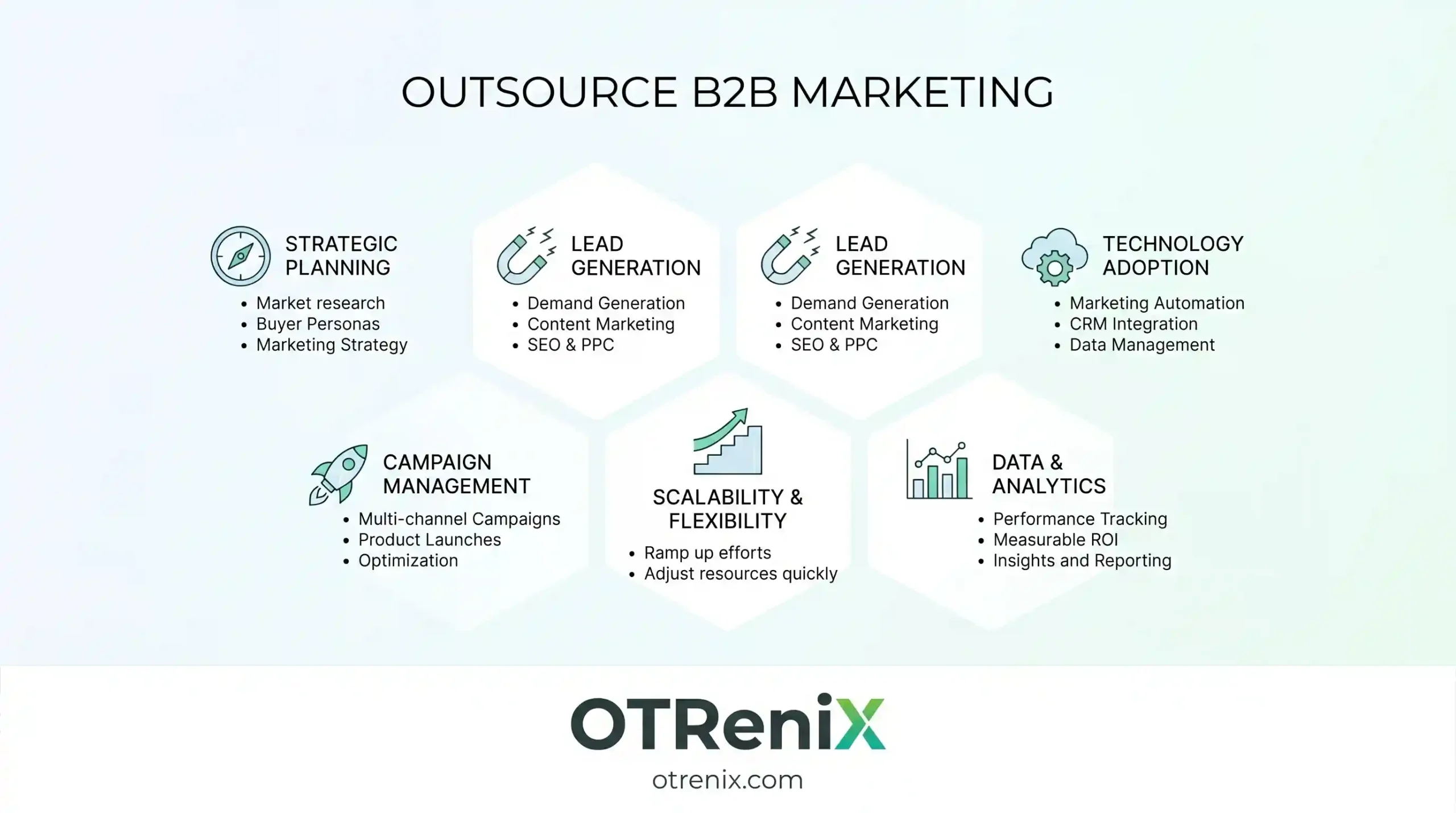

A founder of a $4M ARR cybersecurity company has 3 marketing problems. The website needs a rebuild. Pipeline is flat. Sales reps complain that leads from marketing are mostly junk. The founder has been running marketing on the side for 18 months and is now blocking 30 hours a week to fix it, time that should go to product and customers.
The standard answer is to hire a CMO. But a senior B2B CMO costs $250K plus equity, takes 4 to 6 months to recruit, and may not stay past the second year. The next answer is to hire a junior marketing manager for $90K. They will execute tasks but cannot build strategy, hire a team, or own outcomes.
The third answer is to outsource. The founder hires a fractional CMO for strategy, an agency for content and SEO, a contractor for paid media, and a freelancer for design. Total cost: $20K to $35K a month. Total time to working program: 60 days. No equity, no recruiting, no benefits, no severance risk.
Outsourcing B2B marketing has gone from a niche option to a mainstream model in 2026. The marketing leadership market has changed, the agency model has matured, and the technology to manage distributed teams has caught up. For most B2B companies between $1M and $30M ARR, outsourced marketing now produces better outcomes than building an in house team from scratch.
This article covers what to outsource, what to keep in house, how to structure the relationships, what to expect to pay, and how to make the model work in practice.
Key Takeaways
- Outsourcing B2B marketing means hiring external partners (agencies, fractional executives, contractors, freelancers) to run all or part of the marketing function instead of building a full in house team.
- The model fits best for B2B companies between $1M and $30M ARR, where the cost of a full in house team is hard to justify but the marketing problem is too complex for a single junior hire.
- Realistic budgets in 2026 range from $15K a month for early stage outsourced setups to $80K+ a month for fully outsourced programs at growth stage. This is usually 30% to 50% less than building the equivalent in house team.
- The biggest mistakes are outsourcing strategy without leadership, hiring 5 specialized vendors with no coordination, and measuring outcomes only on activity, not pipeline.
- Some functions should stay in house even in heavily outsourced models. Customer voice, sales alignment, and core narrative belong with the founder or in house leader.
What Outsourcing B2B Marketing Actually Means
The term covers a range of arrangements. The 4 most common in 2026.
Fully outsourced
The company has no in house marketing team. All work is done by external partners. A fractional CMO leads strategy. Agencies handle content, SEO, paid media, and PR. Freelancers cover design and email. The founder or COO acts as the internal point of contact.
This works best for companies under $5M ARR that cannot justify a full time hire yet but need senior marketing thinking and consistent execution.
Hybrid (in house plus outsourced)
The company has 1 to 3 in house marketers, usually a head of marketing plus generalist support. Specialized work goes to external partners: PR agency, SEO agency, paid media agency, design contractors.
This is the most common model for B2B companies between $5M and $30M ARR. The in house team owns strategy and core execution. Specialists fill the gaps that would be expensive to hire for full time.
Outsourced leadership only
The company has a junior or mid level in house team but no senior marketing leader. A fractional CMO provides strategy, manages the team, and owns outcomes. This works when the company has good execution capacity but lacks senior thinking.
This model often serves as a bridge before hiring a full time CMO. The fractional executive runs the function for 12 to 18 months while the company decides what shape the permanent role should take.
Outsourced execution only
The company has a senior in house marketing leader but limited execution capacity. Agencies and freelancers handle the production work: content, design, ads, events. The leader focuses on strategy and senior relationships.
This works at any stage when the leader prefers a small core team plus flexible external resources over a larger fixed cost team.
Why Outsource B2B Marketing in 2026
Several forces have made outsourcing more attractive in 2026 than 5 years ago.
Senior marketing talent has become harder to hire
Senior B2B marketing leaders are expensive, scarce, and increasingly unwilling to take full time roles in early stage companies. The pool of CMOs willing to take fractional or advisory roles has grown 4x since 2021. The pool of strong full time candidates for early stage B2B has shrunk in the same period.
Outsourcing gets access to senior thinking that is now hard to hire any other way.
The agency model has matured
Specialized B2B agencies in content, SEO, paid media, PR, and demand generation are dramatically better in 2026 than they were in 2018. The best agencies have hired senior people from in house roles and developed methodologies that often outperform what an internal team could build in a year.
The trade off is selection. The top 10% of B2B agencies produce real results. The bottom 50% waste budget. Picking the right partner matters more than ever.
Cost of full time marketing has gone up
A full marketing team in B2B (CMO, content manager, demand gen lead, designer, ops) now costs $700K to $1.2M a year fully loaded. That is too much for most companies under $20M ARR. Outsourcing the same scope often runs $300K to $600K a year.
Faster time to results
Building an in house team takes 6 to 12 months. Recruit, hire, onboard, build process, produce work. An outsourced setup can be running within 60 to 90 days. For companies that need pipeline now, this difference matters.
More tolerance for distributed work
The shift to remote and hybrid work in 2020 changed how companies think about team composition. Teams that include freelancers, fractional executives, and agency partners look normal in 2026, where they would have looked strange in 2018.
What to Outsource and What to Keep In House
The wrong things outsourced will hurt the business. The right things outsourced will accelerate it. Here is the typical split.
| Function | Outsource | Keep in house | Why |
|---|---|---|---|
| Strategy and positioning | Sometimes (fractional CMO) | Usually founder or in house leader | Core to the business, requires customer knowledge |
| Content marketing | Yes | Subject matter expertise | Production scales well, expertise must be in house |
| SEO | Yes | None | Specialized work that benefits from agency tools and experience |
| Paid media | Yes | Strategy and budget approval | Specialized work, agencies have better data |
| PR and analyst relations | Yes | Spokesperson availability | Relationships with reporters take years to build |
| Design and creative | Yes | Brand guardrails | Production work, easy to scale up and down |
| Email and marketing automation | Hybrid | Strategy and customer data | Setup outsource, content stays close |
| Events and field marketing | Hybrid | Sales alignment and host roles | Logistics outsource, relationships stay in house |
| Sales enablement | Mostly in house | Most of it | Tightly tied to sales team and product |
| Customer marketing | Mostly in house | Most of it | Customer relationships should not flow through agencies |
| Product marketing | Hybrid | Core positioning, launches | Product knowledge cannot live entirely in an agency |
The pattern: production work outsources well. Customer knowledge, product knowledge, and core narrative should stay close.
How to Structure Outsourced B2B Marketing
The model that works in 2026 has 4 layers.
Layer 1: In house owner
Even fully outsourced programs need an in house owner. This is the founder, COO, or head of marketing who owns the budget, makes final decisions, and represents the company to all external partners.
Without this layer, outsourced programs drift. Agencies optimize for agency goals. Freelancers do good work that does not connect to anything. The in house owner is the strategic glue that holds the program together. They do not have to be a marketing expert, but they have to be available 4 to 8 hours a week.
Layer 2: Strategic leadership
This is usually a fractional CMO or senior marketing consultant. Their role is strategy, ICP definition, channel selection, agency management, and reporting to the in house owner. They typically work 10 to 20 hours a week.
In some models the in house owner takes this role themselves. This works only if the in house owner is a senior marketer. For most founders, it does not, and the fractional layer is required.
Layer 3: Specialized execution partners
The agencies, contractors, and freelancers who do the actual production. A typical setup at growth stage might include:
- 1 content marketing agency
- 1 SEO agency (sometimes the same as content)
- 1 paid media agency
- 1 PR agency
- 1 to 2 design contractors
- 1 marketing operations contractor
Each partner has a clear scope, deliverables, and reporting relationship to the strategic leader. Cross partner coordination usually flows through the strategic leader, not directly between partners.
Layer 4: Tools and systems
The technology stack the company owns and the partners use. This includes the CRM, marketing automation platform, analytics, project management tools, and shared content storage. Companies that try to outsource without owning the tools end up locked into agencies that own the data and processes.
The right pattern is: company owns the tools, partners get access. When a partner relationship ends, the data and process stay with the company.
What This Costs in 2026
Realistic costs for outsourced B2B marketing depend on company stage and scope.
| Setup | Stage | Monthly cost | What is included |
|---|---|---|---|
| Fully outsourced (light) | $1M to $3M ARR | $15K to $25K | Fractional CMO + 1 agency + freelance support |
| Fully outsourced (full) | $3M to $10M ARR | $25K to $45K | Fractional CMO + 2 to 3 agencies + freelancers |
| Hybrid (small in house) | $5M to $15M ARR | $30K to $60K | 1 to 2 in house + fractional CMO + 2 to 3 agencies |
| Hybrid (medium in house) | $15M to $30M ARR | $50K to $100K | 3 to 5 in house + multiple agencies |
| Outsourced leadership only | $5M to $30M ARR | $15K to $25K | Fractional CMO managing in house team |
| Outsourced execution only | Any stage | $20K to $80K | In house leader + agency network |
Compare these numbers to a fully in house equivalent: a CMO ($250K), a head of demand ($180K), a content manager ($110K), a designer ($95K), a marketing ops manager ($120K), plus 30% benefits load. Total: roughly $1M a year, or $85K a month, before tools and contractors.
For most B2B companies under $30M ARR, the outsourced equivalent costs 30% to 50% less and produces comparable or better outcomes when run well.
How to Pick the Right Partners
The biggest risk in outsourced marketing is hiring the wrong partners. Here is what to look for.
For fractional CMOs
The right fractional CMO has run marketing for at least 2 companies in your industry, at your stage. They can name specific results in numbers, not adjectives. They have hired and managed teams, not just executed. They run 3 to 5 clients at most. They have references you can call.
Avoid candidates who are between full time roles. They will leave the moment a CMO job appears. Avoid candidates who promise specific lead numbers in writing. Marketing depends on too many variables outside their control.
For agencies
Look for at least 5 named clients in your industry, recent case studies with pipeline numbers, and a senior team that will actually work on your account. The pitch team is often not the work team. Ask by name who will run the day to day work.
Avoid agencies that promise results in 60 days. B2B marketing rarely produces meaningful pipeline that fast. Avoid agencies that lead with tactics (“we’ll run LinkedIn Ads”) instead of strategy (“here’s how we would approach your business”).
For contractors and freelancers
Look for portfolio quality, past client references, and ability to work autonomously. Strong contractors do not need daily direction. They take a brief, ask the right questions, and produce work on time.
Most contractors should be hired for a small first project before any longer engagement. A $3K test project tells you more than 5 hours of interviews.
For marketing ops contractors
This is a specialized role. Look for people who have set up HubSpot, Salesforce, or whatever stack you use, in companies similar to yours. Marketing ops mistakes are expensive to fix later.
How to Onboard Outsourced Partners
Even the best partner will fail with a bad onboarding. The first 30 days set the trajectory of the entire engagement.
Give full access
CRM, analytics, sales calls, customer interviews, financials, product roadmap. If you hold information back, partners cannot make good decisions. Most engagements that fail in month 3 fail because the partner never had the context to do the work properly.
Schedule the first 90 days
Strategy document by end of month 1. Plan and tools in place by end of month 2. First measurable results by end of month 3. Write this down before they start. Both sides need to know what success looks like.
Block recurring time
A weekly 1 hour call between the in house owner and the strategic lead. A biweekly review with each execution partner. A monthly all hands review with everyone. This is non negotiable. Outsourced programs without these rhythms drift within 60 days.
Set up shared workspace
A Notion page, Slack channel, or shared drive where partners post strategy documents, weekly updates, and progress data. Transparency builds trust. Partners who hide their work usually have something to hide.
Define the decision rights
What can the partner decide alone? What needs in house owner approval? What needs founder approval? Without this clarity, every decision becomes a meeting, and the speed advantage of outsourcing disappears.
How to Manage Outsourced Marketing
Day to day management of an outsourced program is different from managing an in house team. Three principles matter.
Manage outcomes, not activities
In house teams can be managed on activity level: daily standups, hours worked, tasks completed. Outsourced partners should be managed on outcomes: pipeline sourced, content published, campaigns launched, metrics improved.
Companies that try to micromanage agencies on hours and tasks usually destroy the engagement. The partner spends more time reporting than working. The right pattern is clear deliverables, weekly reviews, and trust that the partner is doing what is needed.
Insist on integrated reporting
Each partner reports their work in their own way by default. The in house owner ends up reading 5 different dashboards and trying to assemble a picture of the whole program. This does not scale.
The fix is shared reporting structure. Every partner reports against the same business metrics: pipeline sourced, qualified opportunities, customer acquisition cost, key channel performance. The strategic leader (fractional CMO or in house head) consolidates this into one monthly business review.
Run quarterly partner reviews
Every quarter, formally review each partner: are they delivering what was promised, is the relationship working, what should change. Most partner relationships drift over time. Quarterly reviews catch the drift before it becomes a problem.
This is also the moment to renegotiate scope, swap underperformers, or expand what is working. Partners that produce results should be given more scope. Partners that do not should be replaced quickly. Most companies wait too long to make changes.
What Most Outsourced B2B Marketing Programs Get Wrong
Even well structured programs make these mistakes.
Outsourcing without strategic leadership
Hiring 4 specialized agencies without a fractional CMO or senior in house leader is the most common failure pattern. Each agency optimizes for their channel. Nobody owns the cross channel strategy. The result is a Frankenstein program with no coherent narrative or pipeline outcome.
Hiring too many partners too fast
Companies sign 6 partners in the first quarter. Each one needs onboarding, weekly meetings, monthly reviews. The in house owner spends 25 hours a week managing partners and has no time left to do the strategic work. Start with 1 to 3 partners. Add more only when each one is producing.
Weak in house owner
If the in house owner is a junior person or someone with no marketing background, partners will run the program their way. Sometimes this works. More often it produces output that does not match the company’s actual needs. The in house owner has to be senior enough to push back.
Treating partners as vendors instead of team
The companies that get the most from outsourced marketing treat their partners as extended team. They share strategy openly, invite partners to relevant company meetings, give honest feedback, and build long term relationships. The companies that treat partners as commodity vendors get commodity work.
Switching too often
Long term relationships compound. A partner that has worked with you for 18 months knows your customer, your product, and your sales team better than a new partner ever will. Companies that change partners every 6 months because results are slow usually have unrealistic expectations, not bad partners.
No exit plan when ending engagements
When a partner relationship ends (whether due to growth or performance), the transition is often messy. Data, content, and processes stay scattered. Plan exits in advance. Document everything. Own the tools and assets. Make every relationship reversible.
When Outsourcing Stops Making Sense
Outsourced marketing is not a permanent solution for most companies. There is a stage where building in house starts to produce better outcomes.
Above $30M ARR for most categories
At this stage the cost of building in house equals or exceeds outsourcing, and the strategic value of having marketing leadership inside the company starts to outweigh the flexibility of fractional and agency models.
When marketing becomes a competitive moat
If marketing is genuinely a strategic advantage in your category (rare in B2B but real), the work needs to live in house. You cannot outsource a moat.
When the founder wants out of marketing
Many founders run marketing in early stages because nobody else can. They are happy to outsource the execution but want to stay close to the strategy. When the founder wants to fully step away, a full time CMO usually serves better than a fractional one.
When the team grows beyond 10 marketers
At that scale, managing the dynamics between an outsourced strategic leader and a sizeable in house team gets complicated. A full time leader usually fits better.
For most companies, the transition from outsourced to in house happens between $20M and $50M ARR, often gradually. The fractional CMO becomes a full time CMO. The agencies stay but their role narrows to specialized work. The hybrid model evolves.
Recommendation
If you run a B2B company between $1M and $30M ARR in 2026 and your marketing is not producing the pipeline you need, outsourcing is usually the right answer. It is faster, more flexible, and cheaper than building in house, and the quality gap that existed 10 years ago has closed.
Start by writing down what you actually need. Strategy, execution, or both. Specific channels or full coverage. Senior leadership or specialized production work. The clearer the requirements, the better the partners you can pick.
For early stage companies under $5M ARR, start with a fractional CMO and 1 agency. Add more partners only when each one is delivering. Resist the temptation to outsource everything in the first quarter. Build the program one layer at a time.
For growth stage companies between $5M and $20M ARR, run a hybrid model. A small in house team for strategy and core execution. Specialized agencies for content, SEO, paid media, and PR. Freelancers for design and project work. Aim for monthly costs of $30K to $60K, depending on scope.
For companies between $20M and $30M ARR, plan the transition to more in house. Hire a full time head of marketing. Keep the agency network but narrow its scope. Use the next 12 to 18 months to build the team that will eventually replace most outsourced functions.
Whatever stage you are at, the rules are the same. Pick partners carefully. Onboard them properly. Manage on outcomes, not activities. Review quarterly. Build long term relationships with the ones that work. Replace the ones that do not.
Outsourcing B2B marketing in 2026 is not a compromise solution for companies that cannot afford an in house team. It is often the better answer for companies that want senior thinking, flexible execution, and faster time to pipeline. Done well, it produces marketing programs that compete with anything an in house team could build, at half the cost and a third of the time.
The founder running marketing on the side does not need to hire a CMO to fix it. They need a fractional CMO, the right agencies, and the discipline to manage the program well. Those 3 things, in 2026, are easier to find and cheaper to engage than they have ever been.