Why Content Marketing Is Important for B2B
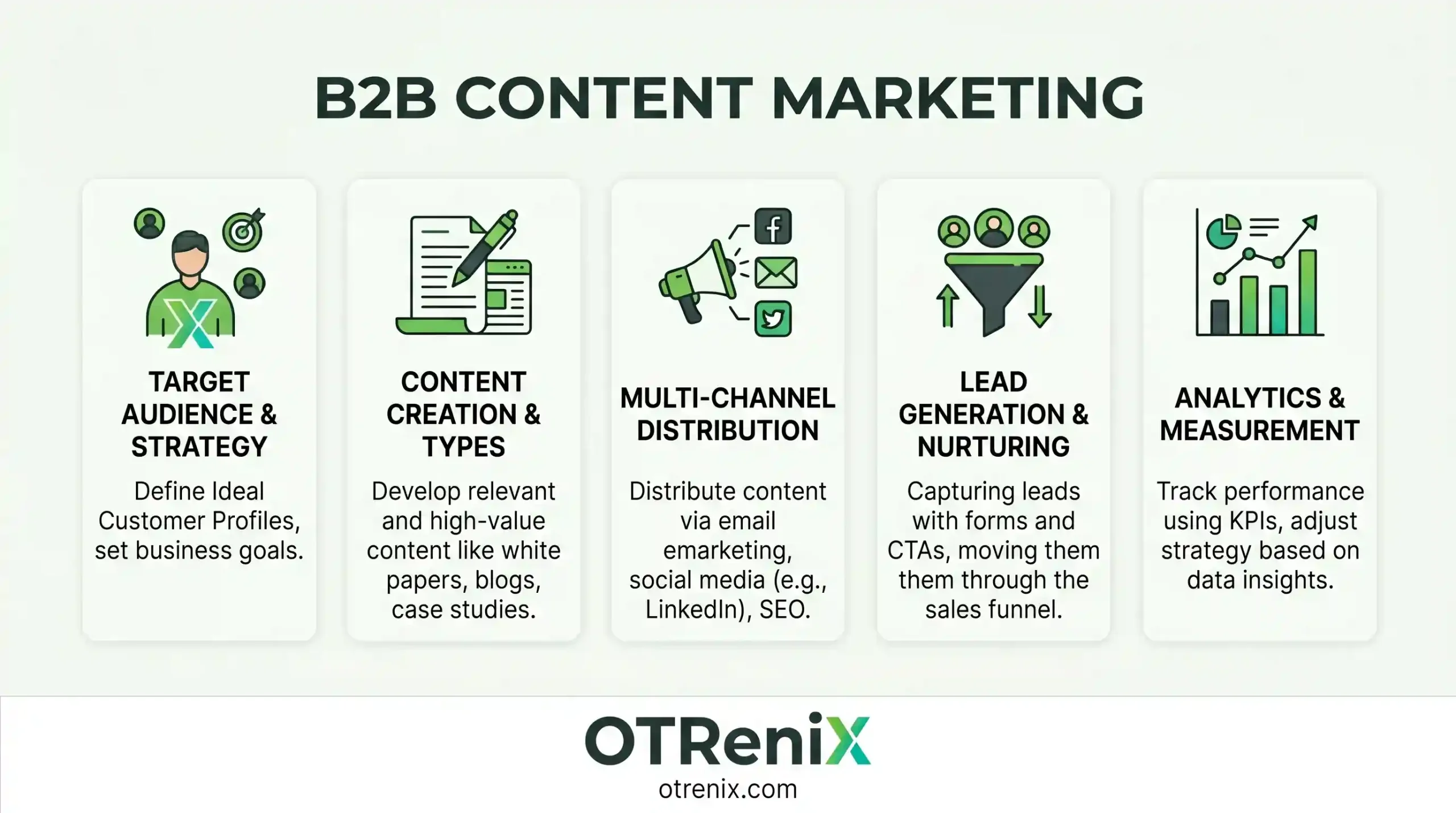

Most B2B founders treat content marketing as something to do when there is time and budget left over. Write a few blog posts, post on LinkedIn, maybe a whitepaper for the gated form. The result is predictable: 200 visits a month, 3 leads a quarter, and a quiet conviction that “content does not work for our market.”
This is wrong, but the diagnosis is wrong too. Content does not fail in B2B because the channel is broken. It fails because most B2B companies treat content as decoration rather than as a core revenue function. They publish without strategy, measure the wrong things, and quit before the channel has a chance to compound.
Done well, content marketing is one of the highest leverage investments a B2B company can make. It generates pipeline at a fraction of paid media cost, builds the credibility that closes enterprise deals, and creates an asset that pays back for years. The companies winning their categories in 2026 are the ones that figured this out 3 years ago and stayed consistent.
This article shows why content matters in B2B specifically, what it actually delivers, what it costs, and how to build a program that works. By the end you should know whether to invest in content marketing this year, and what to expect in return.
Key Takeaways
- B2B prospects do most of their research before talking to a vendor. In 2026, around 70% of the buying journey happens before the first sales conversation. If you are not in that research phase, you are not in the deal.
- Content marketing produces 3x more leads than paid search at less than half the cost over 12 to 18 months. The compound effect is what generic ROI calculations miss.
- The right content shortens enterprise sales cycles by 20% to 40% because prospects walk into demos already educated.
- Most B2B content fails because of poor strategy, not poor execution. Random blog posts will not build pipeline. A focused content engine aligned with the sales motion will.
- Expect 6 to 12 months before a content program produces meaningful pipeline. Companies that quit at month 4 lose the entire investment.
Why B2B Buying Has Changed
The case for content marketing starts with how customers actually buy in 2026. The numbers tell a clear story.
Around 75% of the B2B buying journey now happens before a prospect talks to a sales rep. Buyers research independently, read articles, watch videos, ask peers, and compare options on their own time. By the time they fill out a demo form, they have already shortlisted 2 or 3 vendors and rejected the rest.
This changes the math for marketing. The old model was outbound: a rep calls 150 prospects, books 15 meetings, and closes 1 deal. The new model is closer to inbound: 3,000 prospects research the category, 70 read your content, 20 fill out a form, and 3 close. Without content, you do not exist in the research phase, which means you do not make the shortlist.
The shift is even more pronounced in technical B2B markets. In cybersecurity, dev tools, and infrastructure SaaS, the prospect is often technically sophisticated and prefers to evaluate independently. They are skeptical of marketing claims and want to see proof. Content is how proof gets delivered at scale, before the sales conversation starts.
This is also why cold outbound has declined in effectiveness. In 2019, a well written cold email had reply rates of 6% to 9%. By 2026, the same email gets less then 1%. The reason is not the email, it is the inbox. Prospects are flooded with outreach and have learned to ignore vendors they do not already recognize. Content is the way to be recognized.
What Content Marketing Actually Delivers
The benefits of B2B content marketing fall into 4 categories. Each one is measurable, but most companies only track the first.
Pipeline and revenue
This is the metric most companies focus on, and it does work, but on a longer timeline than paid channels. A well built content program typically generates 20% to 40% of total pipeline within 12 to 18 months of launch. For comparison, paid search rarely exceeds 25% before costs become unsustainable.
The cost difference is significant. The cost per qualified lead from content marketing in B2B is typically $50 to $200 once the program is mature. Paid search in the same categories runs $300 to $800 per lead. Cold outbound, after fully loaded SDR costs, often runs $400 to $1,200 per qualified meeting.
Credibility and trust
In B2B, prospects do not buy from vendors they have never heard of. Content builds the recognition that turns a cold outreach into a warm conversation. When a prospect has read 3 of your articles before the sales call, the call goes differently. They ask better questions, push back less on price, and move through the cycle faster.
This is hard to measure directly, but sales teams feel it immediately. Reps will tell you which prospects “came in warm” vs “had to be educated from scratch.” The warm ones close 2x to 3x more often.
Sales enablement
Content does not just generate leads, it helps close them. A library of case studies, technical deep dives, and comparison guides gives sales reps something to send in every conversation. This shortens sales cycles, often by 20% to 40% in enterprise B2B, because the buying committee gets educated in parallel rather than serially through sales calls.
A typical enterprise deal involves 6 to 10 stakeholders. Sales can only meet directly with 2 or 3 of them. Content reaches the other 7 and answers their questions before they become objections.
Compounding asset value
This is the benefit most companies underweight. A blog post written today still generates traffic 3 years from now. A research report can be cited in industry conversations for 5 years. A well ranked guide can deliver leads every month with no additional spend.
Paid media stops the moment the budget stops. Content keeps producing. After 24 months of consistent publishing, a typical B2B content program has 30 to 50 articles still actively driving traffic and leads. The marginal cost to maintain that output is much lower than the cost to build it, which is why mature programs deliver such strong ROI.
The Real Cost of Not Doing Content
Most companies frame content marketing as a cost. The more honest framing is that not doing content also has a cost, and it is usually higher.
Without content, your only options for pipeline are paid media and outbound. Both have a hard ceiling. Paid media costs scale linearly with growth: doubling pipeline means doubling spend, with no compounding. Outbound costs scale faster than linearly because the best SDRs leave for AE roles within 18 months and you spend constantly on hiring and training.
Companies that rely entirely on paid and outbound usually hit a wall around $10M to $20M ARR. The unit economics break: customer acquisition cost climbs, payback periods extend past 24 months, and the board starts asking why the marketing budget keeps growing without proportional revenue gains.
The companies that broke through this wall almost always had content programs that started 24 to 36 months earlier. The content does not show up immediately in the model, but by year 3 it is the difference between sustainable growth and burning cash to grow.
There is also a competitive cost. If your competitors are publishing and you are not, your prospects are reading their content during the research phase. They are forming opinions about the category based on what your competitors say. By the time the prospect is ready to buy, you are arguing against a frame your competitors set 6 months earlier.
Why Most B2B Content Marketing Fails
Content marketing has a bad reputation in B2B because most programs fail. The failures share a small number of root causes.
No clear ICP
Content written for “anyone interested in our category” reaches no one in particular. The prospect cannot tell whether the article is for them, so they bounce. Strong content programs target specific roles in specific industries with specific problems. “Compliance officers at mid market healthcare companies preparing for HIPAA audits” is a usable target. “B2B decision makers” is not.
Topics chosen by SEO tools instead of customers
Most agencies start with keyword research. They find high volume keywords, write articles to match, and watch traffic grow. The traffic does not convert because the keywords have nothing to do with the actual buying questions. A better approach is to interview 15 customers and 15 lost deals first, find out what they actually search and ask, then build the content plan around those questions.
Generic execution
Most B2B content is interchangeable. Read 5 articles on “what is zero trust security” and you cannot tell which company published which one. Generic content does not build credibility because nothing in it is specific to the publisher. Strong content has a point of view, original data, or specific examples that other publishers cannot copy.
Quitting too early
Content marketing has an obvious J curve. The first 6 months show poor metrics: low traffic, few leads, no compounding. Months 7 to 12 start to show real growth. Month 12 to 24 is when the compounding kicks in and the program produces serious pipeline.
Most companies quit at month 4 or 5, exactly when the curve is about to bend. They look at ROI in month 4, see negative numbers, and shut the program down. The companies that win the long game know this and stay funded through the J curve. The ones that quit hand the long term advantage to competitors who did not.
Treating content as a marketing only function
Sales does not contribute, product does not contribute, customer success does not contribute. The marketing team writes alone, often without access to the actual customer conversations that would make the content useful. The result is content that sounds plausible but does not match how customers think.
Strong programs treat content as a company wide asset. Sales reps suggest topics from real prospect questions. Customer success contributes case studies and product nuances. Engineers write technical pieces. The marketing team curates and publishes, but the content originates from the people closest to the customer.
What Good B2B Content Marketing Looks Like
Strong B2B content programs share a small number of structural traits. None of them are about writing skill, they are about discipline and strategy.
A focused publishing rhythm
Most strong programs publish 4 to 8 high quality pieces a month, not 30 mediocre ones. Quality beats quantity in B2B because the audience is small and skeptical. One excellent article a week reaches more of the right people than 5 generic articles a week.
A mix of content types
A strong program covers multiple stages of the buying journey:
- Top of funnel: broad articles answering common category questions, designed to attract searchers and build awareness.
- Mid funnel: technical deep dives, comparison content, and use case content, designed to educate evaluators.
- Bottom of funnel: case studies, ROI calculators, and detailed product content, designed to support deals already in motion.
- Thought leadership: research, original data, and category defining pieces that build credibility with analysts and senior buyers.
Companies that publish only top of funnel content generate traffic but no pipeline. Companies that publish only bottom of funnel content support deals but never start new ones.
Original data or insight
The strongest B2B content includes something nobody else has. This can be original survey data, internal customer data, technical experiments, or specific insights from customer conversations. Original data gets cited, shared, and linked. Generic content does not.
A single original research report can drive more pipeline than 30 generic articles. The cost is higher per piece, but the ROI is dramatically better.
Consistent distribution
Publishing without distribution is half the work. Strong programs treat distribution as equally important: LinkedIn posts, newsletter, sales enablement, paid promotion to a target list, and outreach to industry publications. The same article gets 5 to 10 distribution moments, not just one.
Measurement aligned with revenue
Strong programs track pipeline contribution, not page views. The key metrics are content influenced opportunities, content sourced opportunities, and conversion rates by content type. Weak programs report traffic, time on page, and “engagement,” which feel like activity but do not connect to revenue.
Cost and Timeline Expectations
Realistic budgets and timelines prevent the most common content marketing mistakes.
Budget
For B2B SaaS companies between $2M and $20M ARR, a serious content program costs $15K to $40K a month. This typically covers 1 senior content lead, 2 to 3 writers, design, SEO support, and distribution. Cheaper programs ($5K to $10K a month) usually produce volume without quality and rarely generate measurable pipeline.
For larger companies ($20M+ ARR), content programs scale to $40K to $100K a month, covering deeper teams, original research, video, and broader distribution. The ROI usually scales with the investment because larger programs have more compounding surface area.
Timeline
The realistic content marketing timeline looks like this:
- Months 1 to 3: Strategy, ICP research, customer interviews, content plan. No published output yet, or just the first 2 to 3 pieces. Pipeline contribution: zero.
- Months 4 to 6: Regular publishing rhythm in place. Traffic growing slowly. Pipeline contribution: 0% to 5%.
- Months 7 to 12: Search rankings improve, articles compound. First clear pipeline contribution. Pipeline contribution: 10% to 20%.
- Months 13 to 18: Compounding accelerates. Multiple articles ranking and generating leads consistently. Pipeline contribution: 20% to 35%.
- Months 19 to 24: Mature program. Predictable pipeline contribution. Pipeline contribution: 30% to 45%.
Companies that judge the program at month 6 will conclude it is not working. Companies that stay the course through month 18 usually find it is the strongest performing channel they have.
When B2B Content Marketing Is Not the Right Investment
Content marketing is not always the right call. A few situations make it the wrong investment.
Pre product market fit
If the product is still changing weekly and the ICP is unclear, content will be written for the wrong audience. Wait until you have at least 15 happy customers and a stable understanding of who they are. Until then, focus on customer interviews and product, not content.
Short term revenue pressure
If the company needs $2M of pipeline in the next 90 days to hit plan, content will not deliver it. Use paid media or outbound for short term pipeline and start content in parallel for the medium term. Companies that try to use content for short term revenue always fail and conclude content does not work.
No founder or executive willingness to participate
The strongest B2B content has executives or technical experts contributing directly. If the CEO refuses to write a single LinkedIn post and the CTO will not be interviewed for technical content, the program will produce only generic agency output. This rarely beats competitors who have leadership willing to show up.
Highly transactional or low value markets
Content marketing economics work because B2B deals are large and customers research deeply. For products selling at $20 a month with 30 day evaluation cycles, content is usually less efficient than paid media. The math favors content above roughly $5K annual contract value.
How to Start a B2B Content Program
If content marketing fits your stage and budget, here is a practical path to launch in 90 days.
Days 1 to 30: Foundation
Run 15 customer interviews and 10 lost deal interviews. Find out what they actually search, what questions they have, what objections come up, and what they wish they knew before buying. Document everything. This becomes the source material for the entire program.
In parallel, audit your existing content. What ranks, what does not, what is on topic, what is off topic. Decide what to keep, update, or kill. Most companies have 10 to 30 articles already published and most need to be reworked.
Days 31 to 60: Plan and team
Build the content plan from the interview data. Map topics to buying stages. Identify the 3 to 5 content pillars that will define your program for the next 12 months. Write the editorial guidelines that ensure every piece sounds like it came from your company, not from a generic content factory.
Hire or contract the team. A typical setup includes 1 senior content lead (in house or fractional), 2 to 3 specialist writers (often contract), 1 SEO specialist, and 1 designer. Skip cheap generalist writers, the work product is rarely good enough.
Days 61 to 90: Publish and measure
Begin a regular publishing rhythm. Start with 4 articles a month and scale from there once the team is producing consistently. Set up the measurement framework: pipeline contribution by article, sourced and influenced opportunities, conversion rates by content type.
Distribute every piece across at least 5 channels: LinkedIn, newsletter, sales enablement, paid promotion to a target list, and outreach to relevant publications. Treat distribution as equally important as creation.
By day 90, the program should be running predictably. Real results will come in months 7 to 18. Stay funded through that period.
Recommendation
If you run a B2B company between $2M and $50M ARR with a stable ICP and an annual contract value above $5K, start content marketing this quarter. The cost of waiting another year is usually worse than the cost of starting now, because the compounding curve takes 18 months to bend.
Begin with the strategic work, not the writing. Run 15 customer interviews and 10 lost deal interviews. Build the content plan from what they actually said, not from keyword research. Identify your 3 to 5 content pillars. Write the editorial guidelines that make your content recognizably yours.
Hire or contract the right team. A senior content lead, 2 or 3 specialist writers, an SEO specialist, and a designer is the typical setup for a serious program. Budget $15K to $40K a month if you are between $2M and $20M ARR. Less than that produces volume without quality, which rarely beats competitors who invested properly.
Set realistic expectations with the board and the leadership team. Content marketing does not produce meaningful pipeline in months 1 to 6. It produces measurable pipeline in months 7 to 12. It produces strong pipeline in months 13 to 24. It produces dominant pipeline in years 2 to 5. Companies that quit at month 4 lose the investment. Companies that stay funded through the J curve usually find content becomes their strongest channel.
Measure pipeline contribution, not traffic. Sourced and influenced opportunities by content piece. Conversion rates by content type. Sales cycle length for content engaged prospects vs others. These are the metrics that connect content to revenue.
B2B content marketing is hard, slow, and easy to do badly. But the companies that build a real content engine usually win their categories within 3 to 5 years. The compounding effect is too strong for competitors to catch up once the lead is established. Start now, stay consistent, and judge the program at month 18, not month 4.