B2B GTM Consulting

A B2B SaaS founder raises a $15M Series A. The pitch deck promised the company would 3x revenue in 18 months. Six months in, growth has flattened. The sales team is missing quota, marketing produces leads that don’t close, and the founder spends weekends rewriting the messaging on the website. The board asks for a plan. Nobody on the executive team has built a go to market motion at this scale before.
This is when most companies hire a GTM consultant. Not a marketing agency, not a sales coach, not a fractional CMO. A go to market consultant who can look at the whole revenue engine, find what is broken, and design a path back to growth that the team can actually execute.
The role exists because GTM problems usually live between functions. Marketing blames sales for not closing. Sales blames marketing for bad leads. Product blames both for unclear positioning. The founder cannot tell which side is right. A GTM consultant cuts through this by treating the entire revenue motion as one system, not 3 separate functions.
Most companies use GTM consultants badly. They hire a famous name for a 6 week project, get a 60 page deck, file it, and change nothing. Or they hire a generalist who knows frameworks but has never run a $20M ARR business and produces advice that does not survive contact with reality.
This article covers what B2B GTM consulting actually is in 2026, when to hire one, what to expect from a good engagement, how to budget, and how to tell the difference between a consultant who will move the business and one who will produce expensive PowerPoint.
Key Takeaways
- B2B GTM consulting is the work of diagnosing and fixing the revenue engine across marketing, sales, product, and customer success. It is broader than fractional CMO or sales consulting.
- Hire a GTM consultant when growth has flattened, an investor round demands a plan, a new market expansion is starting, or the executive team disagrees on what is broken.
- Engagements typically run 8 to 16 weeks for diagnostic work and 6 to 12 months for execution support. Day rates range from $2K to $6K, monthly retainers from $25K to $80K.
- The best consultants have built and run real GTM motions, not just advised on them. Avoid framework only consultants who never carried a quota or owned pipeline.
- A working engagement produces a written GTM strategy, an aligned executive team, a 90 day execution plan, and measurable changes in pipeline within 6 months.
What B2B GTM Consulting Actually Covers
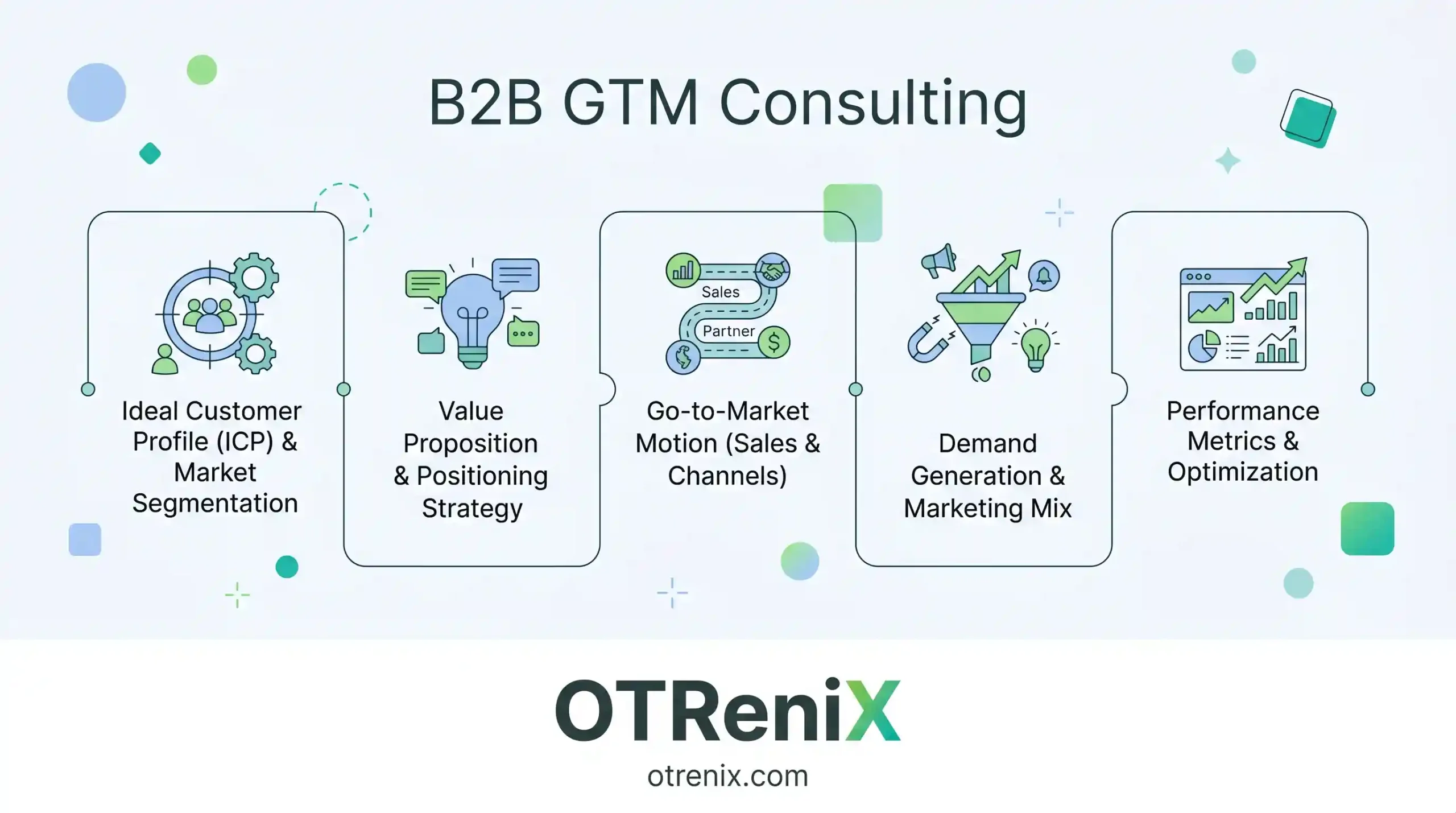
The term GTM (go to market) covers everything a company does to bring a product to customers and grow revenue. A GTM consultant works across all of it, not just one function.
Strategy and positioning
Who is the ideal customer profile (ICP)? What problem does the product solve and for whom? How is it different from the 5 alternatives the customer is considering? What does the messaging actually say to the buying committee? Most GTM problems trace back to fuzzy answers here.
Sales motion design
Is the company doing self serve, sales led, product led, or a mix? What is the sales process from first touch to closed deal? Who are the reps, and what is the right hire profile? How long is the sales cycle and what are the stage definitions? A GTM consultant maps the entire motion and finds the points where deals leak.
Marketing engine
What channels actually produce qualified pipeline? What is the cost per opportunity, and how does it vary by channel? Where is the ratio of marketing investment to pipeline returns broken? GTM consulting is not marketing strategy, but it includes the marketing layer of the revenue engine.
Pricing and packaging
How is the product priced, and is the structure aligned with how customers buy? Are the packages too complex? Too cheap? Too expensive for the market? Pricing changes often produce the fastest revenue impact of any GTM lever, and GTM consultants frequently lead this work.
Customer success and expansion
What is the post sale motion? How are customers onboarded? What drives expansion, and what drives churn? In B2B SaaS, expansion revenue is often where the real growth lives, and GTM consultants increasingly own this layer.
Cross functional alignment
Marketing, sales, product, and customer success need to operate as one system. When they don’t, deals leak, customers churn, and growth flattens. A GTM consultant often spends as much time aligning the executive team as analyzing the business.
When to Hire a B2B GTM Consultant
A GTM consultant is the right hire in 5 specific situations.
Growth has flattened or declined
The most common trigger. Revenue grew 80% one year, 30% the next, then 12%. The team cannot agree on what changed. A GTM consultant can diagnose whether the problem is positioning, the sales motion, the market, or some combination.
A new market expansion is starting
Moving up market from SMB to mid market, or down market from enterprise to SMB, requires a different GTM motion. So does expanding from one geographic region to another, or adding a new vertical. Companies that try to expand without redesigning GTM often fail and waste 12 to 18 months.
A funding round is approaching
Investors increasingly want to see a working GTM model, not just a product. A GTM consultant can sharpen the strategy and the metrics in the 90 days before the raise, often increasing the valuation meaningfully.
A new CRO or CMO has just joined
A new revenue or marketing leader needs to understand the company quickly and build credibility with the team. A GTM consultant can run the diagnostic work in parallel with the new leader, producing a shared view of the business and a roadmap that has the new leader’s fingerprints on it.
The executive team disagrees on the problem
Marketing thinks the problem is sales. Sales thinks the problem is product. The CEO thinks the problem is execution. When the team cannot agree on what is broken, a GTM consultant brings the outside perspective that breaks the deadlock.
If none of these situations apply, a GTM consultant is probably not the right hire. Hire a fractional CMO, a sales VP, a product marketer, or an agency for the specific function that needs work.
What a Good GTM Engagement Looks Like
A working GTM consulting engagement follows a predictable arc. The phases below describe a 12 week diagnostic plus 6 month execution support engagement, which is the most common structure.
Weeks 1 to 4: Discovery and diagnosis
The consultant interviews 20 to 40 people across the company: founders, executives, sales reps, customer success managers, marketing team, and customers. They review CRM data, marketing analytics, financial models, and product metrics. They sit on sales calls and shadow customer onboarding.
The output is a written diagnostic that names the 3 to 5 biggest GTM problems with evidence. Not opinions. Specific numbers showing where deals leak, where pipeline is wasted, and where the strategy disconnects from execution.
Weeks 5 to 8: Strategy and recommendations
Based on the diagnostic, the consultant builds a recommended GTM strategy. This includes ICP definition, positioning, channel strategy, sales motion design, pricing recommendations, and team structure. The output is a written strategy document, not a slide deck. 30 to 60 pages of detailed recommendations the team can debate.
The deliverable also includes a 90 day execution plan with named owners, weekly milestones, and success metrics. A strategy without an execution plan is just expensive theater.
Weeks 9 to 12: Alignment and handoff
The consultant runs working sessions with the executive team to debate, refine, and commit to the strategy. Disagreements get worked out in the room, not in side conversations afterward. The output is an aligned team and a signed off plan.
In the final 4 weeks, the consultant works alongside the team to launch the first parts of the execution plan. Hire the first new role. Update the website. Brief sales on new positioning. Run the first new campaign. This is when good consulting separates from theoretical consulting.
Months 4 to 9: Execution support
After the diagnostic and strategy work, many engagements transition to monthly retainer support. The consultant joins weekly executive meetings, reviews progress against the plan, and helps unstick problems as they appear. This phase is where the strategy actually produces results.
By month 6, a working engagement should show measurable changes in pipeline, win rate, sales cycle, or another core metric. By month 9, the new GTM motion should be running on its own, and the consultant transitions to a quarterly advisory role or exits.
How a Good GTM Consultant Works
The market is full of self proclaimed GTM consultants. Here is what separates the ones who move the business.
They have run a real GTM motion, not just advised
The best GTM consultants spent 10 to 20 years building and running real revenue engines before they started consulting. They have carried a quota. They have hired and fired sales reps. They have sat through quarterly board meetings where the numbers were bad and they had to explain why.
Pattern matching from real experience beats framework knowledge every time. A consultant who has only read about scaling from $5M to $50M ARR will produce advice that sounds right but does not survive execution. One who has actually done it will spot the problems no framework predicts.
They focus on the system, not the function
A weak GTM consultant goes deep on whichever function they came from. The ex sales VP wants to fix sales. The ex CMO wants to fix marketing. The ex product leader wants to fix the product. Real GTM consulting requires the discipline to look at the whole system, even when the consultant has strong opinions on one part.
The test is whether the diagnostic includes problems and recommendations across at least 4 of the 6 GTM areas listed earlier. If it focuses entirely on 1 function, you hired the wrong kind of consultant.
They produce written output, not just decks
Slide decks are good for pitches. They are bad for thinking. A diagnostic and strategy that lives in a deck almost always glosses over the hard parts because the format does not allow for nuance. Written documents force the consultant to be specific about what they recommend, why, and what the trade offs are.
Demand written deliverables. 30 to 60 page strategy documents. Detailed execution plans with named owners. Clear arguments with evidence. If the output is mostly slides with bullet points, the thinking is probably shallow.
They make the team uncomfortable
Real GTM diagnosis names problems the team has been avoiding. The CEO who doesn’t want to hire a CRO. The marketing leader who is not strong enough for the next stage. The pricing model that everyone knows is wrong but nobody wants to change. A consultant who tells the executive team only what they want to hear is providing therapy, not consulting.
The best engagements include 2 or 3 conversations where the consultant says something the executive team wishes they had not heard. This is the value. Avoid consultants who only deliver good news.
They work themselves out of a job
A good GTM consultant has a clear plan to reduce their involvement over 6 to 12 months. They build internal capability, document the playbooks, train the team, and step back. Consultants who design engagements that require them to stay forever are protecting their revenue, not serving the business.
Pricing and Engagement Models
GTM consulting pricing in 2026 follows a few standard models.
| Model | Typical price | When it works |
|---|---|---|
| Project based diagnostic | $40K to $120K for 8 to 12 weeks | One time strategic review, fundraising prep, market expansion planning |
| Monthly retainer | $25K to $80K a month | Ongoing strategic support after initial diagnostic |
| Day rate | $2K to $6K a day | Specific workshops, board prep, executive offsites |
| Hourly | $400 to $1,000 an hour | Light advisory, specific question support |
| Equity plus reduced cash | $10K to $25K cash plus 0.25% to 0.75% equity | Early stage startups with constrained cash |
Most engagements combine these. A 12 week diagnostic at $80K project fee, followed by a $40K monthly retainer for 6 to 9 months. Total engagement cost: $300K to $500K for a serious GTM transformation at growth stage.
This sounds expensive until you compare to alternatives. A bad GTM strategy costs $5M to $20M in wasted budget and lost time at the same stage. A good GTM consultant pays for themselves several times over within 12 months.
What drives the price
Day rates and retainers vary based on consultant seniority and track record. Specifically:
- Operator background. Former CROs and CMOs who scaled companies from $10M to $100M ARR charge 2x to 3x consultants without that experience.
- Industry depth. A consultant who has run cybersecurity GTM for 5 companies can charge more for cybersecurity work than a generalist.
- Engagement scope. Diagnostic only is cheaper than diagnostic plus execution support.
- Time commitment. A consultant working 4 days a week is much cheaper per day than one giving 1 day a week to multiple clients.
If a consultant quotes $5K a month for full GTM work, be careful. Either they are inexperienced, stretched across too many clients, or about to leave for a full time role.
How to Pick a GTM Consultant
The hiring process matters more than for almost any other vendor. Here is how to do it well.
Build a list of 6 to 10 candidates
Sources that work in 2026: founder networks (the highest signal), LinkedIn search for “GTM consultant” or “fractional CRO” plus your industry, specialized marketplaces like Bench Networks or Continuum, and referrals from your investors.
Avoid generic consulting firms unless you are specifically looking for that model. Big firms produce volume work with junior staff. The GTM consulting that moves companies in the $5M to $100M ARR range usually comes from independent operators or small boutiques.
Filter to 3 finalists
The filter criteria that matter:
- They have operated at your stage. A consultant who took 1 company from $5M to $50M ARR can help you do the same. One who only consulted at $500M companies will struggle with your scrappiness.
- They have direct experience in your motion. Sales led is different from product led. Enterprise is different from SMB. Match the experience to your situation.
- They have specific results in numbers. “Helped a Series B SaaS company increase win rate from 18% to 32% in 9 months” is good. “Delivered transformational GTM strategy” is not.
- They have references you can call. 3 founder or CEO references at minimum, all of whom completed an engagement in the past 3 years.
Run 2 conversations with each finalist
The first conversation should be strategic. Ask them to walk through how they would approach your business in the first 30 days. Ask what they would look at, who they would interview, and what hypotheses they would test. Strong candidates are specific. Weak ones speak in frameworks.
The second conversation should be tactical and cultural. Ask about specific past engagements: what was the diagnosis, what was the recommendation, what happened. Look for honesty about what worked and what did not. Be careful with consultants who claim every engagement was a success.
Call references with one specific question
For your top finalist, call 3 references. Ask each one the same question: “What would have made this engagement better?” Specific answers prove the engagement was real and reflective. Vague praise tells you the engagement was forgettable, which usually means the consultant did not push hard enough.
Also ask: “How long after the engagement ended did you keep using the strategy?” If the answer is “we went back to what we were doing,” the strategy did not stick.
Sign a clear contract
The contract should include:
- Specific deliverables: written diagnostic, strategy document, execution plan, monthly progress reports.
- Timeline with milestones: discovery by week 4, strategy by week 8, alignment by week 12.
- Scope: what is included and what is not. Specifically, who from the consultant’s team is doing the work.
- Hours commitment: how many days a week the consultant will commit.
- Exit clause: 30 day notice from either side after the first 60 days.
- Confidentiality: standard NDA covering customer data, strategy, and team information.
Avoid vague scopes like “GTM advisory” with no specific deliverables. This creates conflict in month 3 when expectations diverge.
What a GTM Consultant Cannot Do
Setting expectations on the limits of consulting matters as much as expectations on the value.
They cannot replace the leadership team
A GTM consultant produces strategy and recommendations. The leadership team has to own and execute them. Companies that hire consultants because they do not have a strong CRO or CMO will be disappointed. The consultant can help find and onboard the right hire, but cannot do the job indefinitely.
They cannot fix a broken product
If the product does not solve a real problem for a real customer, no GTM strategy will save it. A good consultant will say this in the first 4 weeks and recommend product work before continuing. If they keep building GTM strategy on a broken product, they are taking your money.
They cannot deliver instant results
Real GTM transformation takes 6 to 12 months to produce measurable revenue impact. Consultants who promise results in 60 days are either lying or planning to optimize short term metrics that look good but do not reflect business reality.
They cannot fix culture problems
A team that does not trust each other will not execute a strategy, no matter how good it is. A consultant can name culture problems and recommend leadership changes, but cannot directly fix the culture. That work belongs to the CEO.
They cannot replace deep domain expertise
A general GTM consultant who has never worked in cybersecurity will struggle with cybersecurity specific dynamics: long sales cycles, CISO buying behavior, analyst dependence, compliance drivers. For specialized markets, hire a consultant with direct industry experience or supplement a generalist with a domain expert.
Common Pitfalls in GTM Consulting Engagements
Even well intentioned engagements go wrong in predictable ways.
Hiring without a clear problem statement
“We need help with GTM” is too vague. Strong engagements start with a specific problem: pipeline is below target, sales cycle is too long, win rate is dropping, expansion revenue is flat. The clearer the problem, the better the engagement.
Skipping the diagnostic
Some teams want to skip to recommendations. They feel they already know the problem. This usually means they are wrong about the problem. The diagnostic is where most of the value comes from. Skipping it produces strategy work built on assumptions that do not survive contact with data.
Treating the strategy document as the deliverable
The deliverable is changed business performance. The strategy document is just a tool to get there. Engagements that end at the strategy document with no execution support produce 60 page documents that get filed. The follow through is where the value lives.
Letting the consultant operate alone
A GTM consultant who does not embed with the team and meet weekly with the executives will produce work that disconnects from reality. The best engagements feel like the consultant is part of the team for 6 months, not an outside observer.
Not protecting the consultant from internal politics
In healthy companies, the consultant tells the truth, including uncomfortable truths about specific leaders. The CEO has to protect the consultant from the people who push back. Engagements where the consultant gets neutralized by political resistance produce safe, useless strategy.
Recommendation
If you run a B2B company between $5M and $100M ARR and growth has flattened, an investor round is approaching, a market expansion is starting, or the executive team cannot agree on what is broken, a GTM consultant is probably the right next hire.
Start by writing down the specific business problem you are trying to solve. Not “we need GTM help.” Something like: “Pipeline is 40% below target, win rate has dropped from 32% to 19%, and we cannot tell whether the problem is the market, our positioning, or our sales execution.” The clearer the problem, the better candidates you will attract.
Build a list of 6 to 10 candidates from founder referrals, investor networks, and LinkedIn. Filter to 3 finalists who have operated at your stage and motion. Run 2 conversations with each. Call 3 references for your top pick. Sign a 12 to 16 week diagnostic engagement first, with the option to extend to monthly retainer support based on the diagnostic results.
Expect to spend $300K to $500K total over a 9 to 12 month engagement at growth stage. The investment is significant, but the alternative (running for another year on a broken GTM motion) costs 5x to 10x more in wasted budget, missed quota, and slow growth.
The right GTM consultant will make the executive team uncomfortable, name problems the team has been avoiding, and produce a strategy and execution plan that changes business performance within 6 months. Pick a real operator who has built the kind of company you are trying to build, give them full access to the data and the team, and protect them from internal politics. Do this well, and the cost of the engagement will look small compared to the trajectory change in the business.
GTM consulting at its best is a lever that compresses 2 years of learning into 6 months. Pick the right partner, set the right expectations, and put the work in alongside them. The companies that grow through hard transitions are the ones willing to bring in outside expertise at the right moment, listen to it, and execute on it.
