B2B Search Engine Marketing
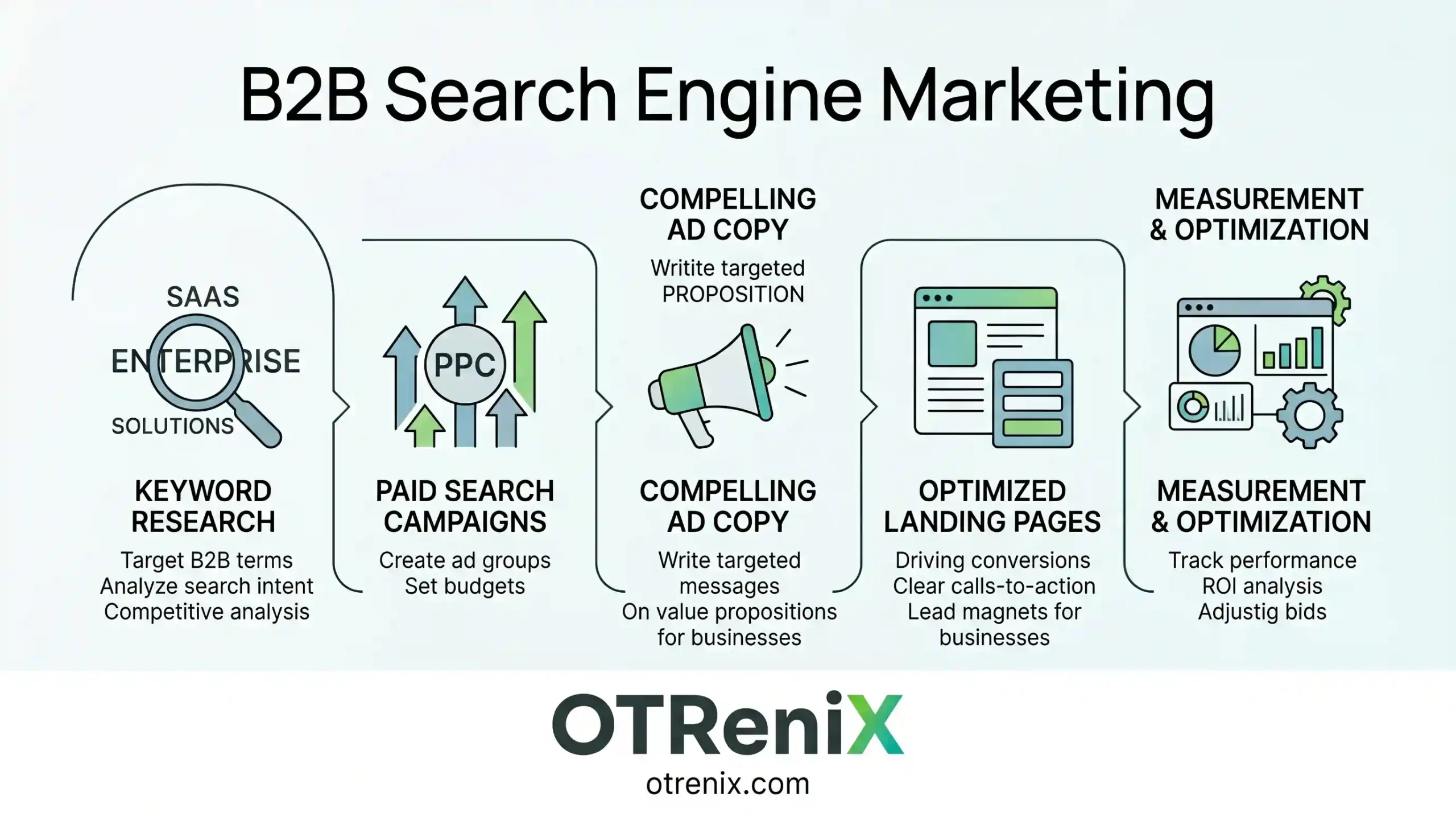

Search engine marketing in B2B is not the same as search marketing for consumer brands. A consumer ad campaign can show ROI in 2 weeks. A B2B search program needs 6 to 9 months before the pipeline picture is clear. Consumer keywords have huge volume and clear intent. B2B keywords are low volume, ambiguous, and split across 5 personas inside the same buying committee.
Most B2B companies get this wrong. They hire an agency that ran search for an e-commerce brand, run the same playbook, and waste $200K a year on the wrong keywords, the wrong landing pages, and the wrong attribution model. Six months later the CFO asks where the pipeline is, and the marketing team has nothing to show.
Done right, B2B search marketing is one of the most predictable channels in the marketing mix. It produces qualified prospects who are actively looking for a solution, not interrupted strangers. The cost per opportunity is usually 30% to 50% lower than outbound, and the close rates are higher because the prospect started the conversation.
This article covers how B2B search engine marketing actually works in 2026, which channels matter, how to budget, and how to measure results in a way that survives a CFO review.
Key Takeaways
- B2B SEM has 2 sides: organic search (SEO) and paid search (PPC). Most successful programs use both, with different goals and timelines for each.
- Realistic budgets in 2026 range from $5K a month for early stage SEO programs to $100K+ a month for enterprise integrated SEM operations.
- The biggest mistakes are bidding on broad keywords, sending paid traffic to the homepage, ignoring intent stages, and measuring only on lead volume instead of pipeline.
- B2B SEO takes 6 to 12 months to produce meaningful pipeline. PPC can produce qualified leads in 30 to 60 days but at a higher cost per lead.
- AI search (Google AI Overviews, ChatGPT, Perplexity) now drives 15% to 30% of B2B research traffic. Generative Engine Optimization (GEO) is no longer optional in 2026.
What B2B Search Engine Marketing Actually Covers
The term “search engine marketing” is used loosely. In practice, B2B SEM in 2026 covers 4 distinct disciplines.
Organic search (SEO)
This is the work of ranking your website pages in Google, Bing, and other search engines without paying for placement. In B2B, SEO usually focuses on keywords that match prospect research questions: “what is XDR,” “best identity management for healthcare,” “SOC 2 vs ISO 27001.”
SEO is slow but compounding. A page that ranks well will produce traffic and leads for years with minimal additional spend. The catch is that getting to that ranking takes 6 to 12 months for most competitive B2B keywords, and longer for crowded categories.
Paid search (PPC)
This is paid placement on search engines, primarily Google Ads and Microsoft Ads. PPC in B2B works best for high intent keywords, such as competitor terms (“alternative to Splunk”), category terms (“SIEM software”), and bottom of funnel queries (“buy endpoint protection”).
PPC produces results faster than SEO, often within 30 to 60 days. The trade off is the cost continues forever. Stop paying and the traffic stops. In B2B, costs per click for competitive categories run from $20 to $300+, which makes campaign quality more important than spend volume.
Generative Engine Optimization (GEO)
This is the new discipline that emerged in 2024 and 2025. GEO is the work of optimizing for AI powered search engines like ChatGPT, Perplexity, Claude, and Google AI Overviews. When a prospect asks an AI assistant “what is the best XDR for mid market,” the answer comes from a small set of cited sources. GEO is the work of becoming one of those sources.
GEO is now responsible for a meaningful share of B2B research traffic. By 2026, most B2B prospects use both Google and AI tools during the research phase. Companies that ignore GEO will lose visibility to those that invest in it.
Conversion and tracking
The fourth discipline is what happens after the click. Landing pages, forms, attribution tracking, and lead routing all sit inside SEM. A search program that produces 1,000 clicks a month but converts at 0.5% has a tracking and conversion problem, not a traffic problem.
How B2B Search Differs From B2C Search
The buyer journey is the core difference, and it changes everything about how SEM is built.
Long sales cycles
A consumer might search for “running shoes,” see an ad, click, buy, all in 5 minutes. A B2B prospect researches for 3 to 9 months before any purchase decision. The same person searches for “what is SOAR” in month 1, “best SOAR for mid market” in month 4, and “Tines vs Torq” in month 8. SEM has to support all 3 stages.
Multiple decision makers
A B2B purchase usually involves 4 to 7 stakeholders. The CISO, the security engineer, the procurement officer, and the CFO all search differently and need different content. SEM that targets only one persona produces incomplete pipeline.
Low volume keywords
B2C keywords like “best laptop” get 2M searches a month. B2B keywords like “best PAM solution for healthcare” might get 200. The play is not volume, it is intent quality. A keyword with 200 monthly searches and 10% close rate is more valuable than one with 20,000 searches and 0.1% close rate.
Higher cost per click, lower cost per opportunity
B2B clicks are expensive. Cybersecurity, fintech, and legal tech see CPCs of $30 to $300. But because deal sizes are also higher, the cost per closed opportunity often comes out lower than B2C. A $200 click that becomes a $50K deal beats a $2 click that becomes a $30 sale.
Lead quality matters more than lead quantity
In B2C, more leads usually means more sales. In B2B, more leads can mean more wasted sales time. Sales teams that get 500 unqualified leads a month produce less pipeline than ones that get 50 highly qualified ones. SEM has to optimize for lead quality, not lead volume.
How to Build a B2B Search Strategy
A working B2B search program is built in 5 stages.
Stage 1: Define the ICP and keyword universe
The first job is identifying which keywords map to your ideal customer. This is not done with a keyword tool. It is done by interviewing 15 to 20 customers and prospects, asking how they searched during their buying process, and which terms they used at each stage.
Most B2B companies skip this step and let an agency build keyword lists from Ahrefs or Semrush. The result is keyword lists that look impressive but produce traffic that never converts. The keywords your customers actually used are usually different from the ones a tool surfaces.
Stage 2: Map keywords to funnel stages
Keywords break into 3 stages.
- Top of funnel: “what is X,” “how does X work,” “X vs Y.” Prospect is researching the problem.
- Middle of funnel: “best X for Y,” “X for mid market,” “X comparison.” Prospect is evaluating solutions.
- Bottom of funnel: “buy X,” “X pricing,” “X demo,” “alternative to [competitor].” Prospect is ready to engage.
Each stage needs different content and different conversion goals. Top of funnel content educates and captures email for nurture. Middle of funnel content compares solutions and captures qualified leads. Bottom of funnel content converts directly to demo or trial requests.
Stage 3: Build landing pages, not just blog posts
Most B2B companies invest in blog content for SEO and a homepage for PPC. Both are mistakes for paid traffic. Each major keyword deserves its own dedicated landing page that matches the search intent precisely.
A prospect searching for “best XDR for healthcare” should land on a page about XDR for healthcare, not your generic homepage. The conversion rate difference is usually 3x to 5x.
Stage 4: Set up tracking that actually works
B2B attribution is a mess in 2026. Cookies are dying, dark social is rising, and most leads come through 5 to 10 touchpoints before converting. The minimum tracking setup includes UTM tagging on every paid click, form fills tied to source, and CRM integration that connects search source to closed revenue.
Last touch attribution lies. A serious B2B SEM program uses multi touch attribution or self reported attribution (“how did you hear about us”) on every form. Both are imperfect but together they paint a useful picture.
Stage 5: Optimize on pipeline, not leads
The standard B2B SEM mistake is optimizing PPC campaigns on cost per lead. This drives the agency or team toward cheap leads, which are usually low quality. The right metric is cost per sales qualified opportunity (SQO), which incentivizes lead quality, not volume.
This requires sales feedback. Every lead from search needs to be flagged as qualified or unqualified, and that data feeds back into bid adjustments, keyword choices, and landing page changes within 30 to 60 days.
SEO for B2B in 2026
SEO is the long term anchor of any serious B2B search program. Here is what works in 2026.
Technical foundation comes first
Site speed, mobile responsiveness, schema markup, internal linking, and crawlability matter more than ever. Google’s Core Web Vitals are now a meaningful ranking factor. A B2B site that loads in 4 seconds on mobile will lose to a competitor that loads in 1.2 seconds, even with worse content.
Most B2B sites have technical SEO problems that take 4 to 8 weeks to fix. This work is unglamorous but it sets the ceiling for everything else. No content strategy compensates for a slow, broken site.
Content depth beats content volume
Google’s algorithm in 2026 rewards depth and expertise over volume. Publishing 20 thin blog posts a month is worse than publishing 2 detailed, expert backed pieces. Publications with named expert authors, original research, and cited sources rank significantly better than generic AI generated content.
A typical B2B SEO program in 2026 produces 4 to 8 high quality pieces a month, each 2,000 to 4,000 words, written or reviewed by named subject matter experts. The cost per piece runs $1,500 to $5,000, which is more than agencies billed in 2022, but the search performance justifies the investment.
Topical authority matters more than backlinks
Building 100 pages on closely related topics now outperforms building 10 pages with 100 backlinks each. Google rewards sites that have demonstrated expertise across an entire topic cluster. A cybersecurity vendor with 80 in depth pages on cloud security will outrank one with 8 well linked pages.
This means B2B SEO programs need to plan content in clusters: pillar page plus 10 to 20 supporting pages on related topics. One off blog posts that don’t fit a cluster usually underperform.
AI generated content is mostly a trap
Most pure AI generated content does not rank well in 2026. Google’s helpful content algorithm explicitly downgrades content that lacks original insight, named expertise, or unique perspective. AI can speed up research and outlining, but the final copy needs human expertise on top.
The companies that succeeded with AI content in 2023 and 2024 are mostly seeing those gains erode. Sites built on AI volume have lost 30% to 70% of their organic traffic since the December 2024 update. The lesson: use AI as a tool, not a replacement for expertise.
PPC for B2B in 2026
Paid search complements SEO and produces faster results when set up correctly. Here is what works.
Start with bottom of funnel keywords
The highest ROI in B2B PPC comes from bottom of funnel keywords: competitor terms, demo requests, pricing pages. These cost more per click but convert at 5x to 10x the rate of top of funnel queries. Most B2B PPC programs should spend 60% to 80% of budget on bottom of funnel terms.
Competitor bidding is usually worth it
Bidding on competitor brand names (“alternative to [Competitor]”) is one of the most reliable B2B PPC plays. The traffic is small but highly intent qualified. Cost per click is high, often $40 to $100, but conversion rates run 5% to 15%, which makes the cost per opportunity reasonable.
The catch is that some competitors will bid on your brand in retaliation. Plan for this in budget allocation.
Match types matter more than ever
Google’s broad match has become more aggressive in 2026. A broad match on “endpoint security” will trigger ads on hundreds of loosely related queries, most of which are wasted spend. Most B2B PPC programs should use phrase match and exact match exclusively, with broad match reserved for specific testing.
Negative keyword lists also need constant maintenance. A typical B2B PPC account adds 50 to 100 negative keywords a month based on search query reports.
LinkedIn Ads is sometimes better than Google Ads
For B2B account based marketing (ABM), LinkedIn Ads often outperforms Google Ads. The targeting is precise (job title, company, industry, seniority) and the audience is captive. Google Ads is better for capturing existing demand. LinkedIn Ads is better for creating it. Most serious B2B SEM programs run both.
Generative Engine Optimization (GEO)
GEO is the most important new discipline in B2B SEM in 2026. Here is what to know.
How AI search works
Tools like ChatGPT, Perplexity, Claude, and Google AI Overviews answer queries by reading content from a small set of trusted sources and synthesizing an answer. The sources cited are not random. They are chosen by the AI based on authority signals: high quality content, named experts, schema markup, citation in other authoritative sources.
When a prospect asks ChatGPT “what is the best XDR for mid market healthcare,” the answer cites 3 to 7 sources. The companies in those sources get the prospect’s attention. The companies not in those sources are invisible.
What works for GEO
The fundamentals overlap with SEO but add specific elements:
- Direct, factual answers to specific questions. AI search rewards content that answers the query precisely, not content that buries the answer in 2,000 words of preamble.
- Named experts and clear authorship. Anonymous content rarely gets cited. Content with named author bios, credentials, and links to published expertise gets cited far more often.
- Schema markup, especially FAQ and HowTo schema. AI search engines parse structured data heavily. Sites with clean schema markup show up in AI answers more often.
- Citation in other authoritative sources. AI search engines weight content that other reliable sources have cited. Backlinks still matter, but in a slightly different way.
Tracking GEO performance
GEO measurement is still imperfect. Tools like Profound, Otterly, and Goodie now track AI citations across major engines. The metrics that matter are share of voice in AI answers for your target queries, citation frequency, and traffic from AI sources (which appears in GA4 as referrals from chat.openai.com, perplexity.ai, etc.).
By the end of 2026, expect most enterprise B2B companies to have GEO baked into their SEM scorecards.
Budgeting for B2B Search Engine Marketing
Realistic budgets in 2026 break down by stage.
Early stage ($1M to $5M ARR)
A starter B2B SEM program at this stage typically runs $8K to $15K a month. This usually covers basic SEO content (4 pieces a month), $3K to $5K in PPC spend on bottom of funnel keywords, and basic tracking setup. Results take 6 to 9 months to appear.
Growth stage ($5M to $25M ARR)
This is where most B2B companies should commit to a full search program: $25K to $50K a month total. This covers 8 to 12 SEO pieces a month, $10K to $25K in PPC spend, GEO work, technical SEO maintenance, and dedicated landing pages for top campaigns.
Enterprise stage ($25M+ ARR)
At this stage budgets typically run $60K to $150K a month. This includes full content programs, multi region PPC, ABM through paid social, dedicated landing page infrastructure, and a dedicated search team or senior agency relationship.
Where the money goes
A balanced B2B SEM budget in 2026 typically splits like this:
- 30% to 40% on content (SEO and GEO)
- 30% to 40% on paid media (PPC and paid social)
- 10% to 15% on technical SEO and infrastructure
- 5% to 10% on tools and tracking
- 10% to 15% on agency or team management costs
Programs that put 80% of budget into PPC usually fail because they have no organic foundation. Programs that put 90% into SEO usually fail because they have no near term pipeline.
How to Measure B2B Search Performance
The metrics most B2B SEM teams report are vanity. Here is what actually matters.
The 5 metrics that matter
- Pipeline sourced from search. Total dollar value of opportunities created from organic and paid search traffic. This is the headline metric.
- Cost per sales qualified opportunity (SQO). Total search spend divided by qualified opportunities. This is the efficiency metric.
- Search influenced revenue. Revenue from deals where search was a meaningful touchpoint, even if not the last touch. Usually 2x to 3x larger than search sourced revenue.
- Share of voice. What percentage of search traffic in your category goes to your site versus competitors. Tracks long term competitive position.
- AI citation rate. What percentage of relevant AI search queries cite your content. Rising metric in 2026.
The metrics to ignore
- Total website traffic. Vanity. Lots of traffic does not mean pipeline.
- Keyword rankings alone. Means nothing if the keywords don’t drive qualified prospects.
- Cost per lead. Optimizes for cheap leads, which are usually bad leads.
- Click through rate. Useful for ad copy testing but not a meaningful business metric.
Reporting cadence
Monthly reporting on traffic, leads, and SQO is standard. Quarterly reports should focus on pipeline contribution and competitive position. Avoid weekly reports for executives. SEM noise is high week to week and meaningful trends only appear over months.
Common Pitfalls
Even well funded B2B SEM programs make these mistakes.
- Bidding on broad terms with weak intent. “Cybersecurity software” gets a lot of clicks but most are researchers, students, and competitors. Skip it.
- Sending PPC traffic to the homepage. Conversion rates collapse. Build dedicated landing pages.
- Optimizing for lead volume instead of lead quality. Sales teams stop trusting marketing leads, and the program loses internal credibility.
- Ignoring sales feedback on lead quality. Without a feedback loop from sales, SEM optimization is blind.
- Hiring an SEM agency that doesn’t understand B2B. Consumer agencies and B2B agencies use different playbooks. The wrong fit wastes 6 to 12 months.
- Running SEO and PPC as separate programs. They share keywords, landing pages, and intent data. Running them in silos misses 30% of the opportunity.
Recommendation
If you run B2B marketing for a company between $1M and $50M ARR, start your search program by defining your ICP and the keywords your actual customers used during their buying journey. Skip the keyword tools until after the customer interviews.
For early stage companies, start with 1 channel done well, not 4 done poorly. SEO if you have 12 months of patience and budget for content. PPC if you need pipeline in 90 days and have $5K+ a month for spend. GEO if your category is moving fast in AI search and your competitors are not yet investing.
For growth stage companies, run all 3: SEO, PPC, and GEO. Set up multi touch attribution from day 1. Build dedicated landing pages for every major campaign. Block sales time monthly to review lead quality from search and feed back into the program.
For enterprise companies, treat search as a full operations function. A dedicated team or senior agency partner. Quarterly business reviews tied to pipeline and revenue. Investment in tools, tracking, and competitive intelligence at the level of any other strategic channel.
Whatever stage you’re in, the rules are the same in 2026. Quality beats volume. Pipeline beats leads. Six months beats six weeks. Search marketing in B2B is one of the most reliable channels you can build, but only if you commit to the timeline and measure on outcomes that matter to the business. Pick the right partner or build the right team, set realistic expectations, and give the program the time it needs to compound into a real competitive advantage.
