Cybersecurity Lead Generation
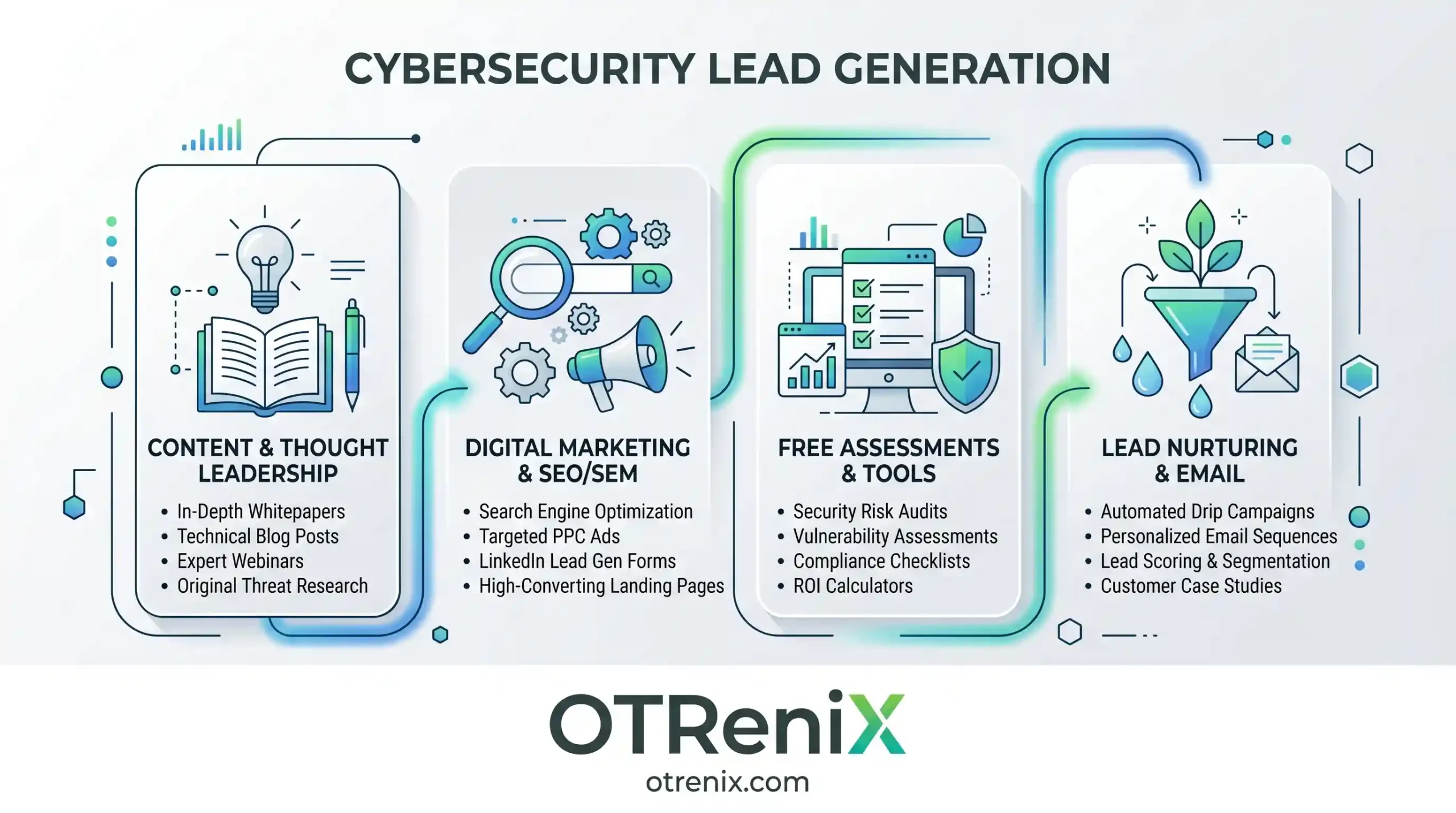

Cybersecurity is the hardest category in B2B lead generation. The average CISO receives more than 34 vendor pitches per year, and at any given moment only 5% to 15% of the addressable market is actively in buying mode. Long sales cycles, compliance gates, and large buying committees turn a single deal into a 12 month marathon.
This playbook is written for cybersecurity marketers, founders of security startups, and fractional CMOs who need a system that brings qualified prospects on a predictable basis. You will find the funnel framework, 10 proven tactics, real benchmarks, the most common mistakes vendors make, and the criteria for selecting a lead generation partner that fits your stage.
What Is Cybersecurity Lead Generation?
Cybersecurity lead generation is the structured process of attracting, qualifying, and converting security focused decision makers into sales ready opportunities. It uses a mix of content, SEO, paid channels, ABM, partnerships, and intent data to engage prospects across long evaluation cycles.
It differs from generic B2B lead generation in three important ways. The audience is technical and skeptical and filters marketing language in seconds. The buying journey is shaped by compliance frameworks and risk tolerance rather than feature lists. The funnel spans 6 to 18 months, which makes nurture infrastructure more important than raw outreach volume.
The cybersecurity funnel follows a familiar path but with longer stages.
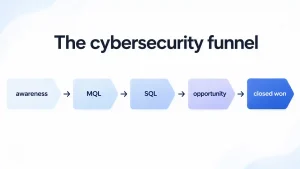
A prospect captured today may convert into revenue 9 to 12 months later, which means attribution and nurture systems must be built for the long haul, not for a quarterly campaign cycle.
Why Cybersecurity Lead Generation Is Different
Four structural factors make cybersecurity unlike any other B2B category. Understanding them changes how you design campaigns, score prospects, and measure results.
Sales Cycles That Last 6 to 18 Months
A prospect that enters your funnel in January may become an opportunity in July and close in December. Average deal cycles for enterprise security products run 9 to 14 months, and complex platforms can stretch beyond 18 months.
This timeline has a direct implication: nurture infrastructure matters more than outreach volume. A polished email sequence, an active LinkedIn presence, and recurring touchpoints across a full year will outperform a one time campaign that floods the inbox in week one and disappears after.
Buying Committees With 6 to 10 Stakeholders
Forrester research shows that enterprise software buying committees average 13 people. In cybersecurity, the typical group includes the CISO, IT director, compliance officer, CFO, legal counsel, procurement, and several end user managers from the teams that will use the tool.
The implication is multi threaded engagement, not single contact qualification. Selling only to the CISO leaves you exposed if IT pushes back on integration or compliance flags a control gap. Your campaigns must reach every relevant role with content tuned to their concerns and incentives.
Compliance Driven Evaluation
SOC 2, NIST CSF, ISO 27001, NIS2, and DORA do not just shape products. They shape vendor selection itself. A prospect cannot adopt a tool that fails a control mapping or audit checklist, no matter how strong the demo was.
This pushes compliance content high up the funnel. Practical resources on frameworks, control mappings, and audit readiness attract prospects who are already feeling regulatory pressure and need vendors who can document compliance from day one.
Skeptical and Technical Prospects
A CISO who receives 50+ vendor pitches per year filters fear, uncertainty, and doubt in seconds. Generic claims about “next generation AI” or “zero trust everything” register as noise and damage credibility instantly.
What works is technical depth, original research, and verifiable proof. Detailed architecture posts, real telemetry from your customer base, named case studies with quantified outcomes, and open product documentation build trust. Everything else gets ignored and forwarded to the spam folder.
Who You’re Generating Leads For: Cybersecurity Buyer Personas
Cybersecurity deals involve several distinct roles. Each one consumes different content, evaluates the product through a different lens, and influences the decision differently.
CISOs and Security Leaders
The CISO is both the economic decision maker and the risk owner inside the company. They respond to peer voices, analyst validation, and original research far more than to vendor brochures or product spec sheets.
Security Architects and Engineers
These are the technical evaluators who decide if your product actually works. They want detailed product documentation, integration guides, API references, hands on demos, and access to a proof of concept environment.
IT Directors and Infrastructure Leaders
In SMB and mid market companies, the IT director often controls the actual budget for security tools. They look for clear comparison content, TCO breakdowns, operational fit signals, and proof that your tool will not break their existing stack.
Compliance and GRC Officers
In regulated industries such as healthcare, financial services, and EU operations, GRC officers act as framework gatekeepers. They need control mappings, alignment with specific regulations, and audit ready evidence of how your product supports their obligations.
Executive Sponsors (CEO, CFO, Board)
The C suite and the board influence security investment indirectly through a champion inside the company. They consume board level briefs, breach cost benchmarks, and risk narratives that frame security as business continuity rather than as a technical purchase.
The Cybersecurity Lead Generation Funnel
Most vendors map their funnel by activity (downloads, demo requests) rather than by intent and stage. Below is a more useful breakdown for the long cycles of security deals.
TOFU: Building Awareness With Skeptical Prospects
At the top of the funnel, the goal is to be discovered by people who are not yet looking for a vendor. What works at this stage is threat research, glossary and definition content, original data, and visibility inside AI search engines.
- Lead types: newsletter signups, content downloads, organic traffic, podcast listeners, social followers.
- Typical CPL: $50 to $200.
- Main metric: branded search growth, share of voice, and assisted pipeline over time.
MOFU: Engaging In Market Evaluators
In the middle of the funnel, prospects know they have a problem and are actively evaluating options. Comparison content, technical whitepapers, free assessments, and webinars perform best at this stage.
- Lead types: demo requests, MQLs, webinar attendees, intent data signals.
- Typical CPL: $200 to $800.
- Main metric: MQL to SQL conversion rate, usually 15% to 25%.
BOFU: Converting Active Prospects
At the bottom of the funnel, the prospect is choosing between two or three vendors. Detailed case studies, ROI calculators, peer validation through G2 or Gartner Peer Insights, and free trials make the difference between winning and losing.
- Lead types: SQLs, demo attended, POC requested, sales engaged opportunities.
- Typical CPL: $1K to $5K.
- Main metrics: SQL to opportunity rate of 30% to 50% and opportunity to closed won rate of 20% to 35%.
10 Cybersecurity Lead Generation Strategies That Actually Work
The tactics below are ranked by a combination of effectiveness and ease of execution. Most mature cybersecurity programs run 5 to 7 of them in parallel.
1. SEO and Generative Engine Optimization (GEO)
High intent comparison queries like “XDR vs EDR” or “SIEM vs SOAR” pull active prospects directly into your funnel. Around 40% of B2B customers now research through AI tools such as ChatGPT and Perplexity, which makes visibility inside AI Overviews and generative answers a new mandatory channel.
Optimize for both classic SEO and GEO. Structure your content with clear definitions, comparison tables, citation friendly statistics, and named sources. AI engines reward structured, well cited content.
2. Threat Intelligence Content Marketing
When a major incident breaks, your window to publish is 24 hours. Vendors who shipped fast coverage on Log4j, SolarWinds, and MOVEit captured massive traffic and gained lasting brand authority.
The strongest threat content is tied to a specific industry vertical. A healthcare focused breakdown of a ransomware attack will outperform a generic technical post every time because it speaks directly to a CISO who is searching for that exact context.
3. Free Security Assessments and Risk Calculators
Self service tools convert better than gated whitepapers because they give immediate value. The most effective formats are SOC 2 readiness scorecards, attack surface scans, breach cost calculators, and posture assessments.
These tools surface real gaps inside the prospect’s environment and create a natural reason for a follow up sales conversation. The “show me my own risk” experience is far more compelling than “read our 30 page report”.
4. LinkedIn ABM Targeting Decision Makers
LinkedIn Sales Navigator combined with intent signals (job changes, recent breach mentions, new hiring activity) lets you target named accounts with precision. Personalized InMail and connection requests from real humans work. Bulk exports and generic templates fail and damage your domain reputation.
The best results come from the CEO, CTO, or CISO of your own company writing personally to prospects who match a tight ICP. Outreach from a marketing inbox underperforms by an order of magnitude.
5. Content Syndication on Trusted Platforms
Platforms such as TechTarget, IDG, and BrightTALK deliver opted in prospects who actively engage with security content. The CPL is higher than organic generation, but the prospects come with verified company data and clear intent signals.
Track quality, not volume. Measure MQL to SQL conversion on syndicated prospects across at least 90 days before you scale spend. Some syndication networks deliver paper qualified prospects that look strong on a spreadsheet but convert at single digit rates.
6. Intent Data and Account Prioritization
Gartner research shows that only 5% to 15% of the addressable market is in active buying mode at any given moment. Tools like 6sense, Bombora, and ZoomInfo Intent identify those accounts before they raise their hand on your website.
Use intent data to prioritize outbound, ad targeting, and SDR effort. Spraying the entire ICP wastes 85% of your budget on accounts that are not in market. Focus the budget where the signal is strong.
7. Industry Events and Webinars
RSA, Black Hat, BSides, and Gartner Security Summit drive meaningful pipeline when you execute a full pre, during, and post event motion. Pre event outreach books meetings. Booth conversations qualify on the spot. Post event follow up converts within 90 days.
For webinars, an educational format with no product pitch outperforms classic vendor sessions by 2x to 3x in attendance and engagement. Bring a customer or an external expert as the main voice and let your team moderate.
8. Compliance Focused Lead Magnets
SOC 2 readiness guides, NIS2 implementation playbooks, HIPAA control matrices, and DORA mapping documents draw prospects who are under regulatory pressure right now. Healthcare, financial services, and EU operations convert at the highest rates because compliance is non negotiable for them.
A single well structured compliance asset can generate prospects for 12 to 24 months because the underlying regulations do not change quickly.
9. Partner and Channel Lead Generation
MSPs, MSSPs, ISVs, and system integrators control huge segments of the cybersecurity market, especially in SMB and mid market. Building a channel program creates leverage that direct sales motions cannot match.
Cloud marketplaces (AWS, Azure, GCP) and co sell programs add another distribution layer. A listing on AWS Marketplace, for example, gives you access to existing committed cloud budgets and accelerated procurement paths for thousands of enterprise customers.
10. Original Research and Industry Reports
Annual reports like Verizon DBIR, Mandiant M Trends, and Sophos State of Ransomware are the strongest link magnets in the industry. They earn press coverage, drive organic backlinks, and position the publisher as the authority on a specific domain.
A single well executed research report can fuel 12 months of content, PR, webinars, and pipeline. The investment is significant but the compounding effect is unmatched by any other tactic.
Common Cybersecurity Lead Generation Mistakes
Even well funded cybersecurity vendors repeat the same predictable mistakes year after year.
Treating Every Lead the Same
A whitepaper download is not a buying signal. A student researching for a thesis, a competitor monitoring your content, and an active prospect all look identical on a form submission.
Lead scoring must factor in persona fit, account fit, and behavioral signals together. Without that combination, your sales team chases noise and burns out on low quality conversations.
Leading With FUD
Fear, uncertainty, and doubt headlines are filtered by experienced CISOs in seconds. “You will be breached” is no longer a message. It is a cliche that registers as a red flag for credibility.
What works instead is operational framing. Talk about time saved on audits, headcount avoided, or the cost of manual investigation in concrete numbers. Specific pain converts much better than abstract fear.
Single Threading the Buying Committee
Selling only to the CISO is a structural risk. If the IT director pushes back on integration complexity, or if compliance flags a missing control, your deal dies regardless of how excited the CISO was on the first call.
Multi threaded engagement is the standard for any deal above $50K ACV. Build relationships with at least three roles inside every target account before you forecast the opportunity.
Measuring CPL Instead of Pipeline
A low CPL often signals low quality prospects, not marketing success. The metric that actually matters is influenced pipeline and CAC payback over a 12 to 18 month window.
Cheap prospects that never convert cost more than expensive prospects that close. Stop optimizing for the cheapest top of funnel number and start optimizing for revenue contribution.
Cybersecurity Lead Generation Benchmarks and Metrics
Real numbers matter more than generic best practices. The benchmarks below are observed across cybersecurity programs in 2024 and 2025.
CPL Benchmarks by Funnel Stage
| Funnel Stage | Typical CPL | Lead Quality Signal |
|---|---|---|
| TOFU | $50 to $200 | Newsletter, content download, organic visit |
| MOFU | $200 to $800 | Demo request, comparison content engagement |
| BOFU | $1K to $5K | Sales engaged, POC requested, contract review |
CPL rises sharply as intent increases. A $50 prospect and a $3K prospect are not the same product, and treating them with the same nurture flow wastes both budget and sales capacity.
Conversion Rate Benchmarks
- MQL to SQL: 15% to 25%.
- SQL to opportunity: 30% to 50%.
- Opportunity to closed won: 20% to 35%.
- Average sales cycle: 6 to 18 months.
If your MQL to SQL rate is below 10%, the issue is either prospect quality at the top or weak qualification criteria at the SDR stage. If your opportunity to closed won is below 15%, you have a positioning, pricing, or competitive problem that more leads cannot fix.
ROI and CAC Benchmarks
Mature cybersecurity marketing programs deliver 3x to 5x marketing ROI when measured across a 12 to 18 month attribution window.
- CAC payback target for SMB segments: under 18 months.
- CAC payback target for enterprise segments: under 24 months.
- Pipeline coverage target: 3x to 4x of quota.
Programs that consistently miss these benchmarks usually have a leak in qualification or sales execution, not in raw lead volume. More prospects on top of a broken funnel will not fix the underlying problem.
How to Choose a Cybersecurity Lead Generation Partner
If you decide to work with an external agency or consultant, the wrong choice will set you back by 6 to 12 months and burn through a meaningful portion of your annual budget. The criteria below filter out the noise.
Verify Experience Specific to Cybersecurity
Generic SaaS portfolios with one token security logo are a red flag. Ask for named clients, ICP overlap with your own, vertical experience (XDR, cloud security, GRC, identity), and case studies with quantified pipeline outcomes.
A partner who built pipeline for an XDR vendor will understand your buying committee, your competitive set, and your messaging needs. A partner who only ran ads for HR tech will not, and the learning curve will be billed to your budget.
Demand Pipeline Attribution Methodology
In a 6 to 18 month cycle, last click attribution is misleading and often dangerous. Ask exactly how the partner handles multi touch attribution across long evaluation windows.
Multi touch models that combine first touch, lead creation touch, opportunity creation touch, and closing touch give a realistic picture of channel contribution. Anyone selling “100 leads in 30 days” with last click reporting does not understand how cybersecurity actually buys.
Match Engagement Model to Your Stage
The right engagement depends on where your company stands today.
- Pre seed and seed stage. Fractional CMO plus foundational content. You need positioning, ICP clarity, and basic demand before you can scale anything.
- Series A. Demand generation retainer with focused programs. You need repeatable lead generation across two or three channels that you can measure.
- Growth stage. Full stack programs including ABM, partnerships, analyst relations, and PR. You need orchestration across many motions at scale.
Hiring a growth stage agency at seed stage burns cash without producing pipeline because the foundation is not ready. Hiring a fractional CMO at growth stage limits scale because the company has outgrown that engagement model. Match the partner and the engagement to the stage of your company, and the system will compound from there.
Key Takeaways
Cybersecurity lead generation is a long term game built on trust, proof, and patience. The points below summarize the most important principles from this playbook.
- Cybersecurity is the hardest B2B category for lead generation. The average CISO receives 50+ pitches per year, only 5% to 15% of the addressable market is in active buying mode at any moment, and sales cycles run 6 to 18 months. Programs must be designed for this reality, not for quick wins inside a single quarter.
- Buying committees decide deals, not individuals. Enterprise security purchases involve 6 to 13 stakeholders across security, IT, compliance, finance, and legal. Multi threaded engagement is mandatory above $50K ACV. Selling only to the CISO kills a large share of forecasted deals at the integration or compliance review stage.
- Trust beats volume every single time. Original research, threat intelligence, named case studies, and analyst validation move prospects forward. FUD headlines, generic AI claims, and “next generation” language damage credibility instantly with technical prospects who have already seen the same pitch many times this year.
- Pipeline contribution is the metric that matters most. Low CPL often signals low quality. Track influenced pipeline, MQL to SQL rate (15% to 25% healthy), SQL to opportunity rate (30% to 50%), and CAC payback (under 18 months for SMB, under 24 months for enterprise). Optimize for revenue, not for the cheapest top of funnel number.
- Match your lead generation partner to your stage. Seed companies need a fractional CMO plus a content foundation. Series A companies need a focused demand generation retainer. Growth stage companies need an integrated team running ABM, partnerships, analyst relations, and PR in parallel. Stage mismatch wastes budget and burns 6 to 12 months of runway.
The companies that win in cybersecurity treat lead generation as a 24 month investment in authority and trust, not as a quarterly campaign. Start with a sharp ICP, build content that serves the full buying committee, capture demand where it already exists, and create demand where it does not yet exist. Done consistently, the system compounds and produces a predictable flow of prospects who are ready to buy.