Cybersecurity Marketing Strategy
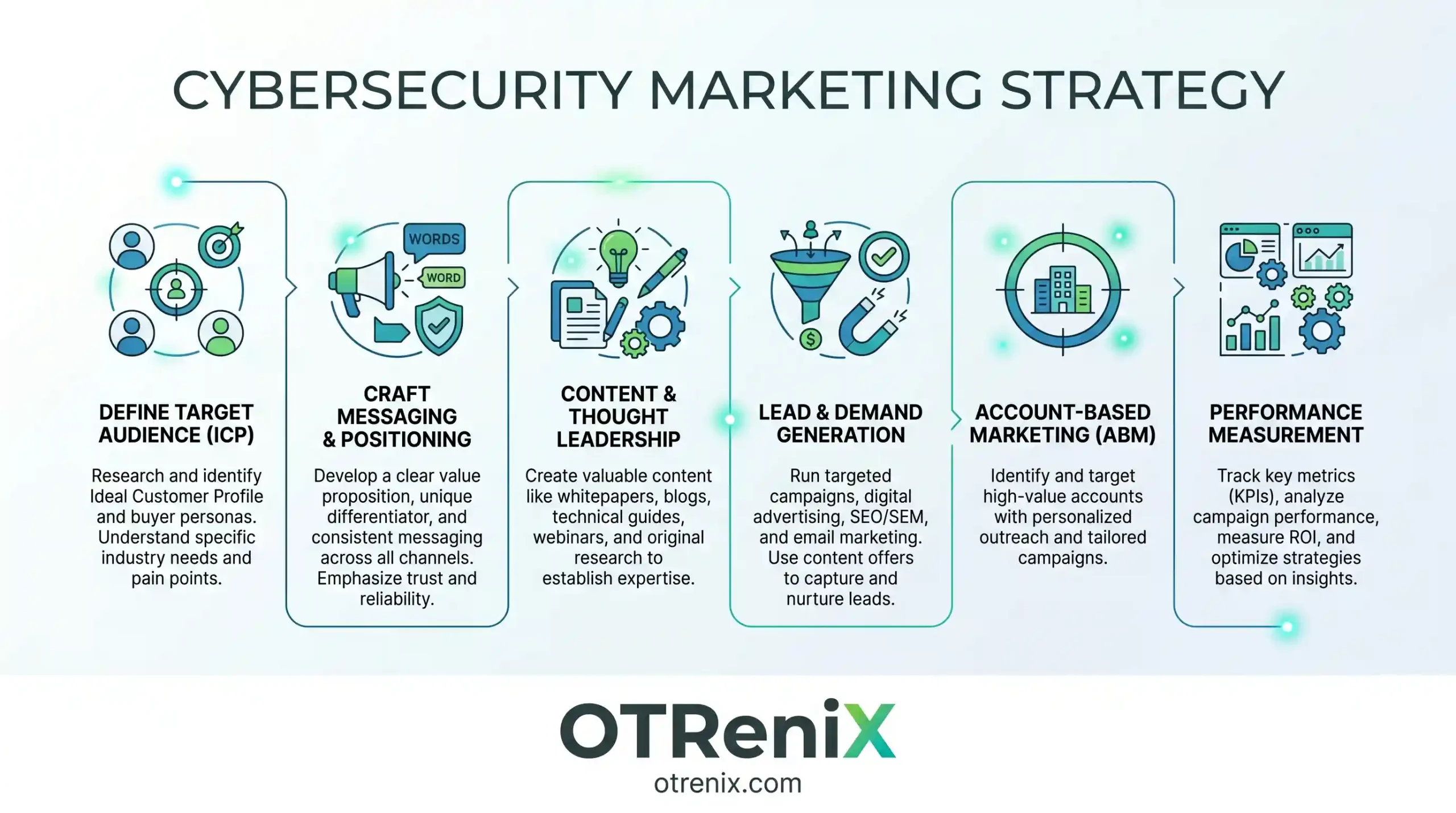

Most cybersecurity vendors confuse marketing tactics with marketing strategy. They run LinkedIn ads, sponsor an RSA Conference booth, publish 4 blog posts a month, and call it a strategy. Six months later the pipeline has not moved, the CFO is asking hard questions, and the marketing team blames the channels instead of the strategy that put them there.
A real cybersecurity marketing strategy answers different questions. Who exactly do we sell to. What problem do they care about most. Why should they choose us instead of CrowdStrike or Palo Alto. Which channels reach our buyers and which ones waste budget. How do we measure whether the program is working. Without clear answers to these questions, no amount of tactical execution produces meaningful pipeline.
This article covers how to build a cybersecurity marketing strategy that produces measurable pipeline. It covers strategic foundations, content marketing strategies, social media tactics, email marketing approaches, and how to attract MSP partners as a force multiplier for growth. The goal is a working playbook you can use this quarter, not a textbook overview.
Key Takeaways
- A cybersecurity marketing strategy starts with positioning and ICP, not channels or tactics. Companies that skip this step waste 12 to 18 months running campaigns built on the wrong foundation.
- The CISO buyer is professionally skeptical and trained to spot hype. Marketing language that works in HR tech or martech actively damages credibility in cybersecurity.
- Content, social, email, and partner programs each play distinct roles in the buying journey. The strongest strategies use all 4 in coordination, not as separate workstreams.
- MSP and MSSP partnerships often produce 25% to 40% of pipeline for cybersecurity vendors that invest in channel programs seriously. Most vendors underinvest here.
- Pipeline focused measurement is the difference between strategy that works and activity that wastes budget. Vanity metrics like impressions, MQLs, and engagement rates do not predict revenue.
What Cybersecurity Marketing Strategy Actually Means
Strategy is the set of choices a cybersecurity vendor makes about who to serve, how to be perceived, and which channels to use to reach the buyer. The choices have to be specific enough that they shape every tactical decision downstream.
The 4 strategic decisions every vendor must make
The first decision is the ICP. Not “enterprise security buyers” but a specific definition: industry, company size, security maturity, compliance pressure, technology environment, and buying triggers. A working ICP narrows the market to 500 to 5,000 named target accounts.
The second decision is positioning. What category does the vendor compete in. What do they do better than the giants and the alternatives. What 3 specific outcomes does the customer get. Without clear positioning, marketing produces messaging that sounds like every competitor in the category.
The third decision is the channel mix. Cybersecurity vendors have access to 8 to 12 viable marketing channels, but no vendor should run all of them. Strategy is choosing the 3 to 5 channels that match the ICP and buying journey, then investing deeply in those.
The fourth decision is the measurement framework. Pipeline sourced from marketing, pipeline influenced by marketing, sales cycle length, win rate by source, and cost per opportunity. Without this framework, marketing cannot defend its budget or improve over time.
The Foundation of a Cybersecurity Marketing Strategy
Every working strategy is built on 5 foundational elements. Skipping any of them weakens everything downstream.
Customer interviews drive everything
The strongest cybersecurity marketing strategies start with 15 to 25 customer and prospect interviews. Vendors learn which words customers use to describe the problem, which competitors they considered, what triggered the buying process, and what almost killed the deal. This information shapes positioning, content topics, channel selection, and sales enablement.
Vendors that skip customer interviews and let an agency or a junior marketer build the strategy from keyword tools usually waste 12 months building campaigns around assumptions that turn out to be wrong.
Compliance triggers shape the buying journey
A meaningful share of cybersecurity purchases happen because the customer needs to satisfy a compliance requirement: SOC 2, ISO 27001, HIPAA, PCI DSS, GDPR, FedRAMP, NIS2, DORA. The strategy should map compliance triggers to specific content, campaigns, and sales motions. Vendors that ignore compliance dynamics miss 30% to 50% of available pipeline.
Analyst recognition matters more than ever
Gartner Magic Quadrants, Forrester Waves, and IDC MarketScapes directly influence enterprise buying. Strategy needs to include analyst relations as a primary channel that gets dedicated investment, not as an afterthought. Vendors recognized in major analyst reports typically see 2x to 4x pipeline growth within 12 months.
Trust is built before the first sales call
Cybersecurity buyers research extensively before engaging vendors. They check competitors with peers in private CISO communities, read content from named industry experts, and validate vendor claims through analyst reports. Strategy needs to build trust through community presence, expert content, and credible third party validation, not just direct response advertising.
Sales and marketing alignment is non negotiable
A typical cybersecurity sales cycle takes 6 to 18 months and involves 6 to 10 stakeholders. Marketing programs that produce leads without sales involvement fail at the handoff. Strong strategies build joint planning processes between marketing and sales, with weekly pipeline reviews and shared accountability for opportunity creation.
Cybersecurity Content Marketing Strategies
Content is the foundation of most cybersecurity marketing programs. Done correctly, it produces 30% to 50% of pipeline at significantly lower cost than paid acquisition. Done badly, it absorbs budget and produces traffic that never converts.
Build content around the buyer journey, not around keywords
The mistake most vendors make is letting SEO tools drive the content calendar. Tools surface high volume keywords that may have nothing to do with the actual buying journey. Strong content programs start with the journey: top of funnel awareness content for prospects researching the problem, middle of funnel evaluation content for prospects comparing solutions, and bottom of funnel decision content for prospects ready to engage.
Original research produces the highest leverage
A single annual threat report or industry research study can drive 6 to 12 months of pipeline through repeated distribution: launch press release, blog series, webinars, sales enablement assets, and analyst briefings. Investment runs $30K to $80K per major report, but the multi channel value typically returns 5x to 10x.
Technical depth wins over generic content
Cybersecurity buyers detect lack of expertise within 2 paragraphs. Generic content written by junior writers using AI templates fails to rank, fails to convert, and damages credibility. Strong content programs hire senior writers with security industry backgrounds or have named experts review every piece before publication.
Content clusters beat scattered topics
Google in this market rewards topical authority over individual keyword targeting. Strong programs build clusters: a pillar page on a major topic plus 15 to 25 supporting pages on related subtopics. A vendor in cloud security might build clusters around CSPM, CIEM, container security, and cloud workload protection.
Content types that work in cybersecurity
| Content type | Primary purpose | Typical investment |
|---|---|---|
| Original research and threat reports | Authority, press, analyst credibility | $30K to $80K per report |
| Technical guides and explainers | SEO, sales education, category authority | $1.5K to $5K per piece |
| Compliance content (SOC 2, HIPAA, etc.) | Bottom of funnel pipeline, long shelf life | $2K to $4K per piece |
| Buyer’s guides and comparison content | High intent traffic, sales enablement | $3K to $8K per piece |
| Customer case studies | Sales enablement, social proof | $5K to $15K per study |
| Executive thought leadership | Personal brands, inbound interest | Internal time + editing |
| Webinars and video content | Engagement, education, demand | $3K to $10K per event |
Distribution matters as much as production
Content sitting only on the vendor blog produces a fraction of what the same content does when distributed across LinkedIn, email, communities, analyst briefings, and sales enablement. Strong programs spend 40% to 60% of content investment on distribution, not just production.
Social Media Marketing for Cybersecurity
Social media in cybersecurity is dominated by LinkedIn, with selective use of YouTube, X, and Reddit. The strategy is fundamentally different from B2C social, where reach and engagement drive sales. In B2B cybersecurity, social media is about credibility, executive presence, and supporting longer sales cycles.
LinkedIn is the primary channel
LinkedIn drives more pipeline for cybersecurity vendors than all other social platforms combined. CISOs, security engineers, and IT leaders spend more time on LinkedIn than any other professional platform. A serious LinkedIn strategy includes 4 components.
The first is company page content: 4 to 8 posts a week covering company news, original research, customer stories, and industry commentary. Engagement rates on company pages are typically low (1% to 3%), but the content supports awareness for prospects who check the page during evaluation.
The second is executive thought leadership. CEOs, CTOs, CISOs, and founders posting under their own names with their own perspectives. Engagement on executive posts typically runs 4x to 8x higher than company page content. A consistent program (3 to 5 posts a week per executive) builds personal brands that drive significant inbound interest over 12 to 24 months.
The third is employee advocacy. Coordinated programs where 20 to 100 employees actively share company content and post their own observations. A working employee advocacy program multiplies organic LinkedIn reach by 5x to 12x without buying additional ads.
The fourth is paid LinkedIn advertising. Sponsored content, message ads, and ABM ads against named target accounts. Cybersecurity LinkedIn ads typically run $30 to $80 cost per click, with cost per qualified lead in the $200 to $600 range for well targeted campaigns.
YouTube and video content
YouTube has become an important secondary channel as buyers increasingly use video for technical learning. Strong cybersecurity programs publish 2 to 4 videos a month covering product demonstrations, threat analysis, customer case studies, and executive commentary. Video content also feeds LinkedIn, where native video gets significantly higher engagement than text or images.
X (Twitter) for security communities
X remains relevant for the security research community. Threat researchers, vulnerability hunters, and security journalists use X heavily, and it remains a valuable channel for vendors with strong technical research to share. Less useful for selling to CISOs directly, more useful for building credibility with technical influencers.
Community presence in CISO groups
Private Slack groups, the CyberEdBoard, ISACs, and ISC2 chapters are where CISOs actually exchange opinions on vendors. Direct vendor advertising in these communities is rejected, but authentic participation by company experts (sharing useful insights, answering questions, contributing to discussions) builds credibility that no paid channel matches.
What to avoid in cybersecurity social media
- Generic vendor content. Posts about “transforming security” or “next generation protection” get ignored. Specific, technical, opinionated content gets engagement.
- AI generated posts. Easily detected and dismissed. Especially damaging on executive accounts where authenticity matters most.
- Excessive promotional content. A working ratio is 80% educational/industry content and 20% company/product content. Vendors that flip this ratio get unfollowed.
- Engagement pods and artificial amplification. LinkedIn’s algorithm has gotten better at detecting these. The penalty is reduced organic reach across all future content.
Email Marketing Tactics
Email engagement has dropped significantly across B2B in recent years, but cybersecurity email programs can still produce strong results when run with discipline. Average B2B email open rates are now under 12%, but cybersecurity vendors with focused programs typically see 18% to 25% open rates because the content is genuinely useful to a defined audience.
Newsletter as the foundation
A weekly or biweekly newsletter is the foundation of most cybersecurity email programs. Strong newsletters combine 3 elements: original commentary on industry news, links to recent vendor content, and curated security stories from external sources. The curation matters because it positions the vendor as a useful information source rather than a self promoter.
Newsletter list sizes for mid market cybersecurity vendors typically run 5,000 to 50,000 subscribers. A working program produces 2% to 5% click through rates with consistent week over week engagement.
Nurture sequences for inbound leads
Most inbound leads need 3 to 6 touchpoints before becoming sales conversations. Email nurture sequences fill this gap, delivering relevant content based on what the lead has shown interest in. Strong nurture sequences run 5 to 12 emails over 30 to 90 days, with content tailored to the lead’s industry, role, and stated interests.
Account based email for target accounts
Personalized email outreach to named target accounts produces dramatically higher response rates than broad nurture. A typical ABM email program runs 100 to 300 messages per week, fully personalized by senior writers, against a list of 200 to 500 named accounts. Response rates run 8% to 15%, well above the 1% to 3% rates of templated outbound.
Event focused campaigns
Cybersecurity event calendars (RSA Conference, Black Hat, Gartner Security Summits, regional CISO events) drive significant email program structure. Strong programs build dedicated campaigns around major events: pre event outreach to schedule meetings, on event content sharing, post event follow up. Events typically produce 30% to 50% of annual pipeline for cybersecurity vendors that invest in event marketing.
What kills email programs
- List buying or scraping. Damages sender reputation, triggers spam filters, and produces no qualified pipeline. The short term cost is wasted budget. The long term cost is ruined deliverability.
- Generic templated outreach. Average response rates have collapsed below 1% as prospects detect AI generated and templated content instantly. Personalized email outperforms by 5x to 10x.
- Over emailing. Sending 3 to 5 emails a week to the same list produces unsubscribes and damages engagement metrics. Most cybersecurity programs should send no more than 1 to 2 emails per week to a given subscriber.
- No segmentation. Sending the same email to CISOs, security engineers, IT directors, and procurement officers produces low engagement everywhere. Segmenting by role and industry typically doubles engagement rates.
Attracting MSP Partners
Managed Service Providers (MSPs) and Managed Security Service Providers (MSSPs) are one of the highest leverage growth channels available to cybersecurity vendors, and one of the most underdeveloped. MSPs and MSSPs collectively manage security for hundreds of thousands of mid market and small enterprise organizations. Vendors that build strong partner programs often source 25% to 40% of pipeline through the channel.
Why MSP partnerships matter
The mid market does not have the budget or the headcount to evaluate every cybersecurity vendor directly. Most rely on their MSP or MSSP to recommend solutions. When the MSP recommends a vendor, the sales cycle is 50% to 70% shorter and the close rate is 2x to 3x higher than direct sales.
MSPs also manage ongoing customer relationships, which means they can drive expansion and retention in ways direct vendors cannot. A single strong MSP partner with 200 customers represents more potential pipeline than dozens of direct outbound sequences.
What MSPs want from vendors
| MSP need | What vendors must provide |
|---|---|
| Margin and incentives | Competitive partner discount (typically 25% to 40%), MDF (market development funds), deal registration protection |
| Easy onboarding | Self serve portal, certification programs, sales and technical training, simple deal registration |
| Co marketing support | Co branded materials, joint webinars, customer events, lead sharing |
| Technical resources | Dedicated technical account manager, integration support, escalation path |
| Predictable economics | Clear commission structure, monthly recurring revenue model, long term partner commitment |
Building a partner program from scratch
The first step is defining the ideal partner profile. Not every MSP is the right partner. The strongest programs target 50 to 200 partners that match specific criteria: customer base size, technical capabilities, geographic coverage, and existing security practice maturity.
The second step is building partner enablement: training programs, certification, sales playbooks, technical documentation, and demo environments. MSPs need to feel confident selling and supporting the vendor’s product before they will lead with it.
The third step is creating partner economics that work. Margin alone is not enough. The strongest programs include MDF for marketing campaigns, deal registration protection, technical support, and co selling motions where vendor reps work alongside partner reps.
The fourth step is investing in partner relationships. Quarterly business reviews, annual partner summits, dedicated channel account managers, and ongoing communication about product roadmap and market trends. Partnerships are relationships, not transactions.
Common partner program mistakes
- Treating partners as a side channel. Programs that get 10% of marketing investment but are expected to deliver 30% of pipeline always disappoint. Resource the program proportionally to the expected outcome.
- Recruiting too many partners. A program of 500 inactive partners produces less than a program of 50 engaged partners. Quality and depth beat quantity.
- No partner segmentation. Treating a $100M MSSP the same as a 10 person regional MSP produces frustration on both sides. Strong programs tier partners by size and engagement, with different support levels for each tier.
- Lack of co marketing investment. MDF that goes unused, joint campaigns that never launch, and webinars that never get scheduled signal the vendor is not serious. Active co marketing produces real pipeline; passive partner programs produce announcements.
Measurement and Pipeline Focused ROI
Strong cybersecurity marketing strategies measure outcomes that connect to revenue, not activity metrics that look impressive but predict nothing.
Metrics that matter
- Pipeline sourced from marketing. Total dollar value of opportunities created with marketing as the source.
- Pipeline influenced by marketing. Opportunities where marketing was a meaningful touchpoint, even if not the source. Usually 2x to 4x larger than sourced pipeline.
- Cost per sales qualified opportunity. Total marketing spend divided by qualified opportunities. The efficiency metric.
- Marketing influenced revenue. Closed revenue from deals where marketing played a role. The headline metric for CFO conversations.
- Win rate by source. Win rates for opportunities sourced from each marketing channel. Reveals which channels produce real pipeline versus apparent pipeline.
- Sales cycle length by source. Cycle length for opportunities from each channel. Reveals which channels produce faster deals.
Metrics to ignore
- Total website traffic. High traffic from non buyers produces no pipeline.
- MQL volume. Optimizes for downloads from non buyers.
- Social media impressions and engagement rates. Useful for content optimization but not a business outcome.
- Email open rates as a primary metric. Useful for content testing but does not predict pipeline.
- Cost per lead. Pushes toward cheap leads that do not convert.
Realistic timelines
Cybersecurity marketing programs need patience. Most channels take 6 to 12 months to produce measurable pipeline. Programs evaluated at month 3 will appear to fail even when they are on track to succeed at month 9. The CFO conversation has to be calibrated to realistic timelines from the start, with clear leading indicators in months 1 to 3 that predict outcome metrics in months 6 to 9.
Common Strategic Mistakes
Five mistakes appear in nearly every failed cybersecurity marketing strategy.
The first is starting with channels instead of positioning. Vendors hire a paid media agency, launch a podcast, or build a content program before defining who they sell to and what makes them different. The result is tactical execution against an unclear strategy, which produces vague pipeline.
The second is trying to serve everyone. Vendors that target “any company that needs security” attract no one in particular. Specific positioning for a specific segment produces 3x to 5x more pipeline than generic positioning, even when the addressable market is smaller.
The third is underinvesting in partner programs. MSPs and MSSPs are one of the highest leverage growth channels in cybersecurity, but most vendors treat them as an afterthought. The result is direct sales motions that work harder for less pipeline.
The fourth is measuring the wrong things. Programs that report on traffic, leads, and engagement rates almost always fail to produce pipeline. Pipeline focused measurement forces strategic discipline that vanity metrics never do.
The fifth is cutting programs before they have time to compound. Cybersecurity marketing investments compound over 12 to 24 months. Programs cut at month 6 abandon the investment exactly when results would have started to appear, then restart the same investment 18 months later because the channel is too important to ignore.
The Bottom Line
Cybersecurity marketing strategy is harder than generic B2B marketing strategy because the buyer is more skeptical, the technical depth required is higher, the analyst landscape is more important, and the sales cycles are longer. The vendors that win in this market over the next 5 years will be the ones that build serious strategic foundations, not the ones with the biggest tactical budgets.
The right strategy starts with positioning and ICP, then layers in content, social, email, and partner programs that work together rather than as separate workstreams. Each channel plays a distinct role: content builds authority and supports SEO, social builds executive credibility and drives inbound interest, email nurtures leads and supports active accounts, and MSP partnerships create force multiplied pipeline through trusted intermediaries. Strategy is choosing how these channels connect and reinforce each other, not running them in silos.
For cybersecurity vendors at any stage, the highest leverage move is taking strategy seriously: customer interviews, sharp positioning, deliberate channel choices, and pipeline focused measurement. The tactical execution matters too, but tactics built on weak strategy waste budget. Tactics built on strong strategy compound into sustained growth that survives market shifts, competitive pressure, and CFO scrutiny. The work is not glamorous, but it is what separates the vendors that build lasting category positions from the vendors that quietly disappear.