Cybersecurity Marketing Trends
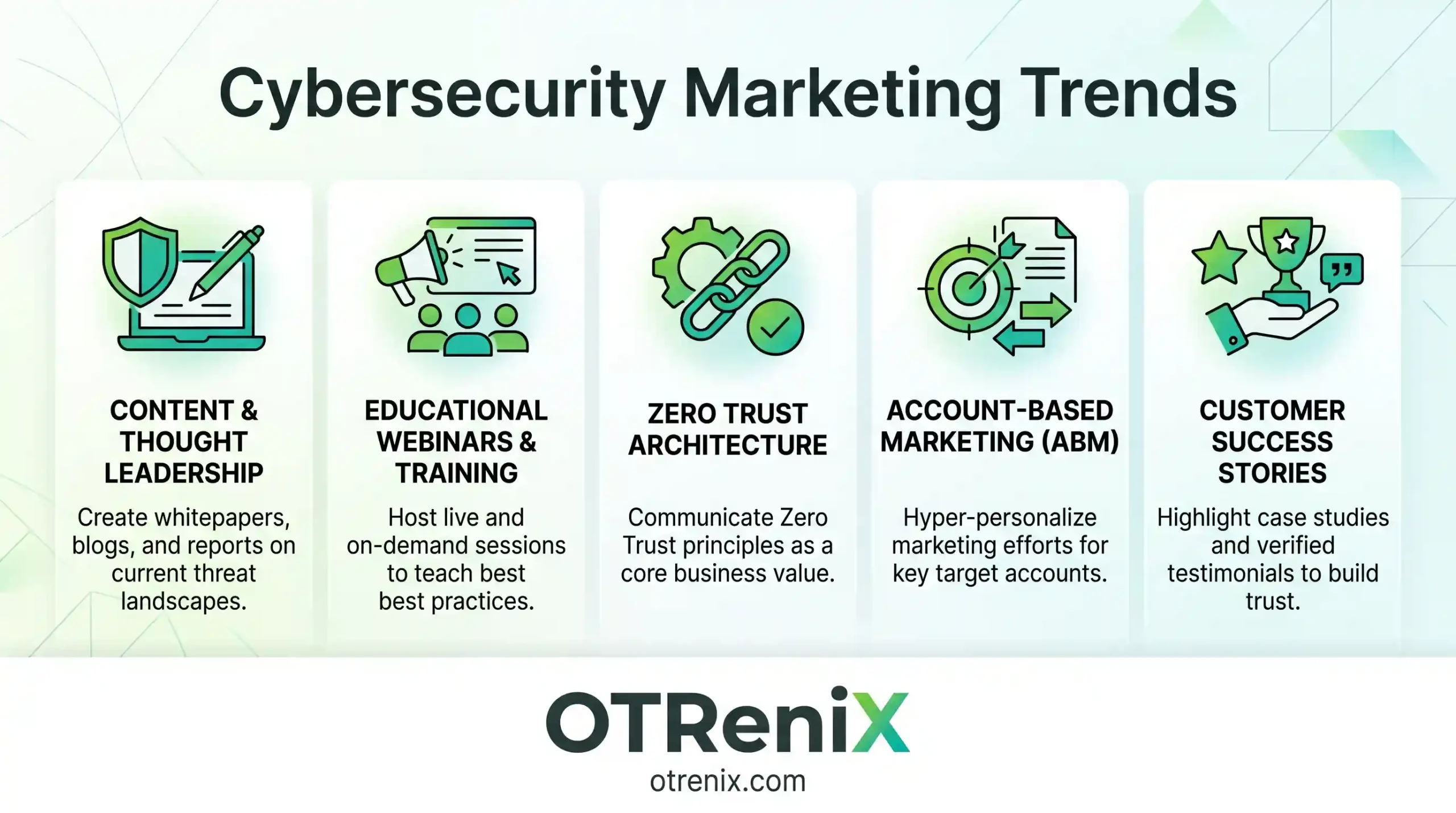

Cybersecurity marketing has changed more in the past 24 months than in the previous 10 years. AI flooded content channels with generic noise. Email engagement collapsed. Search behavior split between Google and ChatGPT. Buying committees doubled in size. Trade press shrank. CISOs got harder to reach through every traditional channel. The marketing playbook that worked in 2023 produces nothing in 2026.
Most vendors have not adapted. They keep running the same blog post calendar, the same RSA Conference booth, the same LinkedIn ad templates, and the same cold email sequences that worked 3 years ago. The pipeline keeps shrinking. The CFO keeps pushing for cuts. The marketing team keeps blaming external factors instead of recognizing that the channels themselves have shifted underneath them.
This article covers the 12 cybersecurity marketing trends that matter in 2026. Some are obvious in retrospect (AI changing search and content). Others are less visible but equally important (the rise of CISO communities, the shift toward MSP led pipeline, the collapse of generic gated content). For each trend I will show what is happening, why it matters, and what cybersecurity vendors should do about it.
Key Takeaways
- AI Visibility (GEO) now drives 25% to 35% of B2B research traffic in cybersecurity. Vendors that ignore optimization for ChatGPT, Perplexity, and Google AI Overviews lose that traffic to competitors who have adapted.
- Generic AI generated content has stopped working. Google’s helpful content algorithm and CISO skepticism have made expert authored content the only kind that produces results.
- LinkedIn outreach response rates have collapsed from 8% to under 3%. The vendors winning on LinkedIn have shifted to low volume, high precision programs with senior writers.
- MSP and MSSP partnerships are producing 25% to 40% of pipeline for vendors that have built serious channel programs. Most vendors still underinvest here.
- Pipeline focused measurement has replaced lead volume as the metric that matters. CFOs cut programs that report MQLs without revenue contribution.
Trend 1: AI Search Has Reshaped How CISOs Research Vendors
The single biggest shift in cybersecurity marketing is the rise of AI search. CISOs increasingly start vendor research in ChatGPT, Perplexity, Claude, or Google AI Overviews instead of traditional Google search. By the end of 2025, AI search drove approximately 25% to 35% of B2B research traffic in security categories, and the share continues to grow.
This changes everything about how vendors get discovered. AI search engines synthesize answers from a small set of cited sources rather than returning a list of links. A CISO asking “what is the best XDR for mid market healthcare” gets an answer that mentions 4 to 7 specific vendors. The vendors mentioned get the consideration. The vendors not mentioned are invisible.
What works for AI Visibility (GEO)
Strong GEO programs share 4 characteristics. Direct, factual answers to specific questions, not buried in 2,000 words of preamble. Named expert authors with verifiable credentials. Schema markup that helps AI engines parse the content correctly. Citation in other authoritative sources, which AI engines weight heavily.
Vendors that have invested in GEO over the past 12 months are seeing meaningful pipeline contribution from AI search referral traffic. Vendors that have not are losing share to competitors who have adapted.
Trend 2: Generic AI Generated Content Has Stopped Working
The AI content boom of 2023 and 2024 produced massive volumes of plausible sounding but generic content. Google’s helpful content algorithm and CISO skepticism have made this content increasingly worthless. Sites built on AI generated content volume have lost 30% to 70% of their organic traffic since the December 2024 algorithm update.
The lesson is not that AI is useless for content production. AI is excellent for research, outlining, and editing support. The lesson is that the final content needs human expertise on top. A senior cybersecurity writer using AI as a tool produces better content faster than either pure AI or pure human writing alone. Vendors that try to scale content through pure AI generation are watching their search performance collapse.
What works for content in 2026
The strongest cybersecurity content programs share 3 characteristics. Senior writers with security industry backgrounds who understand the technology and the buyer. Named expert authors who give the content credibility and AI citation potential. Original research, customer data, or technical depth that AI cannot replicate. Vendors investing in these elements are gaining share. Vendors still publishing 20 thin AI posts a month are losing it.
Trend 3: LinkedIn Outreach Response Rates Have Collapsed
LinkedIn outreach response rates have fallen from 8% to 12% in 2020 to 2% to 4% in 2026. The cause is saturation. Prospects receive 30 to 80 outreach messages a week, almost all of them obviously templated, most of them obviously AI generated. The signal to noise ratio has reached a breaking point.
The vendors still producing pipeline from LinkedIn have changed their approach completely. They send 30 to 80 highly personalized messages a week instead of 500 templated ones. They write each message by hand, using AI for research but not for the final copy. They target 200 to 500 named accounts instead of 5,000 generic decision makers. The result is response rates of 8% to 15%, well above the spam baseline.
What works for LinkedIn outreach
| Old approach (failed in 2026) | New approach (works in 2026) |
|---|---|
| 500+ messages per week, templated | 30 to 80 messages per week, personalized |
| Junior SDRs running automation tools | Senior writers researching each prospect |
| 5,000+ broad ICP target list | 200 to 500 named target accounts |
| Single channel LinkedIn outreach | Coordinated LinkedIn, email, and ad sequences |
| Measured on connection counts and message volume | Measured on sales qualified meetings booked |
Trend 4: Email Engagement Has Continued to Decline
Average B2B email open rates have dropped from 21% in 2019 to under 12% in 2026. Click rates have fallen similarly. Marketing automation sequences that used to nurture leads to demo now produce silence. Cold email programs see response rates below 0.5% when sent at scale.
The vendors that still produce results from email have changed both volume and content. Smaller, more targeted lists with personalized content. Newsletter formats that mix vendor content with curated industry news. Account based email programs run by senior writers, not SDR teams. The economics work because the response rates are high enough to justify the per email cost, even at lower volumes.
Trend 5: CISO Communities Have Become Primary Trust Channels
CISOs have shifted significant portions of their vendor research to private peer communities. The CyberEdBoard, ISC2 chapters, ISACs, CISO Series podcasts, and dozens of private Slack groups now drive more vendor consideration than traditional content marketing for many security categories.
Vendors cannot advertise in these communities. The members reject obvious vendor promotion. But vendors can build authentic presence: experts who share useful insights, contribute to discussions, and answer questions without pitching. This is slow work that compounds over 12 to 24 months, but it produces some of the highest quality inbound interest available in cybersecurity.
What works for community presence
Strong programs assign named experts (CTOs, CISOs, threat researchers) to specific communities. The experts participate consistently over months, sharing genuine perspective and helping members. The vendor benefits indirectly through the expert’s reputation, not through direct promotion. Vendors trying to shortcut this with paid promotion or fake account participation get banned and damage their brand.
Trend 6: MSP and MSSP Channels Are Driving Major Pipeline Growth
Managed Service Providers and Managed Security Service Providers have become one of the most important growth channels in cybersecurity. The mid market increasingly relies on MSPs and MSSPs to evaluate, recommend, and deploy security solutions. Vendors with strong partner programs are sourcing 25% to 40% of pipeline through the channel.
The shift reflects the difficulty mid market organizations have evaluating cybersecurity vendors directly. Most do not have the budget, headcount, or expertise to run rigorous vendor evaluations. They trust their MSP to recommend solutions, and when the MSP recommends a vendor, the sales cycle is 50% to 70% shorter and the close rate is 2x to 3x higher than direct sales.
What works for partner programs
Strong programs combine 4 elements: competitive partner economics (typically 25% to 40% margin plus MDF), serious enablement (training, certification, technical support), co marketing investment (joint webinars, customer events, lead sharing), and dedicated channel account managers building real relationships. Vendors that treat partners as an afterthought get afterthought pipeline. Vendors that resource partner programs proportional to expected outcome get force multiplied growth.
Trend 7: Buying Committees Have Continued to Grow
The typical cybersecurity buying committee in 2020 had 4 to 6 stakeholders. By 2026, it has 6 to 10. The CISO, security engineering, IT operations, procurement, legal, finance, audit, risk, and sometimes the board all play roles in cybersecurity purchases.
This means marketing programs that target only the CISO leave 6 other stakeholders unprepared to support the deal. Modern programs produce content for each role: security engineers want technical depth, procurement wants TCO analysis, legal wants compliance documentation, finance wants ROI models. Vendors building multi persona content libraries are closing more deals at higher prices.
Trend 8: Trade Press Has Shrunk and Influencers Have Risen
Cybersecurity trade press has shrunk significantly over the past 5 years. Some publications closed (TechBeacon, several InformationWeek security verticals). Others reduced staff or shifted to syndicated content. The remaining tier 1 publications (Dark Reading, SC Media, The Record, CSO Online) are harder to land in than ever because more vendors compete for less editorial space.
Meanwhile, individual security influencers have grown in importance. Named experts on LinkedIn and YouTube, hosts of major podcasts (CISO Series, Risky Business, Cybersecurity Today), and analysts at firms like SANS and CyberRisk Alliance now drive significant consideration. Vendors that have built relationships with the right influencers see meaningful pipeline impact.
Trend 9: Analyst Reports Matter More, Not Less
Despite the rise of AI search and influencer content, traditional analyst reports (Gartner Magic Quadrant, Forrester Wave, IDC MarketScape) have actually grown in importance. Enterprise buyers use analyst reports as a shortcut to filter the long list of vendors in any category. Inclusion in a Magic Quadrant typically multiplies pipeline by 2x to 4x within 12 months.
The competition for analyst attention has intensified. Analysts cover more vendors with the same time, which means each vendor gets less analyst attention by default. Vendors that invest in serious analyst relations programs (briefings, customer references, original research, sustained relationship building) get disproportionate visibility. Vendors that skip analyst relations get filtered out of enterprise consideration sets.
Trend 10: Pipeline Focused Measurement Has Replaced Vanity Metrics
CFOs in 2026 will not accept lead volume, traffic growth, or impressions as marketing success metrics. The pressure has forced cybersecurity marketing teams to adopt pipeline focused measurement: pipeline sourced, pipeline influenced, cost per opportunity, win rate by source, sales cycle length by source.
This shift has consequences for which channels survive. Channels that produce qualified pipeline (account based programs, partner channels, executive thought leadership, original research) get budget. Channels that produce vanity metrics without pipeline (mass content syndication, low quality lead gen forms, broad social media campaigns) get cut. The pattern is clear and accelerating.
Metrics that get budget approved
| Old metric (losing favor) | New metric (driving budget decisions) |
|---|---|
| Total website traffic | Pipeline sourced from organic search |
| Marketing qualified leads (MQLs) | Sales qualified opportunities (SQOs) |
| Cost per lead | Cost per qualified opportunity |
| Email open and click rates | Email driven pipeline contribution |
| Social media engagement | LinkedIn driven sales meetings |
| Brand awareness scores | Marketing influenced revenue |
Trend 11: Video Has Become Central to Cybersecurity Marketing
Video content has grown from a supplementary channel to a core part of cybersecurity marketing. CISOs increasingly prefer video for technical learning. LinkedIn and YouTube algorithms favor video content. AI search engines cite video transcripts in answers. The vendors building serious video programs are gaining ground over those still publishing only text content.
The strongest programs combine multiple video formats: short LinkedIn videos for thought leadership, longer YouTube videos for technical deep dives, webinars for demand generation, and customer story videos for sales enablement. Production quality has become an important differentiator. Generic talking head videos get ignored. Well produced content with strong visual elements gets shared and remembered.
Trend 12: Original Research Has Become Essential
Vendors that publish original research (annual threat reports, industry surveys, vulnerability research, breach pattern analysis) are gaining disproportionate share in cybersecurity. The reason is simple: original data cannot be replicated by competitors, gets cited in analyst reports, drives press coverage, supports sales conversations, and produces sustained inbound interest over 6 to 12 months.
A single strong research report typically costs $30K to $80K to produce but returns 5x to 10x in multi channel value: launch press coverage, blog series, webinar content, sales enablement assets, analyst briefings, and conference presentations. Vendors that invest in research consistently outperform vendors of similar size that do not.
Why research wins in 2026
Research wins because it solves multiple problems at once. It feeds AI search citations because AI engines weight original sources heavily. It feeds analyst relations because analysts cite vendor research in their published reports. It feeds press coverage because journalists need data to support stories. It feeds sales conversations because reps can share findings as conversation starters. No other content type produces this kind of multi channel return.
How to Adapt to These Trends
The trends above point to 5 strategic shifts that successful cybersecurity vendors are making in 2026.
Shift 1: Invest in AI Visibility (GEO) immediately
If you do not have a GEO strategy, you are losing 25% to 35% of research traffic to vendors who do. The investment is modest compared to the upside. Hire an agency or internal specialist who understands AI search optimization, audit your existing content for GEO readiness, and build new content with AI search citation in mind.
Shift 2: Replace junior content writers with senior experts
Generic content has stopped working. The vendors winning are the ones with senior writers who have security industry backgrounds and named expert authors who give content credibility. The cost difference is real but small compared to the difference in business outcomes. Cut content volume in half and double the quality of what you produce.
Shift 3: Build serious partner programs
If MSPs and MSSPs are not driving 20%+ of your pipeline, you are leaving major growth on the table. Resource the program proportional to the expected outcome: dedicated channel account managers, MDF for joint marketing, partner enablement programs, and quarterly business reviews with top partners. Underinvested partner programs produce nothing. Properly resourced ones produce force multiplied pipeline.
Shift 4: Shift measurement to pipeline focused metrics
If your marketing reports lead with traffic, MQLs, or engagement rates, you are reporting on the wrong things. Shift to pipeline sourced, pipeline influenced, cost per opportunity, and win rate by source. The conversation with your CFO will get harder in the short term as some weak channels lose budget, but the program will be defensible long term.
Shift 5: Invest in original research as a primary channel
If you have no annual threat report, no industry survey, no original data, you are missing one of the highest leverage content investments available. A serious research program costs $50K to $150K a year and returns 5x to 10x in multi channel value. Make it a budget line item, not an afterthought.
What to Stop Doing in 2026
Some practices that worked in previous years have become actively counterproductive. Cybersecurity vendors should stop:
- Publishing high volume AI generated content. Google’s algorithm has made this content invisible, and CISO skepticism makes it counterproductive when found.
- Running generic LinkedIn outreach at scale. Response rates have collapsed below 3%. Continued use damages your sender reputation and account standing.
- Sending broad email campaigns without segmentation. Open rates below 12% mean most of the audience never sees the message. Segment ruthlessly or stop sending.
- Sponsoring generic conference booths without account based pre work. A $200K booth without a target account list and pre scheduled meetings produces minimal pipeline.
- Reporting on vanity metrics in executive updates. CFOs see through MQL counts and traffic growth. Lead with pipeline numbers or expect budget cuts.
What to Start Doing in 2026
Conversely, several practices are producing results for vendors that have adopted them:
- AI Visibility (GEO) optimization for ChatGPT, Perplexity, and Google AI Overviews citation
- Senior expert authored content with named bylines and credentials
- Account based marketing with 200 to 500 named target accounts and coordinated multi channel touches
- Executive thought leadership programs with consistent posting from CTOs, CISOs, and founders
- Serious partner programs with MDF, enablement, and dedicated channel resources
- Original research investments that produce annual reports, surveys, or threat data
- Pipeline focused measurement with monthly executive reporting on sourced and influenced pipeline
The Bottom Line
Cybersecurity marketing in 2026 looks fundamentally different from cybersecurity marketing in 2023. AI changed search behavior. Email engagement collapsed. LinkedIn outreach got 5x harder. Buying committees got bigger. Trade press shrank. CISOs got more skeptical. The vendors that have adapted are growing. The vendors that have not are watching pipeline shrink while their CFOs ask hard questions.
The path forward is not about doing more of what worked in 2023. It is about recognizing that the channels themselves have shifted and rebuilding the marketing program around what works in 2026. AI Visibility instead of pure SEO. Senior expert content instead of AI volume. Low volume precision LinkedIn outreach instead of mass automation. Pipeline focused measurement instead of vanity metrics. Serious partner programs instead of afterthought channel work. Original research instead of generic blog posts.
The vendors that win the next 5 years in cybersecurity will not be the ones with the biggest marketing budgets. They will be the ones that adapted fastest to the new reality, made hard decisions about which legacy tactics to cut, and invested in the few high leverage channels that actually produce pipeline in 2026. Strategy is choosing what to do and what not to do, and the cost of choosing wrong gets higher every quarter as the gap between adapted and unadapted vendors widens.